Calculating Torques for Equilibrium of Truss System

Join the discussion
Ask a follow-up here, or get your own question answered by working scientists, mathematicians and engineers — people, not an autocomplete.
Real named experts · corrections over time · the nuance an AI answer skips
2 replies · 3K views
paulmdrdo
Messages
89
Reaction score
2
I wonder if there's a physics person here who could help me solve this problem.

the loads applied to the truss shown in the figure cause reactions shown at A & D. A free body diagram of hinge A forms concurrent force system shown enclosed at A. Determine the magnitude of forces P & F directed respectively along bars AB & AE that maintain equilibrium of this system.
 

Attachments
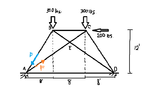
  • statics2.png
    statics2.png
    5.8 KB · Views: 138
Mathematics news on Phys.org
LATEBLOOMER said:
I wonder if there's a physics person here who could help me solve this problem.

the loads applied to the truss shown in the figure cause reactions shown at A & D. A free body diagram of hinge A forms concurrent force system shown enclosed at A. Determine the magnitude of forces P & F directed respectively along bars AB & AE that maintain equilibrium of this system.

Hi LATEBLOOMER! :)

First step is to find all external forces based on the conditions for equilibrium ($\sum F_x = 0, \sum F_y = 0, \sum M_A = 0$).

Suppose the external force at A on the truss has 2 components $A_x$ and $A_y$, and similarly at D we have $D_x$ and $D_y$. Can you find these forces?
I suggest you start with calculating the moments of all external forces with respect to A.
 
I like Serena said:
I suggest you start with calculating the moments of all external forces with respect to A.

Just a comment: in US physics, at least, moments are called torques. See here and here.