Calculating Wavefunction Angles in sp3 Hybridization - How to Use Integrals?

Click For Summary
SUMMARY

The discussion focuses on calculating the angle between wavefunctions in sp3 hybridization, specifically demonstrating that this angle is 109.5 degrees. Participants suggest using expectation values of the wavefunctions and the dot product to derive the angle. The integral evaluations are crucial for obtaining these expectation values, particularly using the position operator. Additionally, there is a side query regarding the use of [PLAIN][\IMG] tags for image display issues.

PREREQUISITES
  • Understanding of quantum mechanics and wavefunctions
  • Familiarity with sp3 hybridization concepts
  • Knowledge of expectation values and dot products in vector spaces
  • Proficiency in integral calculus for evaluating wavefunction integrals
NEXT STEPS
  • Study the calculation of expectation values in quantum mechanics
  • Learn about the properties of sp3 hybridization in molecular geometry
  • Explore the application of dot products in quantum states
  • Review integral calculus techniques relevant to wavefunction analysis
USEFUL FOR

Students and professionals in quantum mechanics, chemists studying molecular geometry, and anyone interested in the mathematical foundations of wavefunction behavior in sp3 hybridization.

Zhelives
Messages
1
Reaction score
0
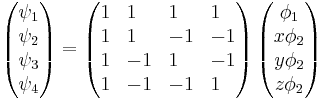
I'm given the following matrix equation:
latex.png


I'm also given:

latex.png


We're supposed to show that the angle between any two of these wave functions is 109.5 (characteristic of sp3 hybridization). I assume I need to calculate the expectation values of x, y and z and then use the dot product, but I'm at a loss on how to evaluate the inegrals. Suggestions?

Thanks.

P.S. Forum Question: Why do the images appear as links when I use the [\IMG] tags?
 
Physics news on Phys.org
I have a very similar problem myself. I think you need to take the expectation value of two wavefunctions with respect to the position operator. so:
<psi_1|r|psi_1>
since the position is a vector operator you will get a vector quantity. Dot the two of them together, and I'm sure you can get it from there.

btw: how do you get LaTeX to work here?
 

Similar threads

Replies
1
Views
2K
  • · Replies 1 ·
Replies
1
Views
2K
  • · Replies 21 ·
Replies
21
Views
3K
Replies
12
Views
3K
Replies
1
Views
2K
Replies
1
Views
2K
  • · Replies 1 ·
Replies
1
Views
3K
  • · Replies 1 ·
Replies
1
Views
2K
  • · Replies 7 ·
Replies
7
Views
2K
  • · Replies 6 ·
Replies
6
Views
5K
