Call by address in C/C++, how does it work?

  • Context: Comp Sci 
  • Thread starter Thread starter shivajikobardan
  • Start date Start date
  • Tags Tags
    Work
Join the discussion
Ask a follow-up here, or get your own question answered by working scientists, mathematicians and engineers — people, not an autocomplete.
Real named experts · corrections over time · the nuance an AI answer skips
3 replies · 1K views
shivajikobardan
Messages
637
Reaction score
54
Homework Statement
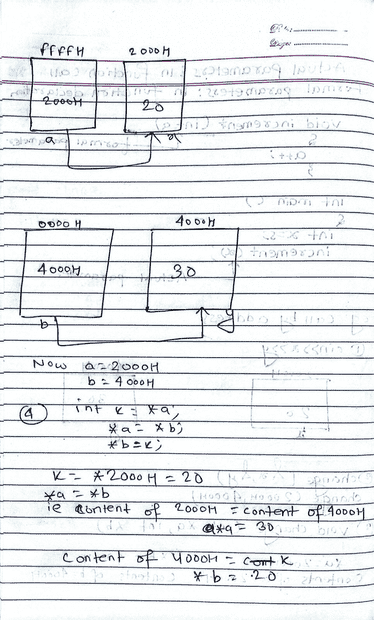
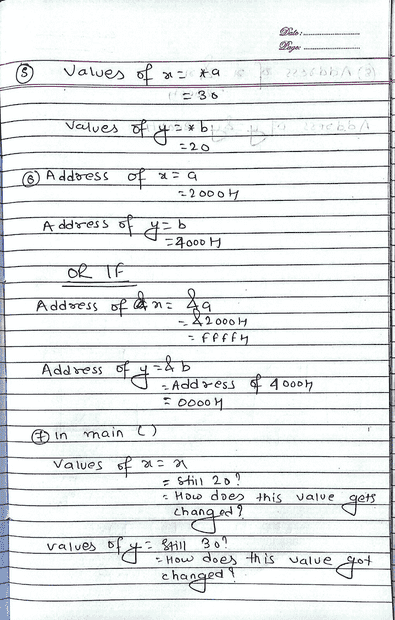
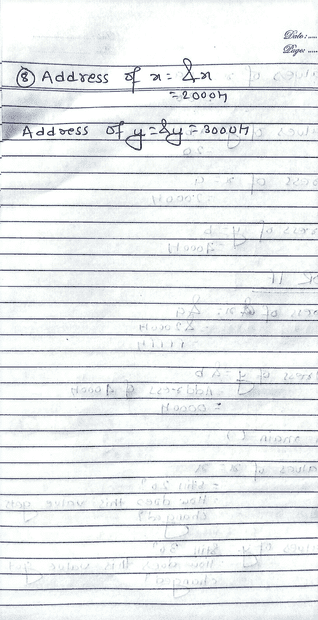
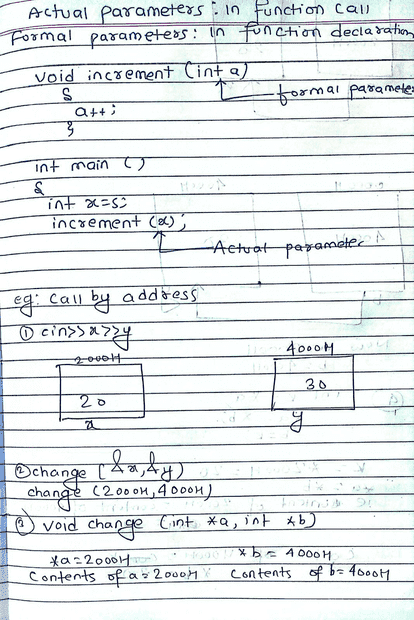
How does changes in user defined function gets reflected in main function in call by address?
Relevant Equations
none
I've asked my question in the figure below as picture speaks 1000 words.
_mImNe1sLJ3ywI1nnmZpeQd_G95jLMB_8DzGVx2WMpICpEMut8.png
JrEA4OoHgAGeJ35oAxi-DtO3_2oUUMY2qxMUAwvTPuSdLdvdTE.png

flLecFEQ9XrIJ8mJI7Y1Rrw1N2xR9FbnjUg8ILxa_dzM5ibLkQ.png

vK61Wnz1DlI0wwPU9sJJGdnalFg6-kAoetvKwyIR29OglRbuqQ.png

Code:
Code:
#include<iostream>
using namespace std;
void change(int*,int*);
int main()
{
    int x,y;
    cout<<"Enter values  of x and y"<<endl;
    cin>>x>>y;
    change(&x,&y);
    cout<<"In main()"<<endl;
    cout<<"Values x="<<x<<" "<<"y="<<y<<endl;
    cout<<"Address x="<<&x<<" "<<"Address y="<<&y<<endl;
    return 0;
}
void change(int *a,int *b)
{
    int k=*a;
    *a=*b;
    *b=k;
    cout<<"In change()"<<endl;
    cout<<"Values x="<<*a<<" "<<"y="<<*b<<endl;
    cout<<"Address x="<<a<<" "<<"Address y="<<b<<endl;
    cout<<"Address x="<<&a<<" "<<"Address y="<<&b<<endl;
}

Output:

Enter values of x and y

20

30

In change()

Values x=30 y=20

Address x=0x79709ffdbc Address y=0x79709ffdb8

Address x=0x79709ffd90 Address y=0x79709ffd98

In main()

Values x=30 y=20

Address x=0x79709ffdbc Address y=0x79709ffdb8
 
Physics news on Phys.org
the common reason i'm reading is "address gets passed so". but I'm failing to realize it mathematically like above.
 
I've got it.

C++:
int main( void ) {
    int x, y; // two variables, allocated on the stack, say at locations 0x4 and 0x8, values undefined
    change( &x, &y ); // receives 0x4 and 0x8
    return x + y; // accesses memory at 0x4 and 0x8, returning the sum of the values stored there
}

void change( int * a, int * b ) {
    *a = 3; // memory at location 0x4 accessed, value set to 3
    *b = 5; // memory at location 0x8 accessed, value set to 5
}
 
shivajikobardan said:
I've got it.
Yes, it seems like you do.
shivajikobardan said:
C++:
int main( void ) {
    int x, y; // two variables, allocated on the stack, say at locations 0x4 and 0x8, values undefined
    change( &x, &y ); // receives 0x4 and 0x8
    return x + y; // accesses memory at 0x4 and 0x8, returning the sum of the values stored there
}

void change( int * a, int * b ) {
    *a = 3; // memory at location 0x4 accessed, value set to 3
    *b = 5; // memory at location 0x8 accessed, value set to 5
}
Your understanding seems fine to me. The only comment I would make is that the compiler would never allocate stack variables at the locations you wrote. The actual locations would be very different. Although it's not crucial to know these addresses, you can see them if you use the debugger.