jojosg
- 37
- 5
- Homework Statement
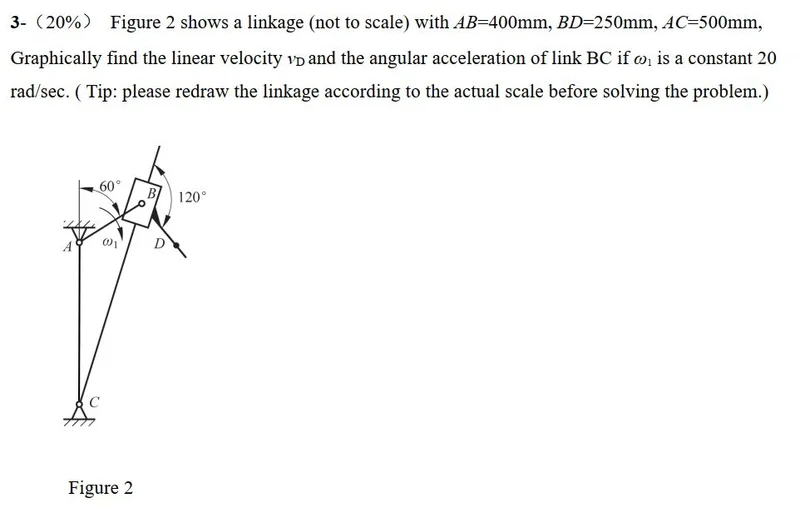
- Graphically find linear Velocity D & Angular acceleration of Link BC
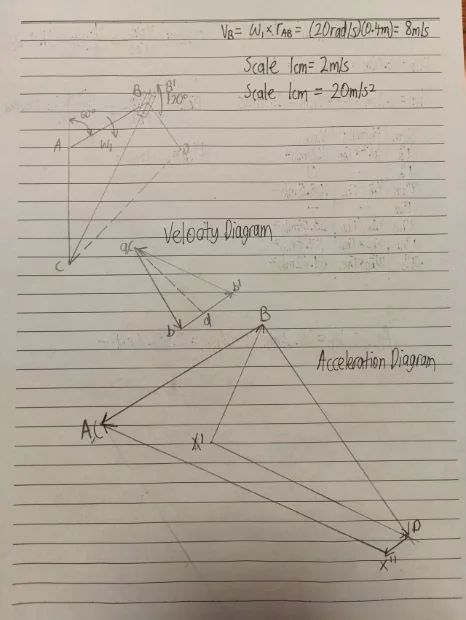
I'm not confident in my acceleration Diagram because this question should have coriolis acceleration but I don't know how to draw it in acceleration diagram. Help would be appreciated.
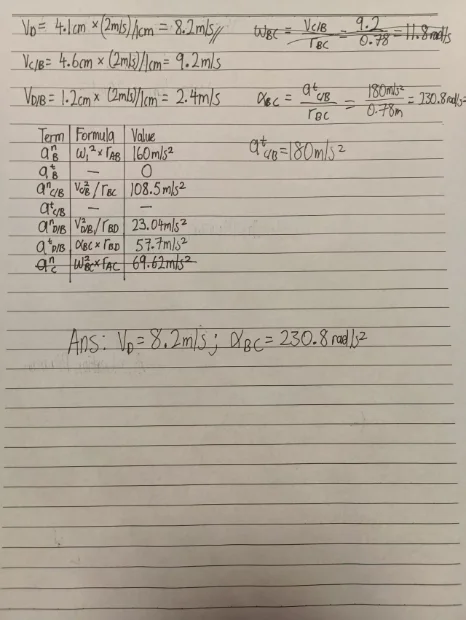
$$V_D = 4.1 \, \text{cm} \times (2 \, \text{m/s}) / 1 \, \text{cm} = 8.2 \, \text{m/s}$$
$$\omega_{BC} = \frac{V_{CB}}{r_{BC}} = \frac{9.2}{0.78} = 11.8 \, \text{rad/s}$$
$$V_{CB} = 4.6 \, \text{cm} \times (2 \, \text{m/s}) / 1 \, \text{cm} = 9.2 \, \text{m/s}$$
$$V_{DB} = 1.2 \, \text{cm} \times (2 \, \text{m/s}) / 1 \, \text{cm} = 2.4 \, \text{m/s}$$
$$\alpha_{BC} = \frac{a_t}{r_{BC}} = \frac{180 \, \text{m/s}^2}{0.78 \, \text{m}} = 230.8 \, \text{rad/s}^2$$
$$a_B^n = W_1^2 \times r_{AB} = 160 \, \text{m/s}^2$$
$$a_B^t = 0$$
$$a_{C/B} = V_{B/B}^2 / r_{BC} = 108.5 \, \text{m/s}^2$$
$$a_{D/B} = V_{DB/B}^2 / r_{BD} = 23.04 \, \text{m/s}^2$$
$$a_D^t = \alpha_{BC} \times r_{BD} = 57.7 \, \text{m/s}^2$$
$$a_C^n = W_{BC}^2 \times r_{AC} = 69.62 \, \text{m/s}^2$$
Ans: $$V_D = 8.2 \, \text{m/s}; \quad \alpha_{BC} = 230.8 \, \text{rad/s}^2$$
$$V_D = 4.1 \, \text{cm} \times (2 \, \text{m/s}) / 1 \, \text{cm} = 8.2 \, \text{m/s}$$
$$\omega_{BC} = \frac{V_{CB}}{r_{BC}} = \frac{9.2}{0.78} = 11.8 \, \text{rad/s}$$
$$V_{CB} = 4.6 \, \text{cm} \times (2 \, \text{m/s}) / 1 \, \text{cm} = 9.2 \, \text{m/s}$$
$$V_{DB} = 1.2 \, \text{cm} \times (2 \, \text{m/s}) / 1 \, \text{cm} = 2.4 \, \text{m/s}$$
$$\alpha_{BC} = \frac{a_t}{r_{BC}} = \frac{180 \, \text{m/s}^2}{0.78 \, \text{m}} = 230.8 \, \text{rad/s}^2$$
$$a_B^n = W_1^2 \times r_{AB} = 160 \, \text{m/s}^2$$
$$a_B^t = 0$$
$$a_{C/B} = V_{B/B}^2 / r_{BC} = 108.5 \, \text{m/s}^2$$
$$a_{D/B} = V_{DB/B}^2 / r_{BD} = 23.04 \, \text{m/s}^2$$
$$a_D^t = \alpha_{BC} \times r_{BD} = 57.7 \, \text{m/s}^2$$
$$a_C^n = W_{BC}^2 \times r_{AC} = 69.62 \, \text{m/s}^2$$
Ans: $$V_D = 8.2 \, \text{m/s}; \quad \alpha_{BC} = 230.8 \, \text{rad/s}^2$$
Last edited by a moderator: