Can a Bridge Sing? Solve the Mystery!

  • Context: High School 
  • Thread starter Thread starter DaveC426913
  • Start date Start date
  • Tags Tags
    Bridge
Click For Summary

Discussion Overview

This thread explores the phenomenon of a high-pitched tone emanating from a bridge, with participants investigating potential causes and mechanisms behind the sound. The discussion encompasses exploratory reasoning, technical explanations, and hypotheses regarding the nature of the sound, its sources, and the conditions under which it occurs.

Discussion Character

  • Exploratory
  • Technical explanation
  • Debate/contested

Main Points Raised

  • One participant describes a high-pitched, steady tone coming from a steel corner of the bridge, noting its location and characteristics.
  • Suggestions for tests include using a multi-meter and a live circuit detector to investigate electrical sources.
  • Multiple hypotheses are proposed regarding the sound's origin, including heat expansion causing vibrations, air currents, flowing water, and distant noise resonating in the bridge's structure.
  • Another participant suggests the sound may be due to the accidental excitation of the bridge's natural frequencies of vibration, similar to striking a metal bar.
  • Some participants propose that the sound could be related to Aeolian tones generated by wind passing over the bridge.
  • A participant mentions the possibility of a lamppost being the source of the sound, suggesting it may have an electrical issue affecting the tone.
  • One participant records the sound, describing it as electronic and noting its frequency, which varies slightly.
  • Concerns are raised about the bridge potentially being a path to ground for electrical systems, which could pose a hazard.

Areas of Agreement / Disagreement

Participants express multiple competing views regarding the source of the sound, with no consensus reached on a definitive explanation. Various hypotheses remain under consideration, and the discussion continues to explore these possibilities.

Contextual Notes

Some limitations include the uncertainty about the exact source of the sound, the dependence on environmental conditions, and the unresolved nature of the tests proposed by participants.

Who May Find This Useful

This discussion may be of interest to individuals curious about acoustics, structural engineering, or those investigating unusual sounds in public infrastructure.

DaveC426913
Gold Member
2025 Award
Messages
24,320
Reaction score
8,514
Don't know how else to head this thread.

Help me solve this mystery.

Today, while walking across the bridge in my local park, I noticed a high-pitched tone coming from the corner of the bridge. It probably wouldn't have been noticed by most unless it was pointed out, but I just happened to be walking slow and in the right place.

The sound was a high-pitched, pure, electronic tone, occasionally interrupted with a slight static sound, as if jiggling a connection. Other than that occasional crackling, the tone was absolutely steady in volume and pitch.

It was not ringing in my ears.I am acquainted with ringing in the ears. This was externally locatable.

I stopped and listened closely. At first intrigued, I became downright perplexed. I zeroed on the sound, coming from the steel corner of the bridge itself. I walked all around, including getting down on my knees near the grass on the outside of the bridge to see if maybe there was a dropped cellphone or something (half expecting to find a dead body :eek:).

There was a certain amount of destructive and constructive interference, meaning if I moved or rotated my head by just a few inches, the sound would seem to almost vanish, until I moved or rotated my head again. But after about 50 samplings (which took about 5 minutes), from every direction and distance, I was able to locate it within a couple of inches (see pic). It was literally coming from the flat I-beam steel of the bridge - not from the horizontal ribs. I could aurally locate it with that level of accuracy. I could look right at the exact spot from less than a foot away. I touched the steel in a number of places but it did not affect the sound at all.

The obvious explanation is a electrical conduit running through the bridge. I checked both ends and both sides of the bridge for any electrical connections, to no avail. The bridge is unlit.

It was noon, on a warm, sunny day, with no inclement weather, and I was completely sober.

When I came back to the spot 6 hours later, it was not making the noise anymore. (That's when I took this pic)
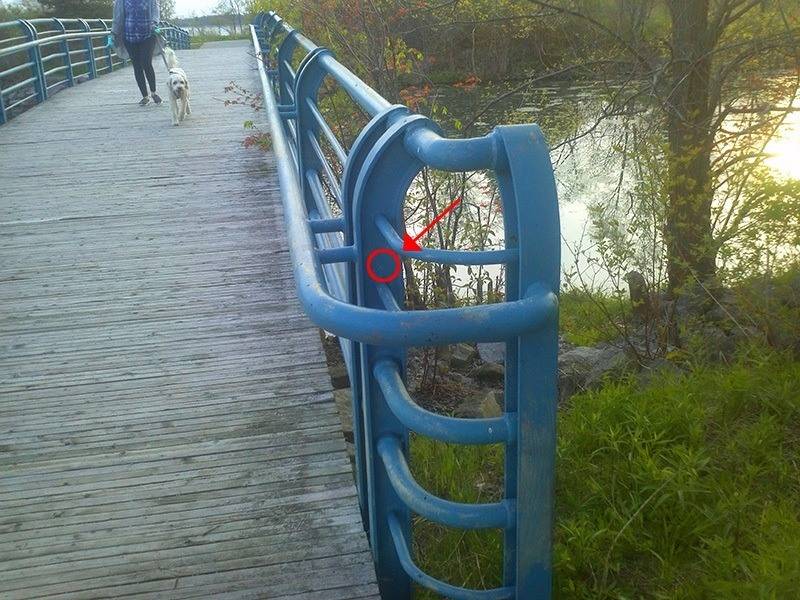
IMG470.jpg
 

Attachments

  • IMG470.jpg
    IMG470.jpg
    94.6 KB · Views: 507
Physics news on Phys.org
I will be back at that spot over the weekend. Maybe my tone will be there again.

If anyone has some suggestions about tests I might run, I'm all ears.

I have a multi-meter on my boat, though I'm not sure how I might use it effectively. I guess I could bring a 'live circuit detector' that I use when doing reno's.
 
Last edited:
I'm going with:

A) Heat expansion causing vibrations in the hollow steel tube rails,
B) Air currents doing same,
C) Flowing water in contact with bridge supports below, or
D) Some distant source of noise resonating in the rails.
 
  • Like
Likes   Reactions: M Saad and CWatters
My thoughts:
Sunny day.
Pipes are heating up.
Small hole in a pipe.
Whistling sound as the air exits.
Static sounds from pipe movements.

Whether the sound is actually being produced at the circled location is questionable.
 
  • Like
Likes   Reactions: M Saad
This is probably due to the accidental excitation of one of the bridges natural frequencies of vibration .

Same basic principle as hitting a suspended metal bar or tube with a metal hammer .

In large objects of complex construction these vibrations can sustain for several minutes .

Actual mechanism of excitation for your bridge may be hard to track down . Try :

Observing what happens when different combinations of walkers and bike riders cross the bridge .
Tapping the actual rails in question and the other metal parts in the same area with a small metal hammer . Be sure to include the long rails that go right across the bridge .

You say weather was mild . So this may not be immediately relevant but bridges can sometimes be heard to emit ' Aeolian Tones '. These are musical notes caused by the wind passing over the rails . They can sometimes excite structural vibration as well .
 
Also try listening to the sound at different locations with a contact engineers stethoscope . If you haven't got a posh one then use a screwdriver .
 
256bits said:
My thoughts:
Sunny day.
Pipes are heating up.
Small hole in a pipe.
Whistling sound as the air exits.
Static sounds from pipe movements.
Yeah but it was definitely an electronic or electrical tone, not a whistle. And it was perfectly steady in pitch and amplitude. Even when mutiple people navigating the bridge.
Nidum said:
This is probably due to the accidental excitation of one of the bridges natural frequencies of vibration .

Same basic principle as hitting a suspended metal bar or tube with a metal hammer .

In large objects of complex construction these vibrations can sustain for several minutes .
I wondered about this too.
Nidum said:
Observing what happens when different combinations of walkers and bike riders cross the bridge .
Tapping the actual rails in question and the other metal parts in the same area with a small metal hammer . Be sure to include the long rails that go right across the bridge .
Yep. Did this. Multliple people crossed the bridge (with eyebrows raised in my direction) and I listened carefully. Absolutely no change in pitch or amplitude.
I grabbed each pipe to see if that made any difference. It did not.

Nidum said:
You say weather was mild . So this may not be immediately relevant but bridges can sometimes be heard to emit ' Aeolian Tones '. These are musical notes caused by the wind passing over the rails . They can sometimes excite structural vibration as well .
Yeah. Though of that too. Definitely electrical or electronic. Perfectly stable in pitch and volume.

Imagine the sound an aging TV makes. That high-pitched, steady, perfectly modular tone.

Somewhere in the 7000-9000 Hz range.


Nidum said:
Also try listening to the sound at different locations with a contact engineers stethoscope . If you haven't got a posh one then use a screwdriver .
I'll try that.
 
I went back today at the same time. Of course, my tone did not deign to make its presence known.

It turns out there is a lamppost 8-10 feet before the bridge. I am going to conclude that this is the culprit.

Whether it be from something funny with the bulb or whether this lamppost has an extension that crosses the bridge, I don't know, but it is the most likely source of the sound.
 
I don't know if a bridge can sing, but apparently it can whistle. :wink:

"There was a certain amount of destructive and constructive interference, meaning if I moved or rotated my head by just a few inches, the sound would seem to almost vanish, until I moved or rotated my head again."

I've been told that sometimes you can stand on an athletic field and hear a tone due to the seats in the stands causing interference, as a diffraction grating does for light.
 
  • #10
Hah. I got the sound on audio.


Definitely electronic. Square or triangle wave.

I was wrong about the freq. More like 800Hz.
And it does vary, just a little. Drifted up to 850Hz.
 
  • #11
Non-electronic sources can still result in a similar waveform as electronic waveforms.

Your bridge could also be part of the path to ground for the lamp you mentioned. This would change the tone depending on soil dampness, notably it would follow the landscaping irrigation schedule. If I'm not mistaken, there is a method for measuring for this by sticking probes into the dirt to measure resistance. If the bridge is a path to ground, it could be a hazard. You might make a call to the relevant maintenance authority.
 
  • Like
Likes   Reactions: M Saad
  • #12
Chris1983 said:
If the bridge is a path to ground, it could be a hazard. You might make a call to the relevant maintenance authority.
You're the second person to suggest that.

I called a passerby over to have a listen. He heard it and made the same suggestion.
 

Similar threads

  • · Replies 12 ·
Replies
12
Views
804
  • · Replies 18 ·
Replies
18
Views
4K
  • · Replies 22 ·
Replies
22
Views
4K
  • · Replies 35 ·
2
Replies
35
Views
4K
Replies
18
Views
2K
Replies
4
Views
3K
  • · Replies 15 ·
Replies
15
Views
3K
  • · Replies 16 ·
Replies
16
Views
2K
Replies
4
Views
2K
Replies
28
Views
3K