Can Conformal Transformations be Derived from Group Composition Rules?

  • Context: Undergrad 
  • Thread starter Thread starter formodular
  • Start date Start date
  • Tags Tags
    Group
Join the discussion
Ask a follow-up here, or get your own question answered by working scientists, mathematicians and engineers — people, not an autocomplete.
Real named experts · corrections over time · the nuance an AI answer skips
4 replies · 2K views
formodular
Messages
34
Reaction score
18
Hi!

Is there a way to end up with the algebra
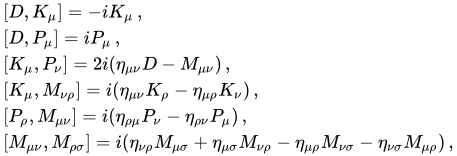
5c1cebad87b5e53e8458678669adeec3e825296d


i) quickly

ii) starting from a group, as how one gets the CR's from the Lorentz group composition rules, as on http://www.krassnigg.org/web/physics/wp-content/uploads/hoqft12-skriptum.pdf.

The other relations are quite complicated and the composition rules well are not clear.

:smile:
 
Physics news on Phys.org
formodular said:
Hi!

Is there a way to end up with the algebra

5c1cebad87b5e53e8458678669adeec3e825296d


i) quickly

ii) starting from a group, as how one gets the CR's from the Lorentz group composition rules, as on http://www.krassnigg.org/web/physics/wp-content/uploads/hoqft12-skriptum.pdf.

The other relations are quite complicated and the composition rules well are not clear.

:smile:

The algebra of the conformal group [itex]\mbox{Con}(1,n-1)[/itex] is isomorphic to that of the Lorentz group [itex]\mbox{SO}(2,n)[/itex]. The latter can be obtained from the infinitesimal form of the group multiplication law [itex]U(\Lambda) U(\bar{\Lambda}) = U(\Lambda \bar{\Lambda})[/itex], by setting [itex]U(\Lambda) = 1 + \frac{i}{2} \omega_{AB}M^{AB}[/itex], where [itex]\omega_{AB} + \omega_{BA} = 0[/itex], and [itex]A , B = -2, -1, 0, 1, \cdots , n-1[/itex]. Doing the easy exercise gives you [tex][i M^{AB } , M^{CD}] = \eta^{BC}M^{AD} - \eta^{AC}M^{BD} + \eta^{AD}M^{BC} - \eta^{BD} M^{AC} ,[/tex] where [itex]\eta^{AB} = (1 , -1, \eta^{\mu\nu})[/itex] with [itex]\eta^{\mu\nu}[/itex] being the Lorentz metric on the n-dimensional Minkowski space-time [itex]\mu, \nu = 0, 1, \cdots n-1[/itex]. Now, the algebra of [itex]\mbox{Con}(1,n-1)[/itex] is obtained from the above by defining the following generators [tex]D = M^{-2 , -1} , \ \ \ J^{\mu\nu} = M^{\mu\nu} ,[/tex] [tex]\frac{1}{2} (P^{\mu} - K^{\mu}) = M^{-2 , \mu} ,[/tex] [tex]\frac{1}{2}(P^{\mu} + K^{\mu}) = M^{-1, \mu} .[/tex]

You may want to look at

https://www.physicsforums.com/showthread.php?t=172461
 
samalkhaiat said:
The algebra of the conformal group [itex]\mbox{Con}(1,n-1)[/itex] is isomorphic to that of the Lorentz group [itex]\mbox{SO}(2,n)[/itex].

Yes!

This is ultimately the answer, and seeing it would give the commutation relations very quickly if you knew you could end up doing this. I must say understanding this is what I am having difficulty with and have spent a week trying to see this, and the link to DeSitter/Anti-DeSitter spaces, in a way that predicts everything in advance, and need to think some more before formulating a question on how to see this in advance, e.g. in an old Dirac paper he just goes to DeSitter space in seconds with no work.
 
formodular said:
Yes!
This is ultimately the answer

The Lie algebra isomorphism [itex]\mathfrak{so}(n,2) \cong \mathfrak{con}(n-1,1)[/itex], which I sketched in #2, is the mathematical base for the correspondence between field theory in the bulk of the space [itex]\mbox{Ads}_{n+1}[/itex] and a conformal field theory on its boundary [itex]\mbox{CFT}_{n}[/itex]. This is because of the fact that the group [itex]SO(n,2)[/itex] is the isometry group of [itex]\mbox{Ads}_{n+1}[/itex], and [itex]\mbox{Con}(n-1,1)[/itex] is (obviously) the symmetry group of [itex]\mbox{CFT}_{n}[/itex].
 
Well...

I do not understand that yet, so from a more rudimentary place - if you view conformal transformations as transformations preserving the lightcone,
$$ds^2 = x^2 + y^2 + z^2 - t^2 = 0 \ \ \to \ \ ds'^2 = f(x)ds^2 = 0$$
then we can go from here to what we will call AdS space by treating this as embedded in
$$x^2 + y^2 + z^2 - t^2 = 0 \ \ \to \ \ x^2 + y^2 + z^2 - t^2 - w^2 = - R^2 $$

https://www.jstor.org/stable/1968649

where when ##x,y,z,t## are small in comparison with ##R## we have ##w## equal to ##R## to first order so that, as ##R \to \infty## we obtain our lightcone, and so it seems reasonable why conformal transformations arise in this AdS context,
$$x'^2 + y'^2 + z'^2 - t'^2 - w^2 = - R^2 \ \ \to \ \ f(x)(x^2 + y^2 + z^2 - t^2) - w^2 = - R^2$$
and why the Lie algebras might be linked.

Then there is another viewpoint

https://www.jstor.org/stable/1968455

where you view your ##4## dimensional surface as a surface in ##5## dimensional projective space which, in homogeneous coordinates, gives ##6## coordinates ##x^{\mu}## and you can go from ##x_{\mu} x^{\mu} = 0## to conformal transformations as in that paper.

So yes this is some rudimentary pieces of this puzzle so far, not enough yet.