Can I Solve for c by Replacing b with a Value Greater Than 0?

  • Context: MHB 
  • Thread starter Thread starter mathland
  • Start date Start date
  • Tags Tags
    Value
Click For Summary

Discussion Overview

The discussion revolves around solving for the variable c in an equation by substituting the variable b with a value greater than 0. Participants explore the implications of this substitution and the resulting equations.

Discussion Character

  • Exploratory, Technical explanation, Debate/contested

Main Points Raised

  • One participant suggests replacing b with any value greater than 0 to solve for c.
  • Another participant prompts the first to expand the left-hand side (LHS) of the equation and equate terms with the right-hand side (RHS).
  • A later reply provides a detailed expansion of the equation, leading to two potential solutions for c based on the values of b (4 and -4), resulting in c being 20 or -20, respectively.
  • Participants discuss the verification of these solutions through substitution back into the original equation.
  • There is a humorous interjection about the time taken to respond to the initial question, indicating a lack of follow-up from the original poster.
  • Another participant makes a lighthearted comment unrelated to the mathematical discussion.

Areas of Agreement / Disagreement

There is no consensus on the approach to solving for c, as participants express different levels of engagement and understanding of the problem. The discussion includes both technical exploration and informal commentary, indicating a mix of serious inquiry and lighthearted banter.

Contextual Notes

Some assumptions about the values of b and their implications on c remain unexamined, and the mathematical steps leading to the proposed solutions could benefit from further clarification.

Who May Find This Useful

This discussion may be of interest to those studying algebraic equations, particularly in the context of variable substitution and equation manipulation.

mathland
Messages
33
Reaction score
0
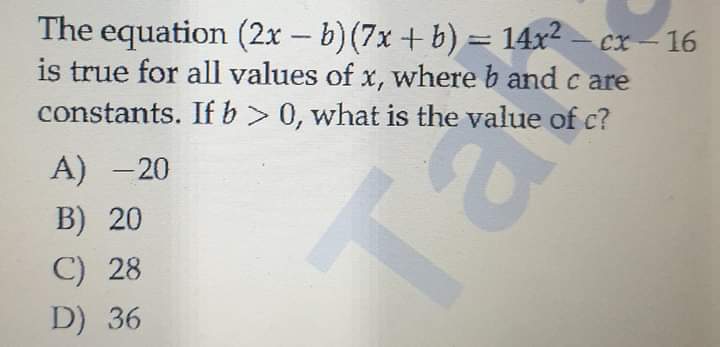
I replace b with any value greater than 0 and then solve for c. Right?
FB_IMG_1612321193999.jpg
 
Mathematics news on Phys.org
What do you get when you expand the LHS and equate the resulting terms with the corresponding terms in the RHS of the given equation
 
Greg said:
What do you get when you expand the LHS and equate the resulting terms with the corresponding terms in the RHS of the given equation

Ok. I will do as you suggested and be back.
 
It's been 7 months now! Are you still working on it?

For those who were wondering, there are two solutions.
(2x- b)(7x+ b)= 14x^2+ 2bx- 7bx- b^2= 14x^3- 5bx- b^2. That is to be equal to 14x^2- cx- 16.

So we must have -5b= -c and -b^2= -16. b^2= 16 so b= 4 or b= -4.
If b= 4, -5b= -20= -c so c= 20.
If b= -4, -5b= 20= -c so c= -20.

Check:
(2x- 4)(7x+ 4)= 14x^2+ 8x- 28x- 16= 14x^2- 20x- 16.
(2x+ 4)(7x- 4)= 14x^2- 8x+ 28x- 16= 14x^2+ 20x- 16.
 
Beer soaked comment follows.
Country Boy said:
It's been 7 months now! Are you still working on it?
...
He's been banned permanently.
 
I'll bet I could drink that cask of wine in less than 20 days!
 

Similar threads

  • · Replies 12 ·
Replies
12
Views
4K
  • · Replies 1 ·
Replies
1
Views
1K
  • · Replies 2 ·
Replies
2
Views
1K
  • · Replies 1 ·
Replies
1
Views
911
Replies
4
Views
2K
  • · Replies 1 ·
Replies
1
Views
1K
  • · Replies 2 ·
Replies
2
Views
2K
  • · Replies 2 ·
Replies
2
Views
2K
Replies
1
Views
2K
  • · Replies 1 ·
Replies
1
Views
2K