High School Can PDF values be equal to zero at some given points?

Click For Summary
A function can be a probability density function (PDF) even if it reaches zero at certain points, as long as it meets the criteria of being non-negative and integrating to one over its entire range. Many well-known distributions, such as the gamma and exponential distributions, have density functions that are zero over sets of infinite measure. The existence of a Borel-measurable map that satisfies these conditions ensures that a corresponding probability measure can be defined. Additionally, while a density function may not be unique, it is unique almost everywhere. Therefore, a function that meets these criteria can indeed be a valid PDF.
Schwann
Messages
7
Reaction score
4
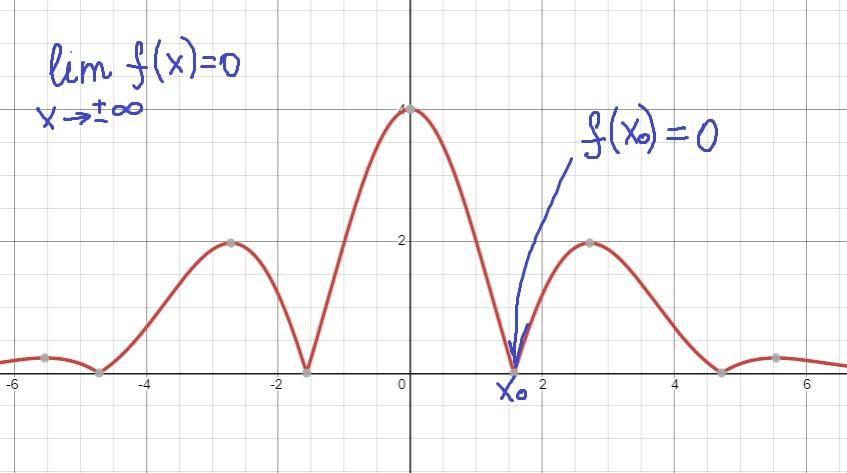
Suppose we have a function which looks like this:
probability.jpg

It seems like it meets criteria of probability density functions: this function is asymptotic to zero as x approaches infinity and also it is not negative. My question is: if at some points this function reaches zero (as I have shown above), does that mean that in cannot be PDF?
 
Physics news on Phys.org
Many pdf functions have zeros.
 
  • Like
Likes Schwann
The only conditions for a function ##f(x)## to be a pdf are ##f(x)\ge 0## for all ##x## and ##\int_{-\infty}^\infty f(x)dx=1##.
 
  • Like
Likes Schwann
An example of a well-known absolute continuous distribution with density function that is zero on a set of infinite measure is the gamma-distribution and the exponential distribution (which is a special case of the former).
 
  • Like
Likes Schwann
Schwann said:
Suppose we have a function which looks like this:
View attachment 252880
It seems like it meets criteria of probability density functions: this function is asymptotic to zero as x approaches infinity and also it is not negative. My question is: if at some points this function reaches zero (as I have shown above), does that mean that in cannot be PDF?

If you have a Borel-measurable map ##f:\mathbb{R}\to [0,\infty[## such that ##\int_\mathbb{R} f =1 ##, then we get a measure

$$\mu(A) =\int_A f d\lambda, A \in \mathcal{B}(\mathbb{R})$$

and this is a probability distribution. One can even show that there is a probability space on which there exists a random variable with this distribution. More formally, there exists a probability space ##(\Omega, \mathcal{F},\mathbb{P})## and a random variable ##X: (\Omega, \mathcal{F})\to (\mathbb{R},\mathcal{B}(\mathbb{R}))## such that ##\mu=\mathbb{P}_X##.

So to anwer your question: such a function is certainly a density function of some random variable on some probability space.

Last remark: a density function ##f## need not be unique, but it is unique almost everywhere.
 
Last edited by a moderator:
  • Like
Likes Schwann and sysprog
First trick I learned this one a long time ago and have used it to entertain and amuse young kids. Ask your friend to write down a three-digit number without showing it to you. Then ask him or her to rearrange the digits to form a new three-digit number. After that, write whichever is the larger number above the other number, and then subtract the smaller from the larger, making sure that you don't see any of the numbers. Then ask the young "victim" to tell you any two of the digits of the...

Similar threads

  • · Replies 2 ·
Replies
2
Views
2K
  • · Replies 1 ·
Replies
1
Views
1K
  • · Replies 1 ·
Replies
1
Views
2K
Replies
4
Views
2K
  • · Replies 2 ·
Replies
2
Views
2K
  • · Replies 2 ·
Replies
2
Views
1K
Replies
2
Views
5K
  • · Replies 6 ·
Replies
6
Views
3K
  • · Replies 3 ·
Replies
3
Views
2K
  • · Replies 26 ·
Replies
26
Views
3K