SUMMARY
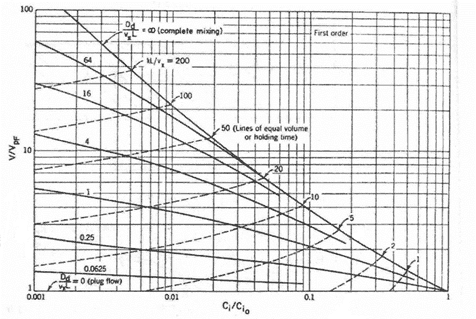
This discussion focuses on the identification and application of a specific graph used to compare Continuous Stirred Tank Reactors (CSTRs) and Plug Flow Reactors (PFRs) performance for first-order reactions. The graph is identified as a nomogram, which is utilized to represent complex relationships in chemical engineering. Key dimensionless groups discussed include Dd/(vxL), which measures axial dispersion and is the inverse of the Peclet number, and kL/vx, representing the ratio of residence time to characteristic decay time for the reaction. The variables are defined as follows: Dd is the axial dispersion coefficient, vx is the axial velocity, L is the length of the tube, and k is the first-order reaction rate constant.
PREREQUISITES
- Understanding of first-order chemical reactions
- Familiarity with reactor types: Continuous Stirred Tank Reactors (CSTRs) and Plug Flow Reactors (PFRs)
- Knowledge of dimensionless numbers in fluid dynamics
- Basic concepts of axial dispersion in chemical engineering
NEXT STEPS
- Research the application of nomograms in chemical engineering
- Study the Peclet number and its significance in reactor design
- Explore the mathematical modeling of first-order reactions in tubular reactors
- Learn about the impact of axial dispersion on reactor performance
USEFUL FOR
Chemical engineers, process engineers, and students studying chemical reaction engineering who are interested in reactor design and performance optimization.