Can symmetries in GUTs explain the occurrence of FCNCs in particle interactions?

  • Context: Graduate 
  • Thread starter Thread starter Chain
  • Start date Start date
  • Tags Tags
    feynman diagram
Click For Summary

Discussion Overview

The discussion centers on the occurrence of Flavor Changing Neutral Currents (FCNCs) in particle interactions, particularly in the context of Grand Unified Theories (GUTs). Participants explore the mechanisms behind particle decays, the role of different bosons, and the implications of symmetries in GUTs.

Discussion Character

  • Technical explanation
  • Debate/contested
  • Mathematical reasoning

Main Points Raised

  • Some participants question whether a virtual quark must emit a photon or Z boson during certain particle interactions, and the implications for spin conservation when these bosons decay into di-lepton pairs.
  • It is noted that external leptons can flip spin states to conserve angular momentum, introducing the concept of "Helicity Suppression" in certain decay processes.
  • Participants discuss the possibility of decays like Lambda_b -> pK occurring without emitting a photon, with references to experimental measurements supporting this.
  • There is a distinction made between tree-level and loop-level processes, with some participants arguing that tree-level decays should have higher branching fractions than FCNC decays, while others challenge this assumption based on CKM matrix elements and helicity suppression effects.
  • One participant raises a question about which symmetries in GUTs can produce FCNCs, noting that many GUTs describe only one generation of particles.

Areas of Agreement / Disagreement

Participants express differing views on the necessity of photon emission in certain decays and the implications for branching fractions between tree-level and FCNC processes. The discussion remains unresolved regarding the specific symmetries in GUTs that could account for FCNCs.

Contextual Notes

Some claims depend on specific definitions of decay processes and the role of various bosons, while the discussion includes unresolved mathematical steps regarding branching ratios and the effects of different particle states.
Chain
Messages
35
Reaction score
3
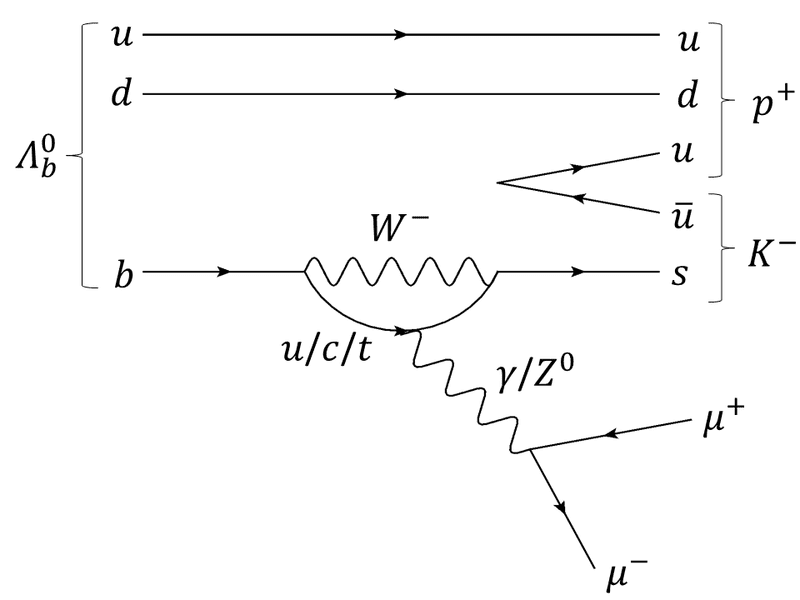
Hi, I'm trying to understand the process in the Feynman diagram below:

K6OO2jp.png
[/PLAIN]

Specifically I'm wondering if the virtual quark has to emit a photon / Z boson and if so why? Also I don't understand how the photon / Z boson decays to a di-lepton pair since surely this violates spin conservation given that the photon / Z boson has spin 1 and the di-lepton pair will have opposite spins cancelling each other out.

I'd much appreciate any help :)
 
  • Like
Likes   Reactions: arivero
Physics news on Phys.org
You can have an external lepton flip spin states, so that they add to what the decaying particle is (spin 0 or 1), in order to conserve angular momentum. But this will give you an extra factor of lepton mass. Its called "Helicity Suppression".

As for "has to emit a photon / Z boson", what else would it emit to get the in state to the out state? Actually I think you could also draw a box diagram:

Code:
b--o--c--o--s
   |     |  
   W     W
   |     |
e--o-nu--o--e

as well as the one where the gamma/Z comes off of the W in the loop, though these contribute less I believe.
 
Ah okay I'll look into that. When you say "what else would it emit to get the in state to the out state?" do you mean what else would it emit to have a di-lepton pair in the final state? Because what I'm asking is does there have have to be a photon or di-lepton pair in the final state or is a decay like Lambda_b -> pK possible without emiting a photon?

Thank you for the response!
 
Chain said:
Ah okay I'll look into that. When you say "what else would it emit to get the in state to the out state?" do you mean what else would it emit to have a di-lepton pair in the final state? Because what I'm asking is does there have have to be a photon or di-lepton pair in the final state or is a decay like Lambda_b -> pK possible without emiting a photon?

Thank you for the response!

##\Lambda_b \rightarrow p K^{-}## is possible alone, and has been measured :

http://pdg.lbl.gov/2013/listings/rpp2013-list-lambdab-zero.pdf

Scroll down to ##\Gamma_{20}##
 
Ah >__< okay thank you for the help :)
 
But also remember without the muon pair the leading diagram to the decal L->pK is NOT a FCNC with a loop. It would be the W emission diagram, where
Code:
u-----u
d-----d
b--w--u

w---> (s ubar)

This will be proportional to Gf Vub Vus, where the FCNC one is a sum over the up-types in the loop, so Vub Vus , Vcb Vcs, Vtb Vts, times the loop factors, and an extra alpha_EM.
 
That's interesting, according to the pdg its branching fraction is still of the same order as the FCNC decay modes which occur at the one-loop level. Surely if it occurs at the tree level it should have a higher branching fraction?
 
massive particles can be both in RH and LH states (because their LH and RH components are coupled through higg's vev)... only the neutrinos which are considered massless the antiparticle and particle exist in one or the other (the coupling to the higgs vev is very weak)...
Am I wrong?
 
That's interesting, according to the pdg its branching fraction is still of the same order as the FCNC decay modes which occur at the one-loop level. Surely if it occurs at the tree level it should have a higher branching fraction?

Not nessecarily. The tree level mode \Lambda_{b}-&gt;p^{+}k^{-}\mu^{+}\mu^{-} is supressed by the small CKM element V_{bu} Where the FCNC is a b->s transition which is only moderatley supressed due to the large top yukawa.

Moreover, this FCNC decay doesn't have helicity supression. Helicity supression happens when a scalar decays to light fermions through a vector coupling, like the decay B_{s}-&gt;\mu^{+}\mu^{-}
 
  • #10
  • #11
which symmetries produce FCNC in GUTs? and in general, how it possible, if all GUTs up to E6 describe only one generation (family) of particles
 

Similar threads

  • · Replies 10 ·
Replies
10
Views
4K
  • · Replies 6 ·
Replies
6
Views
2K
  • · Replies 8 ·
Replies
8
Views
2K
  • · Replies 1 ·
Replies
1
Views
4K
  • · Replies 2 ·
Replies
2
Views
4K
  • · Replies 21 ·
Replies
21
Views
4K
  • · Replies 2 ·
Replies
2
Views
3K
  • · Replies 5 ·
Replies
5
Views
7K
  • · Replies 2 ·
Replies
2
Views
3K
  • · Replies 2 ·
Replies
2
Views
4K