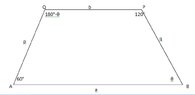
View attachment 3889
The equality $ap+bq=(b+q+a-p)(b+q-a+p)$ is equivalent to $a^2-ap+p^2=b^2+bq+q^2\tag{1}$.
Let $ABPQ$ be the quadrilateral with $AB=a,\,BP=q,\,PQ=b,\,AQ=p,\,\angle BAQ=60^{\circ}$ and $\angle BPQ=120^{\circ}$.
Such a quadrilateral exists in view of the equation we obtained in (1) and the Law of Cosines.
The common value in (1) is $BQ^2$. Let $\angle ABP=\theta$ so that $\angle PQA=180^{\circ}-\theta$.
Applying the Law of Cosines to triangles $ABP$ and $APQ$ gives
$a^2+q^2-2aq\cos \theta=b^2+p^2+2bp\cos \theta$
Hence $2\cos \theta=\dfrac{a^2+q^2-b^2-p^2}{aq+bp}$ and $AP^2=a^2+q^2-aq\left(\dfrac{a^2+q^2-b^2-p^2}{aq+bp}\right)=\dfrac{(ab+pq)(ap+bq)}{aq+bp}$.
Because $ABPQ$ is cyclic, Ptolemny's Theorem gives $(AP\cdot BQ)^2=(ab+pq)^2$.
It follows that
$\dfrac{(ab+pq)(ap+bq)}{aq+bp}\cdot (a^2-ap+p^2)=(ab+pq)^2$.
or simply $(ap+bq)(a^2-ap+p^2)=(ab+pq)(aq+bp)$.
Next, observe that
$ab+pq>ap+bq>aq+bp\tag{2}$.
The first inequality follows from $(a-q)(b-p)>0$, and the second from $(a-b)(p-q)>0$.
Now, assume that $ab+pq$ is prime, it then follows from (2) that $ab+pq$ and $ap+bq$ are relatively prime. Hence, from $(ap+bq)(a^2-ap+p^2)=(ab+pq)(aq+bp)$, it must be true that $ap+bq$ divides $aq+bp$.
However, this is impossible by (2). Thus $ab+pq$ must not be prime.
One example that satisfies the given conditions is $(65,\,50,\,34,\,11)$.