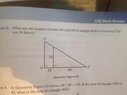
Can you find the length of ON using Pythagoras and similarity?

  • Topic:
  • Thread starter Thread starter alextrainer
  • Start date Start date
  • Tags Tags
    Triangle
Join the discussion
Registration is free. Start your own thread to ask a follow-up.
3 replies · 2K views
alextrainer
Messages
10
Reaction score
0
In attached file, I understand 50 is the base; no idea how to use the 24 height to calculate length of ON - must have to do with property of right triangles?

View attachment 6367
 
Attachments
  • geo.jpg
    geo.jpg
    19.7 KB · Views: 165
Mathematics news on Phys.org
These are, of course, right triangles so you can use the Pythagorean theorem To determine the length of the hypotenuse of the small triangle. Then, since the angles of the large and small triangles are the same, they are similar triangles. Corresponding parts of the two right triangles are proportional.
 
HallsofIvy said:
These are, of course, right triangles so you can use the Pythagorean theorem To determine the length of the hypotenuse of the small triangle. Then, since the angles of the large and small triangles are the same, they are similar triangles. Corresponding parts of the two right triangles are proportional.

Thanks for the smaller triangle I get hypotenuse of 46.65. Then each leg and hypotenuse is multipled by a proportion?

So larger triangle would be 50 leg - no idea how to figure height or hypotenuse unless I multiple by 10/40 percent all the known lengths.
 
Let:

$$\overline{NO}=x$$

Then, by similarity, we may state:

$$\frac{x}{50}=\frac{24}{40}=\frac{3}{5}$$

Hence:

$$x=50\cdot\frac{3}{5}=10\cdot3=30$$

And then by Pythagoras:

$$\overline{OP}=\sqrt{30^2+50^2}=10\sqrt{3^2+5^2}=10\sqrt{34}$$