Can you me understand this mechanism?

  • Thread starter Thread starter nickjmi
  • Start date Start date
  • Tags Tags
    Mechanism
Click For Summary
SUMMARY

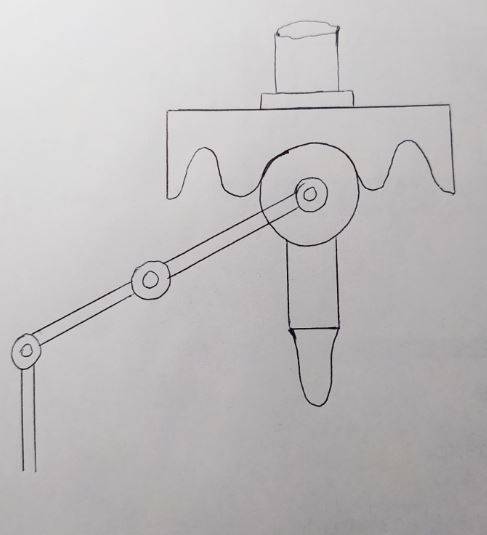
The discussion focuses on the mechanism of converting circular motion into rectilinear motion using a waved-wheel or cam on an upright shaft. The cam rotates around its shaft, which is fixed and cannot slide, while a follower wheel tracks the cam's profile, resulting in an up-and-down motion transferred to an upright bar via an oscillating lever. This mechanism is similar to valve operation in combustion engines, utilizing a face cam or end cam design. The power is supplied by a motor or engine through a rotating shaft, with axial movement restricted by bearings.

PREREQUISITES
  • Understanding of mechanical systems and motion conversion
  • Familiarity with cam mechanisms, specifically face and end cams
  • Basic knowledge of lever mechanics and pivot points
  • Experience with combustion engine valve operation
NEXT STEPS
  • Research the design and function of face cams in mechanical systems
  • Explore the principles of oscillating lever mechanisms
  • Study the role of bearings in restricting axial movement in rotating shafts
  • Watch instructional videos on cam mechanisms and their applications in engines
USEFUL FOR

Mechanical engineers, students studying mechanical systems, and anyone interested in the principles of motion conversion in machinery.
nickjmi
Messages
3
Reaction score
0
TL;DR
Can you explain me how does it work?

Circular into rectilinear motion. The waved-wheel or cam on the upright shaft communicates a rectilinear motion to the upright bar through the oscillating rod.

i've not understood this explanation

Cattura.JPG
 
Last edited by a moderator:
Engineering news on Phys.org
Cattura.JPG
 
Welcome, nickjmi :cool:

The waved-wheel or cam on the upright shaft rotates around its shaft, which cannot slide up or down.
The follower wheel follows (up and down) the profile of the edge of the waved-wheel or cam.

That up and down movement is transferred to the upright bar via the oscillating lever.
That is basically the mechanism of the valves driven by a rocking arm in combustion engines, only that the type of cam is different and the its profile less complex.

camshaft-operation.gif
 
Lnewqban said:
Welcome, nickjmi :cool:

The waved-wheel or cam on the upright shaft rotates around its shaft, which cannot slide up or down.
The follower wheel follows (up and down) the profile of the edge of the waved-wheel or cam.

That up and down movement is transferred to the upright bar via the oscillating lever.
That is basically the mechanism of the valves driven by a rocking arm in combustion engines, only that the type of cam is different and the its profile less complex.

View attachment 262413
Thanks, correct me if I'm wrong...
I think that the cam rotates so the follower is forced to go up and down...

If what I've written is correct, I've not understood:

1How does the cam rotate?
2How does the motion is transferred from the follower to the shaft which goes up and down?
3What is the function of the elements of the left?

Thanks ;)
 
nickjmi said:
Thanks, correct me if I'm wrong...
I think that the cam rotates so the follower is forced to go up and down...

If what I've written is correct, I've not understood:

1How does the cam rotate?
2How does the motion is transferred from the follower to the shaft which goes up and down?
3What is the function of the elements of the left?

Thanks ;)
1) This type of cam is called face cam or end cam. Power from a motor or engine is transferred to it through a rotating shaft, which axial movement is restricted by bearings.

2) It is a simple lever mechanism, which fixed pivot is located midway.

3) I can't understand this question.

Please, watch this video:


Similar threads

Replies
3
Views
2K
  • · Replies 5 ·
Replies
5
Views
4K
Replies
1
Views
1K
Replies
23
Views
2K
  • · Replies 7 ·
Replies
7
Views
2K
  • · Replies 17 ·
Replies
17
Views
4K
Replies
6
Views
2K
  • · Replies 9 ·
Replies
9
Views
4K
Replies
1
Views
2K
  • · Replies 9 ·
Replies
9
Views
2K