Carothers exercise 32: open balls in normed vector spaces

4 replies · 3K views · last reply
Math Amateur
Gold Member
MHB
Messages
3,920
Reaction score
48
I am reading N. L. Carothers' book: "Real Analysis". ... ...

I am focused on Chapter 3: Metrics and Norms ... ...

I need help Exercise 32 on page 46 ... ... Exercise 32 reads as follows:

View attachment 9201
I have not been able to make much progress ...

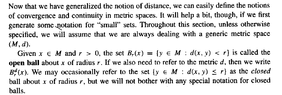
We have ...$$B_r(x) = \{ y \in M \ : \ d(x, y) \lt r \}$$

... and ...

$$B_r(0) = \{ y \in M \ : \ d(0, y) \lt r \}$$... and ...$$x + B_r(0) = x + \{ y \in M \ : \ d(0, y) \lt r \}$$But ... how do we formally proceed from here ...
Hope that someone can help ...

Peter===================================================================================

The above post refers to/involves the notion of an open ball ... so I am providing Carothers' definition of the same ... as follows:
View attachment 9202
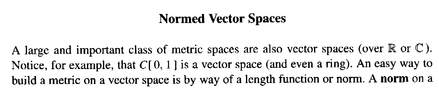
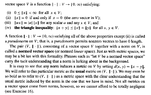
The above post also refers to/involves the notion of a normed vector space ... so I am providing Carothers' definition of the same ... as follows:
View attachment 9203
View attachment 9204Hope that helps ...

Peter
 
Attachments

  • Exercise 32 from a textbook: In a normed vector space (V, ||·||), show that B_r(x) = x + B_r(0) = {x + y : ||y|| < r} and that B_r(0) = rB_1(0) = {rx : ||x|| < 1}.
    Carothers - Exercise 32.png
    3.1 KB · Views: 197
  • Carothers - Defn of Open and Closed Ball .png
    Carothers - Defn of Open and Closed Ball .png
    16.7 KB · Views: 191
  • Printed textbook page with the bold heading 'Normed Vector Spaces' followed by a paragraph beginning 'A large and important class of metric spaces are also vector spaces (over R or C).' and mentioning C[0, 1] and norms.
    Carothers - 1 - Defn of a Normed Vector Space ... ... PART 1 ... .png
    7 KB · Views: 196
  • Printed text defining a norm on a vector space V as a function from V to [0, ∞) satisfying four properties, with a definition of pseudonorm and normed vector space below.
    Carothers - 2 - Defn of a Normed Vector Space ... ... PART 2 ... .png
    29.3 KB · Views: 210
Given $x,y\in V$, let $z = y-x$. Then $$y \in B_r(x) \Longrightarrow \|y-x\|<r \Longrightarrow \|z\|<r \Longrightarrow z\in B_r(0) \Longrightarrow y = x+z \in x + B_r(0).$$ Therefore $B_r(x) \subseteq x + B_r(0)$. That argument also works in the opposite direction, giving the reverse inclusion in the same way.
 
Opalg said:
Given $x,y\in V$, let $z = y-x$. Then $$y \in B_r(x) \Longrightarrow \|y-x\|<r \Longrightarrow \|z\|<r \Longrightarrow z\in B_r(0) \Longrightarrow y = x+z \in x + B_r(0).$$ Therefore $B_r(x) \subseteq x + B_r(0)$. That argument also works in the opposite direction, giving the reverse inclusion in the same way.
Hi Opalg ...

Thanks for the help ...

... but ... just a clarification ...

You write:

" ... ... $$z\in B_r(0) \Longrightarrow y = x+z \in x + B_r(0)$$ ... ... "I am somewhat perplexed as to how we justify (or even interpret ...) the above statement ... how do you justify it based solely on the axioms of a normed vector space and the basics of set theory ... indeed ... what does the statement ... ... $$y = x+z \in x + B_r(0)$$ ... ... mean exactly ...
My thoughts are as follows ...

$$y = x + z$$

$$\Longrightarrow y = x \ + $$ ... a particular element of the set $$B_r(0)$$

$$\Longrightarrow$$ ... (means ... ) ... $$y \in x + B_r(0)$$Is that correct ... am I interpreting things correctly ...?

Regarding the reverse argument ... my thoughts are as follows:

$$y \in x + B_r(0)$$

$$\Longrightarrow y = x + z $$ where $$z \in B_r(0)$$

$$\Longrightarrow y - x = z$$ where $$z \in B_r(0)$$But $$\| z \| \lt r$$

$$\Longrightarrow \| y - x \| \lt r$$

$$\Longrightarrow y \in B_x(r)$$ Is that correct?Hope you can help further ...

Peter
 
Last edited:
Peter said:
You write:

" ... ... $$z\in B_r(0) \Longrightarrow y = x+z \in x + B_r(0)$$ ... ... "I am somewhat perplexed as to how we justify (or even interpret ...) the above statement ... how do you justify it based solely on the axioms of a normed vector space and the basics of set theory ... indeed ... what does the statement ... ... $$y = x+z \in x + B_r(0)$$ ... ... mean exactly ...
My thoughts are as follows ...

$$y = x + z$$

$$\Longrightarrow y = x \ + $$ ... a particular element of the set $$B_r(0)$$

$$\Longrightarrow$$ ... (means ... ) ... $$y \in x + B_r(0)$$Is that correct ... am I interpreting things correctly ...?
That is correct. In fact, in the statement of Exercise 32, Carothers defines $x+B_r(0)$ to mean $\{x+y:\|y\|<r\}$:
View attachment 9205

Peter said:
Regarding the reverse argument ... my thoughts are as follows:

$$y \in x + B_r(0)$$

$$\Longrightarrow y = x + z $$ where $$z \in B_r(0)$$

$$\Longrightarrow y - x = z$$ where $$z \in B_r(0)$$But $$\| z \| \lt r$$

$$\Longrightarrow \| y - x \| \lt r$$

$$\Longrightarrow y \in B_x(r)$$ Is that correct?
For the reverse inclusion $x+B_r(0) \subseteq B_r(x)$, you need to start with an element $z\in B_r(0)$. Then $$z\in B_r(0) \Longrightarrow \|z\|<r \Longrightarrow \|x-(x+z)\|<r \Longrightarrow x+z\in B_r(x).$$
 
Attachments
  • Exercise 32 from Carothers: In a normed vector space (V, ||·||), show that B_r(x) = x + B_r(0) = {x + y : ||y|| < r} and that B_r(0) = r B_1(0) = {rx : ||x|| < 1}.
    Screenshot 2019-07-21 at 09.23.47.png
    6.6 KB · Views: 177
Opalg said:
That is correct. In fact, in the statement of Exercise 32, Carothers defines $x+B_r(0)$ to mean $\{x+y:\|y\|<r\}$:
For the reverse inclusion $x+B_r(0) \subseteq B_r(x)$, you need to start with an element $z\in B_r(0)$. Then $$z\in B_r(0) \Longrightarrow \|z\|<r \Longrightarrow \|x-(x+z)\|<r \Longrightarrow x+z\in B_r(x).$$
Thanks Opalg ...

Still thinking over the reverse inclusion proof ...

Peter