Cathodes/Anodes in Chemistry and Physics

  • Context: Undergrad 
  • Thread starter Thread starter quanticism
  • Start date Start date
  • Tags Tags
    Chemistry Physics
Click For Summary
SUMMARY

Cathodes and anodes serve distinct roles in both chemistry and physics, leading to confusion regarding their definitions. In chemistry, the cathode is the positive terminal where conventional current flows out, while in physics, particularly in vacuum tubes, the cathode acts as the negative terminal where electrons are emitted. This distinction is crucial for understanding devices like galvanic cells and cathode ray tubes (CRTs), where electron flow and conventional current differ. The historical context of these conventions is essential for grasping the underlying principles of electrical devices.

PREREQUISITES
  • Understanding of galvanic cells and their components
  • Familiarity with vacuum tube operation
  • Knowledge of conventional current versus electron flow
  • Basic principles of electrochemistry
NEXT STEPS
  • Research the operation of galvanic cells in detail
  • Study the principles of vacuum tube technology
  • Explore the differences between conventional current and electron flow
  • Investigate the historical development of electrical conventions
USEFUL FOR

This discussion is beneficial for chemistry students, physics enthusiasts, electrical engineers, and anyone seeking to clarify the roles of cathodes and anodes in various electrical devices.

quanticism
Messages
29
Reaction score
3
Hi,

I'm confused at why cathodes are the positive terminal in chemistry but appear to be the negative terminal in physics. I hope someone can clear this up for me.

Definitions:
Anode: An anode is an electrode through which conventional current flows into a polarized electrical device.
Cathode: A cathode is an electrode through which conventional current flows out of a polarized electrical device

Galvanic Cell
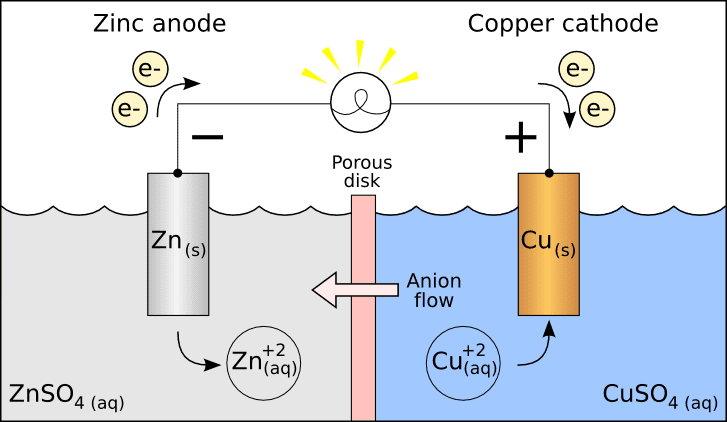
Galvanic_cell_with_no_cation_flow.png


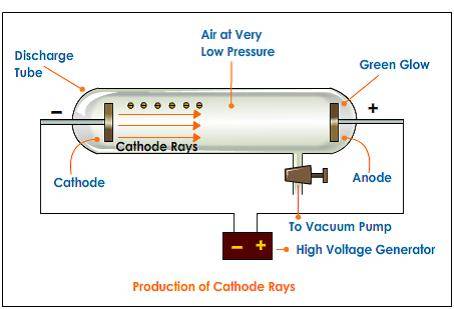
Vacuum Tube
cathode-rays-formation.jpe


Going by the definition above, I agree with the galvanic cell "cathode/anode" labels.

However, looking at the vacuum tube, the electrons traveling to the right through the partial vacuum and entering the anode, ie conventional current is leaving the anode which seems to contradict the provided definition.
 
  • Like
Likes   Reactions: davidbenari
Physics news on Phys.org
The definitions describe what happens outside the device.

Inside the CRT, electrons travel from the cathode to the anode.

Outside the CRT, to complete the circuit, electrons travel from the anode to the cathode.

So outside the CRT, conventional current travels from the cathode to the anode.

So conventional current flows from outside the CRT into the anode.
 
  • Like
Likes   Reactions: davidbenari
Thank you very much! I finally see the light now :)
 
There is a difference between conventional current (taken as flowing from positive to negative) and electron current. This link will explain it and the history of the convention. http://web.engr.oregonstate.edu/~traylor/ece112/lectures/elect_flow_vs_conv_I.pdf
 
Last edited by a moderator:
The electrons are reppeled from Cathode and attracted to Anode.
The electrons in galvanic cell can not move trough the Porous disk, and they move trough the outside circuit.
 
Last edited:

Similar threads

  • · Replies 2 ·
Replies
2
Views
2K
  • · Replies 3 ·
Replies
3
Views
3K
  • · Replies 17 ·
Replies
17
Views
4K
  • · Replies 15 ·
Replies
15
Views
3K
  • · Replies 19 ·
Replies
19
Views
4K
Replies
4
Views
2K
  • · Replies 3 ·
Replies
3
Views
3K
  • · Replies 5 ·
Replies
5
Views
2K
  • · Replies 1 ·
Replies
1
Views
3K
  • · Replies 10 ·
Replies
10
Views
2K