Chemists learn more about how life started on earth?

Click For Summary
SUMMARY

A team of chemists at the MRC Laboratory of Molecular Biology in Cambridge has proposed a series of reactions that could explain the formation of essential biomolecules, including sugars, amino acids, ribonucleotides, and glycerol, which are critical for metabolism and the creation of proteins and RNA. Their findings, published in the journal Nature Chemistry, do not claim to solve the origin of life but rather suggest potential pathways for biomolecule synthesis. Critics highlight that the plausibility of these reactions occurring on early Earth remains uncertain, with alternative hypotheses, such as those involving meteorite impact conditions, also being explored.

PREREQUISITES
  • Understanding of organic chemistry principles
  • Familiarity with biomolecular structures and functions
  • Knowledge of early Earth conditions and their implications for chemical reactions
  • Awareness of current theories regarding the origin of life
NEXT STEPS
  • Research the implications of the findings in Nature Chemistry regarding biomolecule synthesis
  • Explore alternative hypotheses for the origin of life, including meteorite impact studies
  • Investigate the role of cyanide concentrations in early Earth chemistry
  • Examine the methods used in simulating early Earth conditions for biomolecule formation
USEFUL FOR

Researchers in biochemistry, evolutionary biology, and astrobiology, as well as educators and students interested in the origins of life and the chemical processes involved.

Messages
19,910
Reaction score
10,919
Chemists claim to have solved riddle of how life began on Earth
http://phys.org/news/2015-03-chemists-riddle-life-began-earth.html

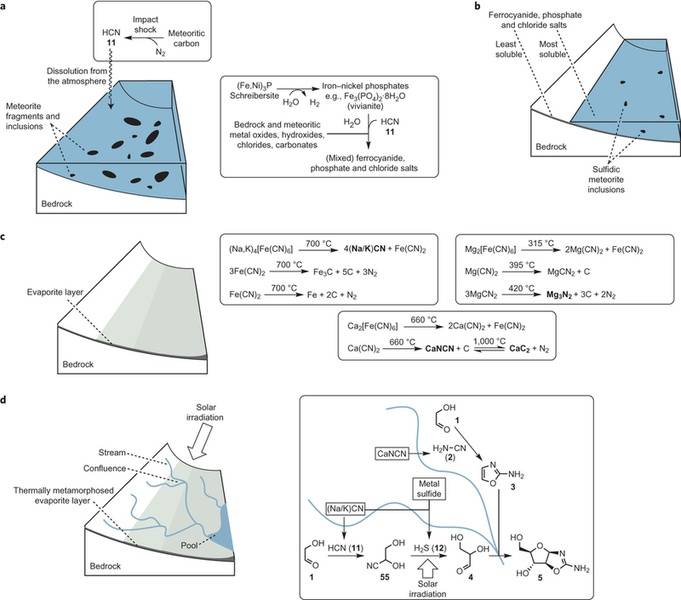
A team of chemists working at the MRC Laboratory of Molecular Biology, at Cambridge in the UK believes they have solved the mystery of how it was possible for life to begin on Earth over four billion years ago. In their paper published in the journal Nature Chemistry, the team describes how they were able to map reactions that produced two and three-carbon sugars, amino acids, ribonucleotides and glycerol—the material necessary for metabolism and for creating the building blocks of proteins and ribonucleic acid molecules and also for allowing for the creation of lipids that form cell membranes.

Here is the journal article
http://www.nature.com/nchem/journal/vaop/ncurrent/full/nchem.2202.html
55097cc7b29d5.jpg
 
Last edited:
Chemistry news on Phys.org
Greg Bernhardt said:
Chemists claim to have solved riddle of how life began on Earth

Nope. The study does not claim to have solved the origin of life as the headline claims (to be fair, the headline is PhysOrg's fault, as I'm sure the authors of the study would not make that claim). The study does present a set of reactions that could potentially serve as the origin of biomolecules on Earth, which is still quite an impressive and important feat. The origin of life – how these biomolecules might organize into a living system – is a separate but related issue that is not addressed in the study.

There are reasons to think that the proposed sequence of reactions may not have been plausible on early Earth (for example, this article cites a researcher who questions whether high enough concentrations of cyanide would have been available), and there are other hypotheses for how these molecules could have formed (for example, a recent study used lasers to simulate the conditions of a meteorite impact and showed that such conditions could promote the formation of the nucleobases from formamide, though Sutherland's paper has the advantage in that his scheme produces nucleosides, not just nucleobases). This is very much an open area of research, and it will certainly take much thought and debate to sort through the various hypotheses out there.
 
  • Like
Likes   Reactions: Greg Bernhardt

Similar threads

  • · Replies 3 ·
Replies
3
Views
4K
  • · Replies 2 ·
Replies
2
Views
7K