Discussion Overview
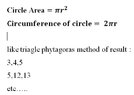
The discussion revolves around methods for quickly calculating the circumference and area of a circle, exploring various approaches including ratios, series, and alternative mathematical techniques. Participants express interest in shortcuts and tactics for multiple-choice exams.
Discussion Character
- Exploratory
- Technical explanation
- Homework-related
- Mathematical reasoning
Main Points Raised
- Some participants inquire about quick methods for finding the circumference and area of a circle, suggesting the use of ratios or series similar to the Pythagorean theorem.
- One participant mentions that using the radius or diameter is the main way to find circumference and area, implying it is also the quickest method.
- Another participant expresses a desire for a tactical approach to answering multiple-choice questions, comparing it to the Pythagorean concept.
- One response suggests that learning the results is the only real shortcut and emphasizes using exact answers in terms of $$\pi$$ rather than approximations.
- Several participants discuss using the approximation $$\pi \approx \frac{22}{7}$$ for calculations, with one mentioning the use of $$\frac{355}{113}$$ for more precision.
- A participant shares a link to a resource on Vedic mathematics, asking for ideas on finding the nearest value of circumference and radius using this method.
- Another participant provides rational approximations for calculating radius from area and circumference, using the approximation of $$\pi$$.
Areas of Agreement / Disagreement
Participants express various methods and approaches, but there is no consensus on a single best method for calculating circumference and area quickly. Multiple competing views and techniques remain present in the discussion.
Contextual Notes
Some methods discussed depend on approximations of $$\pi$$, and there are unresolved questions regarding the effectiveness of different shortcuts and their applicability in various contexts.