dedocta
- 11
- 3
- TL;DR
- I'm looking for a way to calculate how much an asteroids trajectory would change, based off of a collision event.
In short, I was trying to look into feasibility of deflecting an asteroid with a collision of ~32MJ of direct energy. I wanted to know how many collisions are necessary to deflect at a given time out (distance away.)
I found this link, where the collision is perpendicular to the motion of the asteroid:
https://physics.stackexchange.com/q...an-asteroid-with-force-always-perpendicular-tSo, taking the following equation, and with the ideal scenario of a perpendicular collision we are left with an isosceles triangle, where we can solve for Theta based off of the distance away of the asteroid and the distance we want to deflect / modify trajectory.
𝑚(𝑣1^2)(1−cos(𝜃))
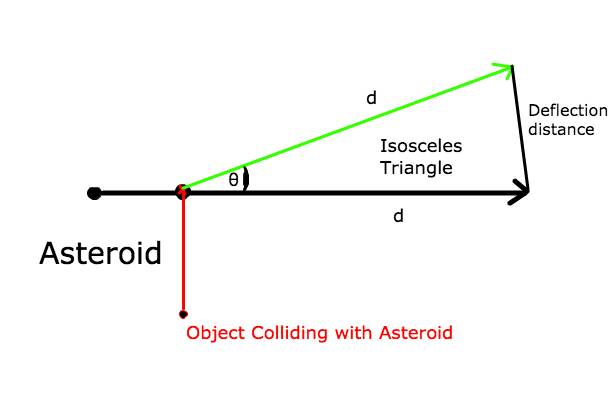
I then created an excel spreadsheet to calculate theta based off of the distance away and deflection distance, and asked how many 32MJ interractions it would take to change the trajectory by a certain distance at a certain time of collision. It would appear smaller asteroids it would be possible to change trajectories with this, however, not so much for the lower and upper bounds of the Chicxilub asteroid and another larger current NEO.
Would this be an acceptable way to do this? If so, I've been stuck on where to go next if the collision is not perpendicular, if anyone had any input?
I found this link, where the collision is perpendicular to the motion of the asteroid:
https://physics.stackexchange.com/q...an-asteroid-with-force-always-perpendicular-tSo, taking the following equation, and with the ideal scenario of a perpendicular collision we are left with an isosceles triangle, where we can solve for Theta based off of the distance away of the asteroid and the distance we want to deflect / modify trajectory.
𝑚(𝑣1^2)(1−cos(𝜃))
I then created an excel spreadsheet to calculate theta based off of the distance away and deflection distance, and asked how many 32MJ interractions it would take to change the trajectory by a certain distance at a certain time of collision. It would appear smaller asteroids it would be possible to change trajectories with this, however, not so much for the lower and upper bounds of the Chicxilub asteroid and another larger current NEO.
Would this be an acceptable way to do this? If so, I've been stuck on where to go next if the collision is not perpendicular, if anyone had any input?
Last edited: