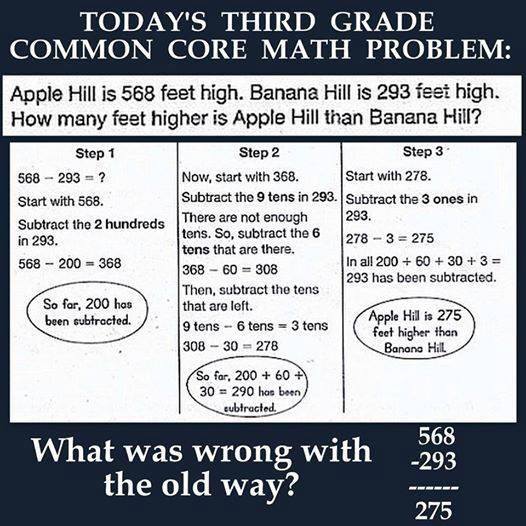
First of all, let me point out that yes, the old way is still taught. Sometimes, you just need mindless, algorithmic processes to get a job done.
That said, the second method is more intuitive, and when I (and many other people who study in STEM fields) do mental arithmetic, this method is the method I use. It's highly unfeasible to imagine doing it the "old way" in your head--it's too easy to lose your place!
But it's much easier to take it one step at a time to simplify things. And this is exactly what I do: I subtract using a bunch of easy steps, and then take the total amount I subtracted. I don't pull out a sheet of paper and say "okay, now carry the one..."
Now, the old way is great. It works, but at the same time, it really isn't that necessary. Any sufficiently complicated problem can be solved with a calculator or computer. There's never any need to subtract a 13-digit number from a 14-digit number unless you just want to practice. What's more important when applying math is to understand intuitively what you're doing, and getting an intuitive feel for numbers is how you come up with those little tricks to make mental arithmetic easier.
For instance, what's [itex]15 \times 17[/itex]? I could pull out a sheet of paper and calculate it. I could also line the two up in my head and try to remember what the individual products are and then add them together, but that's the same as doing the following!
Notice that [itex]17 = 10 + 7[/itex], then [itex]15 \times 17 = 15 \times (10 + 7)[/itex]. That's much more manageable. Right away I know [itex]15 \times 10 = 150[/itex], and I can further divide [itex]7[/itex] into [itex]7 = 5 + 2[/itex]. Then I multiply 15 by each of those. That's fairly easy: [itex]15 \times 5 = 75[/itex] and [itex]15 \times 2 = 30[/itex], and in my head, I can add [itex]150 + 75 + 30 = 225 + 30 = 255[/itex]. I can do that in my head in about 5 seconds (or faster, if I'm in the zone!), because I know intuitively what it means to perform those operations. I don't need to rely on some algorithm without understanding what I'm doing.
Another example of a similar thought process. You're at the store, and you buy something that costs $3.72. You pay with a 20$ bill. How much change do you get? I'm not going to pull out a sheet of paper and calculate 20.00 - 3.72. I'm going to note that 3.72 + .28 = 4. Then note that 4 + 16 = 20. So my change is 16.28$. Again, it's hard to get that insight by just following a set of rules called subtraction. It requires understanding the meaning of subtraction.
And the beauty is that (I feel) those skills extend to higher level mathematics when you're no longer dealing with constants. That's where you're at an advantage when you understand what things mean as opposed to just how to do things. Understanding how to take a derivative is nearly useless unless your job requires you to analytically find derivatives. Understanding what a derivative is and how rates of change are all around us is the important skill.