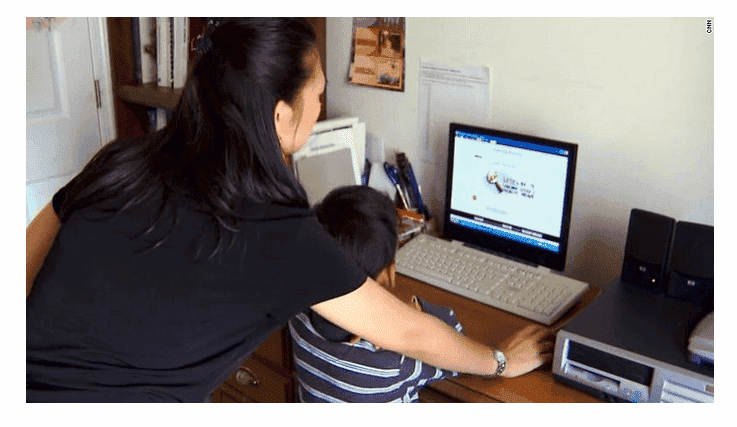
Parents' frustration with distance learning -- "Common Core Math Methods"

  • Thread starter Thread starter berkeman
  • Start date Start date
  • Tags Tags
    Core Math methods
Click For Summary

Discussion Overview

The discussion revolves around parents' frustrations with the "Common Core" math methods used in primary education, particularly during distance learning. Participants share their experiences and challenges in helping their children with math homework, highlighting the differences between traditional methods and the new techniques introduced by Common Core.

Discussion Character

  • Debate/contested
  • Conceptual clarification
  • Exploratory

Main Points Raised

  • Some participants express that the new "Common Core" methods, such as "grouping," complicate the process of helping children with math homework.
  • Others recount personal experiences where children struggle to explain their teachers' methods, leading to frustration for both parents and students.
  • A participant mentions that elementary school teachers often lack strong math skills, which may affect the quality of math education.
  • Concerns are raised about the adequacy of math curricula, with some participants suggesting that traditional methods may have been more effective.
  • One participant shares a positive experience with a math tutor who provided personalized support, contrasting it with the challenges faced in the school system.
  • There is a discussion about the differences in multiplication table education between the US and other countries, suggesting that broader memorization could enhance math skills.
  • Some participants reflect on the cultural attitudes towards math, particularly regarding gender stereotypes and the implications of parents' attitudes on children's learning.

Areas of Agreement / Disagreement

Participants generally express frustration with the Common Core methods and the challenges they pose, but there is no consensus on the effectiveness of these methods compared to traditional approaches. Multiple competing views remain regarding the best way to support children's math education.

Contextual Notes

Participants note limitations in their understanding of Common Core methods, and there are references to personal experiences that may not represent broader educational trends. The discussion includes anecdotal evidence and subjective interpretations of educational practices.

Who May Find This Useful

Parents navigating distance learning, educators interested in different teaching methods, and individuals concerned about math education and its impact on children.

berkeman
Admin
Messages
69,479
Reaction score
25,006
Interesting article. At first I thought the article was saying that for many parents, helping their kids with their math homework was the hardest because maybe they weren't all that great at math themselves.

But the real reason is that the "Common Core" math methods used in primary school these days involve new tricks ("grouping") to solve the problems. The methods that we are all used to have been replaced, so if you're going to help your kids with their work, you'll need to learn the new paradigm. Sigh.

https://www.cnn.com/2020/09/08/us/distance-learning-problems-parents-trnd/index.html

1599594614645.png

1599594821709.png

(CNN)It's a truly humbling moment when your child asks you to help diagram a sentence or solve a grade-level math problem and you, a functioning adult with a diploma and years of experience, draw a complete blank.

Anyone with school-aged children can probably relate. And as many schools start the year with virtual learning, parents are trying to summon even more of that long-forgotten knowledge.
Helping your child navigate Zoom tech support can be daunting. So can balancing work and household duties with making sure your children are engaged and learning.

But the single biggest challenge, many parents say, are the math topics taught through Common Core -- a standardized teaching method rolled out in 2010.
 
  • Like
Likes   Reactions: Lnewqban
Science news on Phys.org
Our parents had the same frustration as did I with my sons.

The usual complaint when helping with a math problem was "No that's not how the teacher did it." and when asked how the teacher did it " I don't remember" and finally after several fruitless minutes "Oh now I get it."

During a school open house, the math dept head talked about their teaching methods. I asked about why kids can't bring their tests home. The response was that's against school policy, we only have a limited number of test problems and we don't want the students passing them on to other students.

However, you as a parent are welcome to stop by to view the test questions provided the teacher is available and you've made an appointment and your boss let's you leave work early so you can get there.

My old HS math teacher said those teachers were just too lazy to make up new problems for their tests and makeup tests.

The end result was the graded homework was too late to fix mistakes that then cascaded onto quizzes and tests. Your kid does poorly and you are helpless to help them short of getting them a regular tutor to fill in for the missing feedback.

We did in fact get a math tutor and he was great. He had several students come in one by one. While waiting for your tutoring time, he would give you a quiz to work on. Tutoring time was spent reviewing the quiz and any questions you had and things progressed from there. He was an amazing tutor.

However, nowadays we also have Khan Academy and that's a great step in the right direction.
 
  • Like
Likes   Reactions: Astronuc, bhobba, atyy and 2 others
berkeman said:
But the real reason is that the "Common Core" math methods used in primary school these days involve new tricks ("grouping") to solve the problems.
A disclaimer: 'm not very familiar with what is in Common Core math at the elementary level; my math teaching experience is lower-division college level, and mostly ended back in '97. Also, it's been many years since my son was in the primary grades.
However, I have seen some of the new techniques that are used for teaching division, and I'm very skeptical about it, as well as many of the other concepts involving arithmetic.
jedishrfu said:
The usual complaint when helping with a math problem was "No that's not how the teacher did it."
An important thing about elementary grade school teachers is that they very seldom have strong math skills. The chart here, https://www.businessinsider.com/heres-the-average-sat-score-for-every-college-major-2014-10https://www.businessinsider.com/heres-the-average-sat-score-for-every-college-major-2014-10, shows that Education majors are in the bottom quintile of SAT Math scores, with an average score more than 100 points below those of the highest scoring majors.

I'm also very skeptical about people who get PhD's in Education. When I was still teaching, one of my fellow instructors attended a program at the local university, and was granted a PhD in Education. One of the Chem instructors asked her, "Why didn't you opt for a real degree?"
jedishrfu said:
My old HS math teacher said those teachers were just too lazy to make up new problems for their tests and makeup tests.
That would be my guess as well.
 
  • Like
Likes   Reactions: WWGD and CalcNerd
Most of my math tutoring with my son was when he was in high-school where I encountered the attitude I mentioned above which extended into other subjects as well. My wife covered the grade school stuff since her schooling in Taiwan was superior to what we learned arithmetic-wise. Basically, her mental math is beyond my ability to compete with (hehe but I know Calculus).

One interesting thing to note is that US teachers stop at 10x10 multiplication tables whereas in other countries they extend it to 12x12 or even further to 20x20. Granted its repetitious to learn 20x20 tables but it does increase your ability as a kid to memorize things setting a higher bar which they can meet and it gives you a lifelong boost in that it encompasses so much of what we do with respect to mental math.

In counterpoint to 10x10 and beyond:

https://blog.wolfram.com/2013/06/26/is-there-any-point-to-the-12-times-table/

Similarly the Japanese limit times tables to 9x9 but with extensive memory drills, mnemonic schemes and speed competitions:

https://www.japantimes.co.jp/life/2002/10/11/lifestyle/chant-away-to-calculation-competence/

Of course, one can't neglect some common basic knowledge:

A Sufi Story from the Middle East

A scholar asked a boatman to row him across the river. The journey was long and slow. The scholar was bored. "Boatman," he called out, "Let's have a conversation." Suggesting a topic of special interest to himself, he asked, "Have you ever studied phonetics or grammar?"

"No," said the boatman, "I've no use for those tools."

"Too bad," said the scholar, "You've wasted half your life. It's useful to know the rules."

Later, as the rickety boat crashed into a rock in the middle of the river, the boatman turned to the scholar and said, "Pardon my humble mind that to you must seem dim, but, wise man, tell me, have you ever learned to swim?"

"No," said the scholar, "I've never learned. I've immersed myself in thinking."

"In that case," said the boatman, "you've wasted all your life. Alas, the boat is sinking."

http://www.storyarts.org/library/nutshell/stories/boatman.html
 
Last edited:
  • Like
Likes   Reactions: Astronuc and atyy
berkeman said:
Interesting article. At first I thought the article was saying that for many parents, helping their kids with their math homework was the hardest because maybe they weren't all that great at math themselves.

But the real reason is that the "Common Core" math methods used in primary school these days involve new tricks ("grouping") to solve the problems. The methods that we are all used to have been replaced, so if you're going to help your kids with their work, you'll need to learn the new paradigm. Sigh.
The choice of grouping as an example is a particularly poor one. If a parent can't understand grouping, I would say it's because they aren't great at math. Plus I remember a form of grouping taught when I was in elementary school, but to be fair, not a lot of time was spent on it, if I recall correctly.

What's sad is the attitude of one mother quoted in the article, who said "I refused to do the math portion of anything," leaving that responsibility to her husband. It tends to foster the idea that it's okay to give up on math because "it's too hard!" and the stereotype that girls aren't good at math.

The sense I got from the article is that these frustrated parents view learning as an unpleasant chore, and that's what they're teaching their kids. I get that it can be annoying to parents that they can't answer questions off the top of their head, but the flip side is that it's the good opportunity for parents to show their children how to deal with subjects they don't already know.
 
  • Like
  • Sad
Likes   Reactions: Astronuc, Filip Larsen, Lnewqban and 2 others
jedishrfu said:
One interesting thing to note is that US teachers stop at 10x10 multiplication tables whereas in other countries they extend it to 12x12
Is that true? I was taught to memorize up to 12x12 (back in the '70s), and I seem to recall a year or two ago my niece (from Wisconsin) telling me they had to learn up to 12x12.
 
  • Informative
Likes   Reactions: symbolipoint
vela said:
I was taught to memorize up to 12x12 (back in the '70s),
Same for me, but it was back in the mid-50s.
 
  • Like
Likes   Reactions: bhobba and mpresic3
Quick story about multiplication tables and an "aha" moment that I had as a kid...

I was having trouble memorizing the multiplication table (10x10 for me), I think in 1st or 2nd grade. There were just some combinations of numbers that I got confused on and sometimes I was off by a digit or two. I was watching TV at home one night when the "Beverley Hillbillies" TV show came on, and I started singing the theme song at the start of the show. When I was done, my dad said, "So you can memorize that song, but you can't memorize the multiplication table?"

Whelp, that gave me pause, and I realized that I just wasn't putting enough effort into memorizing the multiplication table. Things went much more smoothly soon after that. :smile:
 
  • Like
  • Haha
Likes   Reactions: DrClaude, Astronuc, mathwonk and 3 others
vela said:
Is that true? I was taught to memorize up to 12x12 (back in the '70s), and I seem to recall a year or two ago my niece (from Wisconsin) telling me they had to learn up to 12x12.

Yes, they still do this in some places to 12x12. My nine year old little girl demands that I quiz her on the table! She’s obsessed. She even quizzes me in the car while I’m driving. Bath time is her math, physics, and philosophy (she’s curious about death right now) free-for-all! I love it.
 
  • Like
Likes   Reactions: docnet, Astronuc and PeroK
  • #10
12x12, late '60s... maybe the excuse for stopping at 10x10 is that "dozen" is now considered archaic ?

Meh, make them go to 16x16 to be modern.
 
  • Like
Likes   Reactions: bhobba
  • #11
Some of my best friends were intimately involved with creating the common core math stuff, and they meant well, but I am motivated to recall my comment about the consequences of changing calculus books when we taught math in the department: namely, no matter how much better a given new book might be in theory, whenever we changed books, we had one year of confusion while the teachers learned the new book themselves. Hence since the teacher is more important than the book, it is always better to stay with the book they know. I.e. no matter how bad the current book is, the teachers have learned how to compensate for it, and when you change it, you throw the whole system out of balance for one or more years.

Of course this is not true for the tiny subset of good students who actually read the book and teach themselves from it. These may be the ones the professors who write the core identify with. But I am conscious that my friends involved in the common core have no chance to defend their work here. By the way, one of those friends has a math PhD in arithmetic geometry from Penn and held the prestigious Gibbs instructorship in the math dept. at Yale. My impression is that when she had children and observed what was being taught them in schools, her commitment switched to improving math instruction, and she is author of a nationally recognized book for teaching elementary school math. Although it is true that education majors score notoriously low in math, the math ed department at UGA requires their students to take significant amounts of substantive math courses from the math department, including say foundations of geometry, graduate algebra (Galois theory etc.)

My friend's book is excellent in my opinion, and could help frustrated parents. Almost the only negative amazon reviews are referring to the weight of the book for carrying around or the physical condition of the used copy received. It is quite expensive though.
https://www.amazon.com/dp/0321825721/?tag=pfamazon01-20

@berkeman: you made me laugh and recall my kid's experience in second grade. We splurged for the expensive private school and on the days before class started, I emphasized that he should know his multiplication tables at least up to 12 x 12, so as not to be embarrassed. When he came home I asked him if he had indeed been ready for this high end school, and he burst out laughing. When he calmed down, he explained that at this progressive school, they did the times tables one month at a time, and the first month was the zeroes times table. I had a little conversation with myself over the loans I had taken out to pay the tuition at this "school", but at least in terms of English training it did prove valuable.
 
Last edited:
  • Like
  • Wow
  • Haha
Likes   Reactions: Astronuc, bhobba, Greg Bernhardt and 3 others
  • #12
mathwonk said:
When he calmed down, he explained that at this progressive school, they did the times tables one month at a time, and the first month was the zeroes times table.
Then in a 9-month school year, they must have gotten only to the "8 times" row. Unbelievable.
 
  • Like
Likes   Reactions: bhobba
  • #13
When I had to teach the grouping stuff, I tried to make up real world examples, like using old fashioned English money: i.e. given 5,000 pence say, how many pounds, shillings, and pence would that make, if you changed it all into the largest denominators possible? Or given 650 empty bottles, how many cardboard cartons holding 24 bottles, and cardboard six packs, and cases holding 4 cartons, do they fill ?

Of course the basic purpose of memorizing multiplication tables is to be able to actually multiply multiple digit numerals using positional notation, and since we use the decimal system, you only need to know them up to 10 x 10. For doing problems in your head of course, and for fun, it would be nice to know them up to 16 x 16, or 20 x 20. In our strange world you mark yourself off as an egg head if you happen to know what 17x17 is. I used to try to impress my class by flaunting such esoteric knowledge, or by using tricks like 19x19 = 20x20 - 40 + 1.
 
  • #14
@Mark44: yes when our son came home he had this guilty look, like he had a license to steal, since there were no challenging expectations on him at that school where he got to essentially play all day long.
 
Last edited:
  • Haha
Likes   Reactions: berkeman
  • #15
mathwonk said:
Of course the basic purpose of memorizing multiplication tables is to be able to actually multiply multiple digit numerals using positional notation, and since we use the decimal system, you only need to know them up to 10 x 10.
Well, up to 9x9 really. That's what I had in grade school, mid 1960s.

For someone who ended up doing more math than average, I had a difficult time memorizing the "times tables." I still remember in class one day, the teacher calling on us one by one, she asked me "seven times eight?" and all I could say was "uh... uh... uh.." then the kid behind me blurted out "fifty six" and I remembered that one from then on. Weird.
 
  • Like
Likes   Reactions: Astronuc and berkeman
  • #16
Technically I agree, but it is hard to imagine someone who needs to use that method to multiply 10 by 10 (i.e. one digit at a time). I.e. I would have said up to 9x9, but I couldn't imagine someone not knowing what it means to move a decimal point.

By the way as I read your post I could not remember what 7x8 is either. That was always a hard one for me. I prefer 8x8 or 9x9, or 7x7, maybe I like the squared ones.
 
  • #17
if it is asked as 8 times 7, I see it as "twice 28" which I know is forty plus sixteen.
 
  • Like
Likes   Reactions: boneh3ad
  • #18
Mark44 said:
An important thing about elementary grade school teachers is that they very seldom have strong math skills.
Perhaps, but my wife is Montessori primary teacher and she might say, most people don't understand child development. Just because you're an expert in mathematics doesn't mean you know how to teach it to young children. She is more in favor of common core as it's closer to how they teach in Montessori which is curriculum designed with the science of whole child development in mind.
 
Last edited:
  • Like
  • Informative
Likes   Reactions: Astronuc, vela, mathwonk and 2 others
  • #19
Greg Bernhardt said:
Perhaps, but my wife is Montessori primary teacher and she might say, most people don't understand child development. Just because you're an expert in mathematics doesn't mean you know how to teach it to young children. She is more in favor of common core as it's closer to how they teach in Montessori which is curriculum designed with the science of child development in mind.
That's very interesting, thanks Greg. Do you know of any papers or other references for more reading? I wonder how my brain changed from those early days to now, in terms of how I process math problems.
 
  • #20
Mark44 said:
An important thing about elementary grade school teachers people is that they very seldom have strong math skills.
Fixed that for you.

Common core is the way most everyone I know in science and engineering thinks about math, it's just that they're trying to teach that mode of thinking to kids now (as opposed to the algorithmic arithmetic that we all grew up with). I personally think it's great: kids actually get to engage with math concepts instead of being drilled on how to multiply fractions quickly or whatever.

The practicality of knowing how to do tedious arithmetic by hand is largely in the past--calculators exist for a reason (After all, how many of us actually remember how to compute a square root by hand, if we ever knew in the first place?). Sure, an intuition for when the result of a computation doesn't "smell" right is important, but I'm not convinced that knowing how to do algorithmic arithmetic quickly is the exclusive path to developing that intuition.

I think it's probably more a function of familiarity and comfort with numbers, which is where the parents and teachers come in. Since a large fraction of adults in general (including parents and teachers) are functionally innumerate and even math-phobic--I'm mainly talking about the US here--it's not particularly surprising that they would wrestle with changes to a basic curriculum that they perhaps never truly understood to begin with.
 
  • Like
Likes   Reactions: boneh3ad and PeroK
  • #21
Greg Bernhardt said:
Just because you're an expert in mathematics doesn't mean you know how to teach it to young children.
And conversely, just because someone is an expert in child development, he or she doesn't necessarily know how to teach math skills to young children. This thread is about distance learning and Common Core math teaching, so my point is that elementary and middle-school teachers should also have something beyond one year of high school math. I'm not sure that getting a certificate to teach at the elementary level requires even one college-level math class, or even any science class, for that matter.
 
  • #22
Mark44 said:
I'm not sure that getting a certificate to teach at the elementary level requires even one college-level math class, or even any science class, for that matter.
My wife teaches 3,4,5 year olds. She needs to know calculus why? My wife has noted a common issue is that teachers teach how they were taught. This leads to generational stagnation and stubborness. Why we are teaching the same we did 50 years ago blows my mind.
 
  • Like
Likes   Reactions: vela, OmCheeto and etotheipi
  • #23
Greg Bernhardt said:
My wife teaches 3,4,5 year olds. She needs to know calculus why?
My remarks were about the primary and middle-school grades. Obviously, someone teaching kindergarten and below doesn't need calculus, but those teaching math at, say, 4th grade and up should have more than one year of high-school math, IMO.
Greg Bernhardt said:
My wife has noted a common issue is that teachers teach how they were taught. This leads to generational stagnation and stubborness. Why we are teaching the same we did 50 years ago blows my mind.
Well, 50 years ago puts us at 1970, and which was quite a while after I had graduated from high school. What exactly was so bad about the educational methods back then?

BTW, the educational methods at that time had produced scientists and engineers who were about to put men on the moon in 1969.
 
Last edited:
  • Like
Likes   Reactions: Astronuc
  • #24
Greg's comment about understanding how a child's mind develops reminded me of reading works by Piaget where he pointed out that his experiments showed that at a certain age children do not realize that the amount of milk does not change when you pour it from one glass to another different shaped glass. I would probably not have realized that when trying to teach volumes. So as always, teaching requires more of us, both knowledge of the subject and knowledge of instruction.
 
  • Like
Likes   Reactions: gleem and Greg Bernhardt
  • #25
mathwonk said:
So as always, teaching requires more of us, both knowledge of the subject and knowledge of instruction.
I don't disagree with that at all. It just seems to me that too many teachers at the K-12 level have very lopsided levels of subject knowledge vs. instruction knowledge.
 
  • Like
Likes   Reactions: symbolipoint, Astronuc, Mondayman and 1 other person
  • #26
Indeed what to do? Maybe if we raised the pay...?
 
  • Like
Likes   Reactions: boneh3ad, atyy and Greg Bernhardt
  • #27
Mark44 said:
I don't disagree with that at all. It just seems to me that too many teachers at the K-12 level have very lopsided levels of subject knowledge vs. instruction knowledge.
Might be a matter of how much we pay them. If you want them to be a master at instruction and knowledge you better pay them more than $58k/yr. :)
 
  • Like
Likes   Reactions: Mondayman
  • #28
Mark44 said:
BTW, the educational methods at that time had produced scientists and engineers who were about to put men on the moon in 1969.
And in 550BC Pythagoras was kicking butt, but do we want to go back to 550BC education system? There will always be some that rise in any occasion give circumstances are right. For a national education system we need to keep evolving with the science of child development and pedagogy to rise the educational floor for everyone. I can tell you straight up the traditional education system did not work for me. It was by a grace of some deity that was I privileged to have so many opportunities even after really struggling in school. Dice roll in any other way and I my life is a different story.

Kids naturally need is to move and communicate. So what do, we put them in a chair all day, doing countless worksheets and telling them to raise their hand if they want to speak. Then we they don't we scold and drug them with Ritalin.
 
  • Like
Likes   Reactions: boneh3ad and bhobba
  • #30
TeethWhitener said:
kids actually get to engage with math concepts instead of being drilled on how to multiply fractions quickly or whatever.
It's not an either/or situation. There's been a controversy amongst math teachers for at least the past 25 years, with one side denigrating any rote memorization such as the "times" table or even such basics as adding or multiplying single-digit numbers. This seems foolish to me, to toss out such foundational knowledge. One of my fellow math instructors used the term "vacuous drill" so often that I offered an abbreviation -- VD. My point is that both are important - math concepts and a certain set of basic knowledge. After all, you can't build a house without a solid foundation.
TeethWhitener said:
The practicality of knowing how to do tedious arithmetic by hand is largely in the past--calculators exist for a reason (After all, how many of us actually remember how to compute a square root by hand, if we ever knew in the first place?). Sure, an intuition for when the result of a computation doesn't "smell" right is important, but I'm not convinced that knowing how to do algorithmic arithmetic quickly is the exclusive path to developing that intuition.
And even calculators are becoming passé -- everyone has a smart phone with calculator abilities. But what do you do when your phone dies? And if you don't have some vague sense of what the calculated answer should be, and you key in an incorrect number, it's just garbage in-garbage out, and you have no way to get a ballpark estimate to confirm or toss what the calculator gave.
Instead of calculators, I think kids would be better off working with slide rules, and there are a lot of math teachers at the middle-school and high school level who agree with this.
@TeethWhitener, What are you calling "algorithmic arithmetic"? The only things I can think of, aside from the square root calculation, are multiplication and division, and the arithmetic of fractions. Surely these concepts don't need to be the sole focus of math classes - creative teachers could come up with applied problems that use these concepts.
Going back to what I said earlier about the need for teachers to have better math skills, at least from about 4th or 5th grade on up, there are a lot of teachers who wind up being assigned to teach a math class, but who aren't qualified to do so.
As an anecdote, I have a close friend who was a welder for his entire career, and is now retired. He told me about being in 9th grade at a public school in Idaho. The math teacher was a coach pressed into teaching the math class. The teacher spent most of the time talking with the guys who were on whatever team the teacher coached, and virtually no time teaching anyone in the class mathematics. These are the kinds of teachers who rely on "drill and kill" because they don't know anything else to do. As a result of this experience, my friend has an extremely limited knowledge of arithmetic, and nothing beyond that. He wanted to learn trig so that he could qualify for an advanced ham radio license, but gave up because it was too hard for him.
I've met lots of people, who, when they found out that I taught math, had similar experiences along about junior high or high school.
BTW, I learned how to do square roots by hand in, I think, 8th grade. Still know how to do them.
Greg Bernhardt said:
Kids naturally need is to move and communicate. So what do, we put them in a chair all day, doing countless worksheets and telling them to raise their hand if they want to speak. Then we they don't we scold and drug them with Ritalin.
What you said especially applies to boys. Our education system tries to pretend that there is no difference between boys and girls, with the result that boys are dosed with Ritalin at twice the rate that girls are (https://www.statista.com/statistics/814592/adha-among-us-kids-by-gender/). There's a lot of lip service given to being able to teach diverse groups, but educators seem to believe in a one-size-fits-all sort of methodology with regard to sex differences.
Greg Bernhardt said:
nd in 550BC Pythagoras was kicking butt, but do we want to go back to 550BC education system?
Well that's quite a jump, from 50 years back, to 2570 years back.
Greg Bernhardt said:
For a national education system we need to keep evolving with the science of child development and pedagogy to rise the educational floor for everyone.
One important factor that would prevent this from happening is when parents don't see the value of education, don't read to their young children, and don't make sure that the children are keeping up with their schoolwork.
 
  • Like
Likes   Reactions: CalcNerd, Greg Bernhardt and berkeman

Similar threads

  • · Replies 4 ·
Replies
4
Views
2K
  • · Replies 10 ·
Replies
10
Views
1K
Replies
19
Views
4K
  • · Replies 27 ·
Replies
27
Views
4K
  • · Replies 28 ·
Replies
28
Views
9K
  • · Replies 5 ·
Replies
5
Views
5K
  • · Replies 17 ·
Replies
17
Views
3K
  • · Replies 50 ·
2
Replies
50
Views
6K
  • · Replies 38 ·
2
Replies
38
Views
12K
  • · Replies 1 ·
Replies
1
Views
2K