Kakashi
- 31
- 1
- Homework Statement
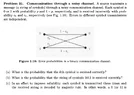
- A source transmits a message through a noisy channel. Each symbol is 0 or with probability p and 1-p respectively and is received incorrectly with probability $$ \epsilon_{0} $$ and $$ \epsilon_{1} $$ respectively. Errors in different symbol transmissions are independent.
a) What is the probability that the kth symbol is received correctly?
b) What is the probability that the string of symbols 1011 is received correctly?
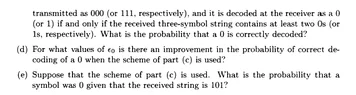
c) In an effort to improve reliability each symbol is transmitted three times and the received string is decoded by majority rule. In other words, 0 or 1 is transmitted as 000 or 111 respectively and its decoded at the receiver as 0 or 1 if and only if the received string contains atleast two 0's or 1s respectively. What is the probability that a 0 is correctly decoded?
d) For what values of $$ \epsilon_{0} $$ is there an improvement in the probability of correct decoding of a 0 when c) is used?
e) Suppose that c) is used. What is the probability that a symbol was 0 given that the received string is 101?
- Relevant Equations
- Bayes Rules
Total Probability Law
Independence
a) The kth symbol can be 0 or 1. If 0 or 1 are transmitted they can either be received correctly or incorrect.
P(kth symbol is transmitted correctly)=P(0 is transmitted and received correctly)+P(1 is transmitted and received correctly)=$$p(1-\epsilon_{0})+(1-p)(1-\epsilon_{1}) $$
b) P(1011 is received correctly|1011 is transmitted)=P(1011 is received correctly and transmitted)/P(1011 is transmitted)= $$ \frac{p(1-\epsilon_{1})^{3}(1-\epsilon_{0})}{p}=(1-\epsilon_{1})^{3}(1-\epsilon_{0}) $$
c) P(0 is correctly decoded| 0 is transmitted)=P(Three symbol string contains atleast two 0's| 0 is transmitted)=(P(000 and 0 is transmitted)+P(001 and 0 is transmitted)+P(010 and 0 is transmitted)+P(100 and 0 is transmitted))/P(0 is transmitted)=$$\frac{p(1-\epsilon_{0})^{3}+3p(1-\epsilon_{0})^{2}\epsilon_{0}}{p}=(1-\epsilon_{0})^{3}+3(1-\epsilon_{0})^{2}\epsilon_{0} $$
d) P(0 is correctly decoded| 0 is transmitted)>P(0 is received correctly|0 is transmitted)
$$ (1-\epsilon_{0})^{3}+3(1-\epsilon_{0})^{2}\epsilon_{0}>(1-\epsilon_{0}) $$
$$(1-\epsilon_{0})^{2}+3(1-\epsilon_{0})\epsilon_{0}>1 $$
$$ 0<\epsilon_{0}<\frac{1}{2} $$
e) P(0 is transmitted | 101 is received)=P(0 and 101 is received)/P(101 is received)=$$\frac{p\epsilon_{0}^{2}(1-\epsilon_{0})}{p\epsilon_{0}^{2}(1-\epsilon_{0})+(1-p)(1-\epsilon_{1})^2\epsilon_{1}} $$
P(0 and 101 is received)=P(101 is received| 0 is transmitted)P(0)=$$ p\epsilon_{0}^{2}(1-\epsilon_{0}) $$
101 can be trasmitted if the symbol is 0 or 1.
P(101)=P(101 is received and 0 is transmitted)+P(101 is received and 1 is transmitted)=$$ p\epsilon_{0}^{2}(1-\epsilon_{0})+(1-p)(1-\epsilon_{1})^2\epsilon_{1} $$
P(kth symbol is transmitted correctly)=P(0 is transmitted and received correctly)+P(1 is transmitted and received correctly)=$$p(1-\epsilon_{0})+(1-p)(1-\epsilon_{1}) $$
b) P(1011 is received correctly|1011 is transmitted)=P(1011 is received correctly and transmitted)/P(1011 is transmitted)= $$ \frac{p(1-\epsilon_{1})^{3}(1-\epsilon_{0})}{p}=(1-\epsilon_{1})^{3}(1-\epsilon_{0}) $$
c) P(0 is correctly decoded| 0 is transmitted)=P(Three symbol string contains atleast two 0's| 0 is transmitted)=(P(000 and 0 is transmitted)+P(001 and 0 is transmitted)+P(010 and 0 is transmitted)+P(100 and 0 is transmitted))/P(0 is transmitted)=$$\frac{p(1-\epsilon_{0})^{3}+3p(1-\epsilon_{0})^{2}\epsilon_{0}}{p}=(1-\epsilon_{0})^{3}+3(1-\epsilon_{0})^{2}\epsilon_{0} $$
d) P(0 is correctly decoded| 0 is transmitted)>P(0 is received correctly|0 is transmitted)
$$ (1-\epsilon_{0})^{3}+3(1-\epsilon_{0})^{2}\epsilon_{0}>(1-\epsilon_{0}) $$
$$(1-\epsilon_{0})^{2}+3(1-\epsilon_{0})\epsilon_{0}>1 $$
$$ 0<\epsilon_{0}<\frac{1}{2} $$
e) P(0 is transmitted | 101 is received)=P(0 and 101 is received)/P(101 is received)=$$\frac{p\epsilon_{0}^{2}(1-\epsilon_{0})}{p\epsilon_{0}^{2}(1-\epsilon_{0})+(1-p)(1-\epsilon_{1})^2\epsilon_{1}} $$
P(0 and 101 is received)=P(101 is received| 0 is transmitted)P(0)=$$ p\epsilon_{0}^{2}(1-\epsilon_{0}) $$
101 can be trasmitted if the symbol is 0 or 1.
P(101)=P(101 is received and 0 is transmitted)+P(101 is received and 1 is transmitted)=$$ p\epsilon_{0}^{2}(1-\epsilon_{0})+(1-p)(1-\epsilon_{1})^2\epsilon_{1} $$
Attachments