Comparing MO Labelling Schemes: LHS vs. RHS

  • Thread starter Thread starter etotheipi
  • Start date Start date
Click For Summary
SUMMARY

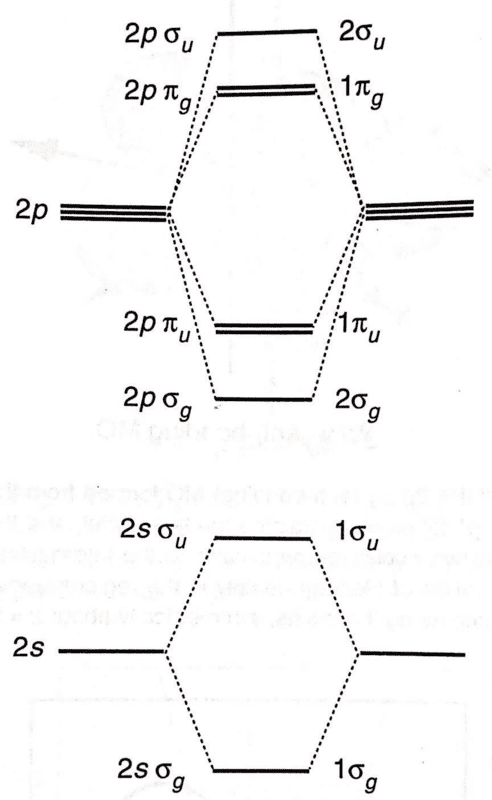
This discussion focuses on the comparison of two molecular orbital (MO) labeling schemes: the Left-Hand Side (LHS) and Right-Hand Side (RHS) schemes. The LHS scheme labels MOs based on the atomic orbitals (AOs) from which they are derived, incorporating designations such as ##\sigma##/##\pi## and ##u##/##g##. The RHS scheme employs a numbering system to distinguish orbitals of the same symmetry, specifically using a sequential numbering format (1, 2, ...) for orbitals like the first and second sigma_g and sigma_u orbitals. Understanding these distinctions is crucial for accurate interpretation of molecular orbital diagrams.

PREREQUISITES
  • Familiarity with molecular orbital theory
  • Understanding of atomic orbitals (AOs)
  • Knowledge of symmetry labels in molecular orbitals (e.g., sigma, pi, u, g)
  • Basic grasp of orbital diagrams and their representations
NEXT STEPS
  • Research the implications of symmetry in molecular orbital theory
  • Study the significance of orbital labeling in quantum chemistry
  • Explore advanced topics in molecular orbital diagrams
  • Learn about the application of MO theory in predicting molecular properties
USEFUL FOR

Chemistry students, educators, and researchers interested in molecular orbital theory and its applications in understanding molecular structure and behavior.

etotheipi
Two different labelling schemes for MOs are shown on the left and right of this diagram:
1602192168794.png


I understand the LHS naming scheme, since the MOs are simply labelled according to the AOs from which they are derived (along with ##\sigma##/##\pi## and ##u##/##g## for the MO).

I don't understand the numbering scheme on the RHS. The book says that 'orbitals of the same symmetry are distinguished from one another by numbering them 1,2,...'. What does this mean? Thanks.
 
Chemistry news on Phys.org
There is the first sigma_g orbital, the second sigma_g orbital, the first sigma_u orbital, the second sigma_u orbital ... The symmetry is specified here by sigma/pi and the u/g label.
 
  • Like
Likes   Reactions: etotheipi
DrDu said:
There is the first sigma_g orbital, the second sigma_g orbital, the first sigma_u orbital, the second sigma_u orbital ... The symmetry is specified here by sigma/pi and the u/g label.

Ah, I see. Thanks!
 

Similar threads

Replies
1
Views
2K
Replies
7
Views
2K
  • · Replies 3 ·
Replies
3
Views
2K
  • · Replies 7 ·
Replies
7
Views
2K
  • · Replies 1 ·
Replies
1
Views
2K
  • · Replies 20 ·
Replies
20
Views
5K
  • · Replies 2 ·
Replies
2
Views
4K
  • · Replies 15 ·
Replies
15
Views
2K
  • · Replies 1 ·
Replies
1
Views
2K
  • · Replies 20 ·
Replies
20
Views
3K