mcastillo356
Gold Member
- 666
- 365
- Homework Statement
- Useful identities
Many important properties of ##\cos t## and ##\sin t## are deduced from the fact they are the coordinates of the point ##P_t## in the circunference ##C##, with equation ##x^2+y^2=1##.
Identities of complementary angles
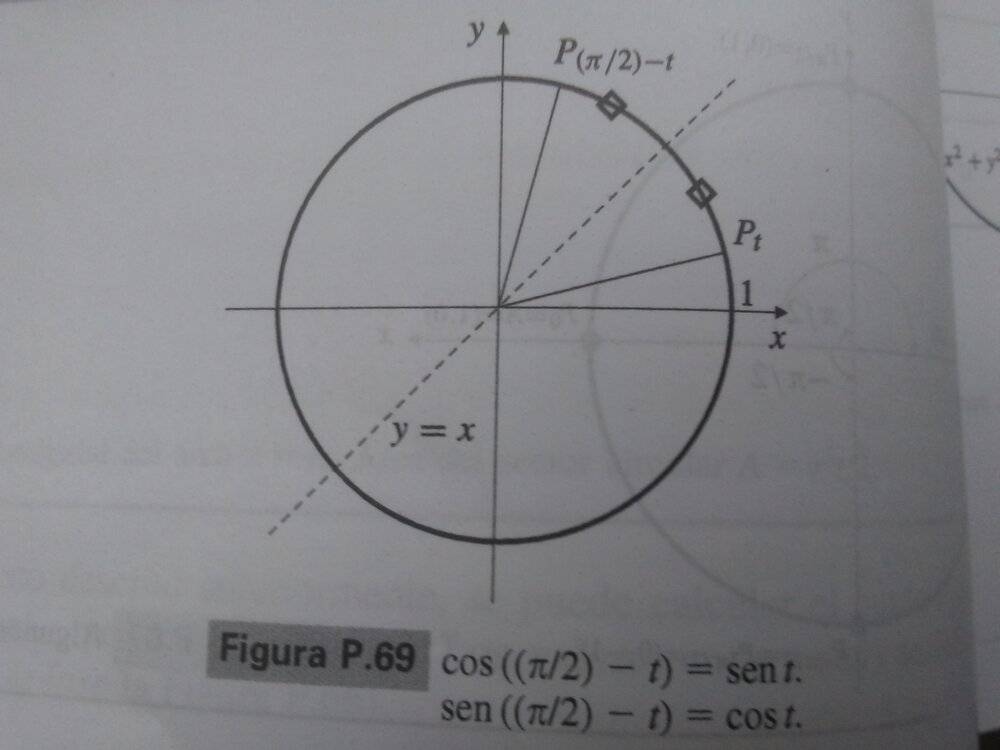
Two angles are complementary if they add up ##\pi/2## (or 90º). The points ##P_{(\pi/2)-t}## and ##P_t## are reflections (one of the other) about the line ##y=x## (Figura P.69), so the ##x## coordinate of one of them is the ##y## coordinate of the other, and vice versa. So
##\cos \left({\dfrac{\pi}´´ 2 -t\right)=\sin t## and ##\sin \left({\dfrac{\pi}2-t}\right)=\cos t##
- Relevant Equations
- Maybe Thales Theorem?
I thought I understood it until I found the statement mentioned. It's obvious having a look at Figura 3.53:
##\cos \alpha=\dfrac{OP_1}{OP}\Rightarrow{OP_1=\cos \alpha}##,
##\sin \alpha=\dfrac{OP_2}{OP}\Rightarrow{OP_2=OP\cos \left({\dfrac{\pi}{2}-\alpha}\right)=OP\sin \alpha}##
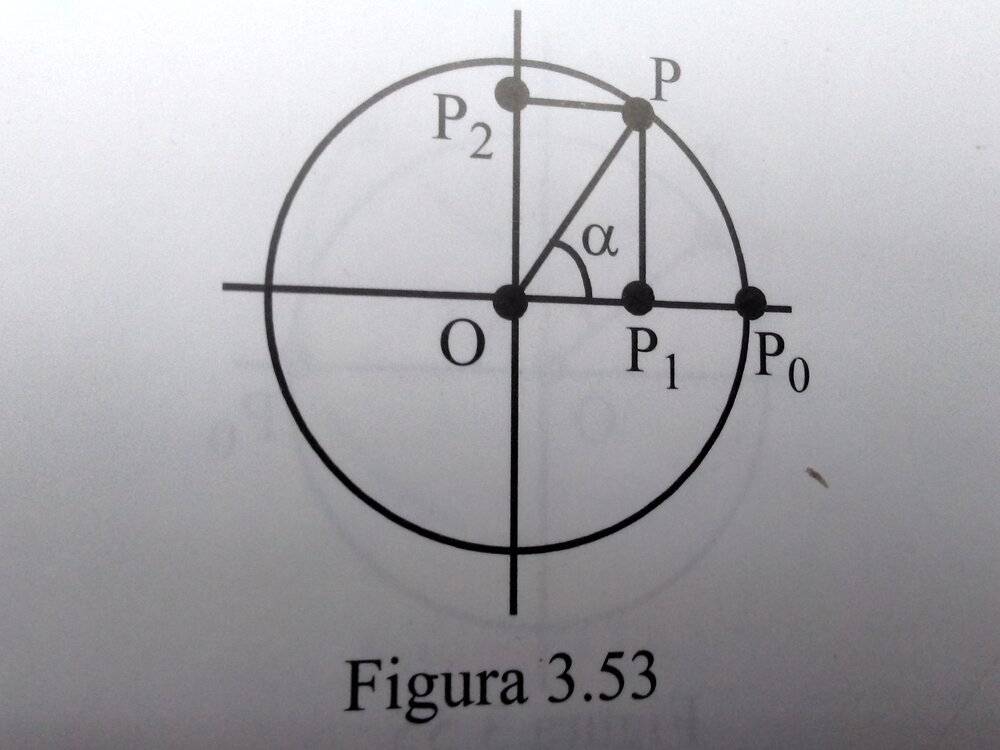
##\cos \alpha=\dfrac{OP_1}{OP}\Rightarrow{OP_1=\cos \alpha}##,
##\sin \alpha=\dfrac{OP_2}{OP}\Rightarrow{OP_2=OP\cos \left({\dfrac{\pi}{2}-\alpha}\right)=OP\sin \alpha}##
