Discussion Overview
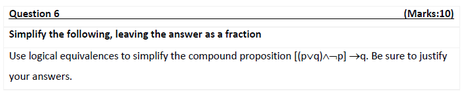
The discussion revolves around the simplification of a compound proposition using logical equivalences, specifically focusing on the expression $[(p \vee q) \wedge \neg p] \to q$. Participants seek assistance in understanding the simplification process and the application of logical laws.
Discussion Character
- Homework-related, Technical explanation, Exploratory
Main Points Raised
- One participant expresses difficulty in simplifying the compound proposition and requests guidance on the process.
- Another participant states that $a \to b$ is equivalent to $\neg a \vee b$ and applies this to the expression, suggesting it can be rewritten as $\neg [(p \vee q) \wedge \neg p] \vee q$.
- A different participant reiterates the same equivalence and expresses gratitude for the help received.
- One participant mentions reaching a point in the simplification but struggles with the expression $(p \vee q)$ and questions how to proceed.
- Another participant suggests using the distributive law to simplify the expression, providing a specific equivalence involving $q \wedge \neg p$.
- One participant notes a lack of instruction on the topic from their professor and seeks help with the simplification.
- Another participant interprets the logical expression and concludes that if "p is true OR q is true" AND "p is NOT true," then it follows that q must be true.
Areas of Agreement / Disagreement
Participants express varying levels of understanding and approaches to the problem, with no consensus on the simplification process or the final form of the expression. Multiple competing views and methods are presented without resolution.
Contextual Notes
Some participants reference logical equivalences and laws without fully explaining their application, leading to potential gaps in understanding for those less familiar with the concepts. There is also an indication that not all participants have been taught the necessary theory to simplify the proposition effectively.
Who May Find This Useful
This discussion may be useful for students learning about logical equivalences and simplification of compound propositions, particularly those seeking help with homework or theoretical understanding in logic.