Graduate Computing Thomas Precession: Part 2 | Francesco

Click For Summary
SUMMARY

The forum discussion focuses on the derivation of the Thomas precession as outlined in "Classical Mechanics" by Goldstein, Poole, and Safko. Francesco seeks clarification on the transformation S_3 -> S_1, specifically regarding the composition of boosts on the x" and y" axes. Key differences in the matrix elements are highlighted, particularly the '-' signs and the zero in position [3,2]. Users recommend studying Lie algebra and refer to J.D. Jackson's 1975 edition for a clearer understanding of the topic.

PREREQUISITES
  • Understanding of classical mechanics principles
  • Familiarity with Lorentz transformations
  • Basic knowledge of Lie algebra
  • Experience with Fermi-Walker transport concepts
NEXT STEPS
  • Study the derivation of the Thomas precession in J.D. Jackson's "Classical Electrodynamics" (2nd edition, section 11.8)
  • Learn about Fermi-Walker transport and its applications in relativistic physics
  • Explore the mathematical foundations of Lie algebra relevant to physics
  • Review matrix transformations in the context of special relativity
USEFUL FOR

Students and researchers in theoretical physics, particularly those focusing on relativistic mechanics and the mathematical frameworks underlying classical mechanics.

Coelum
Messages
97
Reaction score
32
TL;DR
While computing the transformation matrix associated to Thomas precession - as described by Goldstein (7.3) - I cannot reproduce a step in the derivation. This is a step later than the one described in my previous post "Computing the Thomas precession".
Dear PFer's,
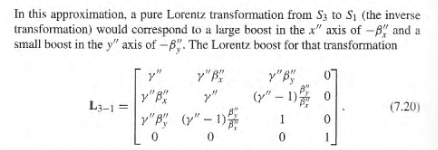
I am reproducing the steps to derive the expression for the Thomas precession, as described in Goldstein/Poole/Safko "Classical Mechanics". Hereafter an excerpt from the book describing the step I am currently working on.
Screenshot from 2022-08-30 10-18-29.png

Based on the text, the transformation S_3 -> S_1 should be the composition of a boost on the x" axis
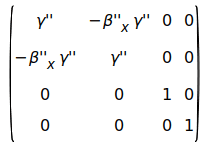
1661847678210.png

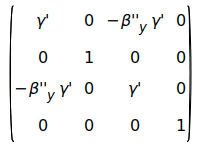
and a boost on the y" axis

1661848318941.png

which, when composed assuming γ'=1, yield
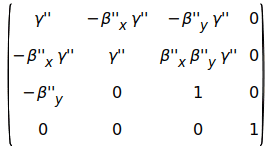
1661848394308.png
.
The differences with (7.20) are:
  1. the '-' sign in elements [1,2], [2,2], [2,1], [3,1]
  2. the '0' in position [3,2]
  3. the element in position [2,3], which can be approximated as (dropping the " for readability):
    βxβyγ = γ(βyxx2 ≈ γ(βyx2 = γ(βyx)(1-1/γ2) = (γ-1/γ)βyx. Close, but not identical.
Can anybody help me understand?

Thanks,

Francesco
 
Physics news on Phys.org
vanhees71 said:
The Thomas precession is hard to calculate. Here's my attempt (Sect. 1.8):

https://itp.uni-frankfurt.de/~hees/pf-faq/srt.pdf
Hi vanhees71,
thanks for your answer! I am not familiar enough with Lie algebra to follow your exposition. But I understand I will need to learn the mathematical tools you are using if I want to dig deeper.
 
  • Like
Likes vanhees71
I think you don't need much more about Lie algebra than what's in this manuscript.
 
vanhees71 said:
I think you don't need more about Lie algebra than what's in this manuscript to understand Fermi-Walker transport and thus the Thomas precession.
 
Not to sound like a wise guy, but I've always thought the treatment of J.D. Jackson (I have a translation of the 1975 edition) to be the best: lucid and straight to the point.
 
  • Like
Likes vanhees71
Hi dextercioby, thanks for the pointer! In fact, the Thomas precession is discussed in section 11.8 of the second edition of Jackson's, though it requires reading the previous section on infinitesimal transformations.

As an update: I fixed all the issues except the '0' element in position [3,2]. That looks very strange: that element is certainly zero!
 
Just an idea: to first order in β, γ"-1 ≈ 0. It can replace 0 in position [3,2]...
 

Similar threads

  • · Replies 1 ·
Replies
1
Views
2K
  • · Replies 2 ·
Replies
2
Views
2K
  • · Replies 2 ·
Replies
2
Views
3K