Computing Thomas Precession: Part 2 | Francesco

  • Context: Graduate 
  • Thread starter Thread starter Coelum
  • Start date Start date
  • Tags Tags
    Computing Precession
Click For Summary

Discussion Overview

The discussion centers around the derivation of the expression for Thomas precession, referencing the text "Classical Mechanics" by Goldstein/Poole/Safko. Participants are exploring the mathematical steps involved in this derivation, particularly focusing on transformations and their implications in the context of special relativity.

Discussion Character

  • Technical explanation
  • Mathematical reasoning
  • Debate/contested

Main Points Raised

  • Francesco outlines a specific transformation involving boosts on the x" and y" axes and notes discrepancies in the resulting matrix compared to a reference equation.
  • Some participants express that the calculation of Thomas precession is complex, with one sharing a link to their own attempt at the derivation.
  • There is mention of the necessity of understanding Lie algebra to fully grasp the mathematical tools being used in the discussion.
  • One participant suggests that the treatment of Thomas precession in J.D. Jackson's work is particularly clear and effective.
  • Francesco updates that most issues have been resolved except for a peculiar zero element in the transformation matrix, which they assert is indeed zero.
  • Another participant proposes that the zero in position [3,2] could be approximated by a first-order term involving β, suggesting a potential alternative approach to the issue.

Areas of Agreement / Disagreement

Participants express varying levels of familiarity with the mathematical concepts involved, and while some agree on the clarity of certain texts, there is no consensus on the best approach to resolving the discrepancies in the transformation matrix. The discussion remains unresolved regarding the exact nature of the zero element in position [3,2].

Contextual Notes

Participants acknowledge the complexity of the mathematical derivation and the potential need for additional background in Lie algebra and related concepts to fully engage with the discussion.

Coelum
Messages
97
Reaction score
32
TL;DR
While computing the transformation matrix associated to Thomas precession - as described by Goldstein (7.3) - I cannot reproduce a step in the derivation. This is a step later than the one described in my previous post "Computing the Thomas precession".
Dear PFer's,
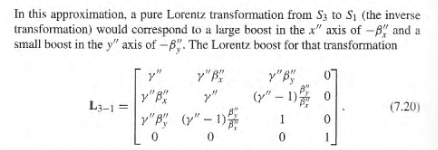
I am reproducing the steps to derive the expression for the Thomas precession, as described in Goldstein/Poole/Safko "Classical Mechanics". Hereafter an excerpt from the book describing the step I am currently working on.
Screenshot from 2022-08-30 10-18-29.png

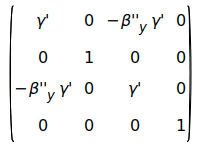
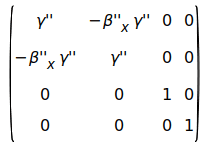
Based on the text, the transformation S_3 -> S_1 should be the composition of a boost on the x" axis
1661847678210.png

and a boost on the y" axis

1661848318941.png

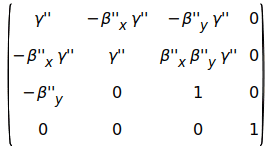
which, when composed assuming γ'=1, yield
1661848394308.png
.
The differences with (7.20) are:
  1. the '-' sign in elements [1,2], [2,2], [2,1], [3,1]
  2. the '0' in position [3,2]
  3. the element in position [2,3], which can be approximated as (dropping the " for readability):
    βxβyγ = γ(βyxx2 ≈ γ(βyx2 = γ(βyx)(1-1/γ2) = (γ-1/γ)βyx. Close, but not identical.
Can anybody help me understand?

Thanks,

Francesco
 
Physics news on Phys.org
vanhees71 said:
The Thomas precession is hard to calculate. Here's my attempt (Sect. 1.8):

https://itp.uni-frankfurt.de/~hees/pf-faq/srt.pdf
Hi vanhees71,
thanks for your answer! I am not familiar enough with Lie algebra to follow your exposition. But I understand I will need to learn the mathematical tools you are using if I want to dig deeper.
 
  • Like
Likes   Reactions: vanhees71
I think you don't need much more about Lie algebra than what's in this manuscript.
 
vanhees71 said:
I think you don't need more about Lie algebra than what's in this manuscript to understand Fermi-Walker transport and thus the Thomas precession.
 
Not to sound like a wise guy, but I've always thought the treatment of J.D. Jackson (I have a translation of the 1975 edition) to be the best: lucid and straight to the point.
 
  • Like
Likes   Reactions: vanhees71
Hi dextercioby, thanks for the pointer! In fact, the Thomas precession is discussed in section 11.8 of the second edition of Jackson's, though it requires reading the previous section on infinitesimal transformations.

As an update: I fixed all the issues except the '0' element in position [3,2]. That looks very strange: that element is certainly zero!
 
Just an idea: to first order in β, γ"-1 ≈ 0. It can replace 0 in position [3,2]...
 

Similar threads

  • · Replies 1 ·
Replies
1
Views
2K
  • · Replies 2 ·
Replies
2
Views
2K
  • · Replies 2 ·
Replies
2
Views
3K