Concentric Metal Sphere - Gauss's Law

Click For Summary

Homework Help Overview

The discussion revolves around a problem involving concentric metal spheres, specifically focusing on the effects of grounding and charge distribution. The original poster presents questions regarding the induced charges on a grounded shell due to inner and outer charged spheres, as well as the distribution of these charges on the shell's surfaces.

Discussion Character

  • Exploratory, Conceptual clarification, Assumption checking

Approaches and Questions Raised

  • Participants explore the implications of grounding on charge distribution, questioning how grounding affects the net charge and electric fields between the spheres. Some suggest considering the effects of removing the outer shell and grounding, while others discuss the arrangement of charges in response to electric fields.

Discussion Status

The discussion is active, with various interpretations being explored regarding the effects of grounding and charge interactions. Some participants offer insights into the nature of electric fields within and around the spheres, while others express confusion about the grounding effect and its implications for charge distribution.

Contextual Notes

Participants are grappling with assumptions about grounding, charge neutrality, and the behavior of electric fields in the context of the problem. There is an ongoing examination of how these factors influence the overall charge distribution and electric field dynamics.

fonz
Messages
151
Reaction score
5
1. Please see the attached problem, essentially a metal ball with charge Q1 is surrounded by a grounded shell q which in turn is surrounded by a further shell with charge Q2

Q1. The first question is what is the charge induced on q by Q1 and Q2
Q2. The second question is how is the charge distributed between the inner and outer surfaces of q
[/b]


2. None


3. My problem is I am not sure what the effect of grounding is. From the information given I have assumed the following:

qinner = Q2-Q1
qouter = Q1-Q2
qnet = qinner+qouter=Q2-Q1+Q1-Q2=0

This I believe would apply to an ungrounded shell so what is the effect of grounding if the net effect = 0?
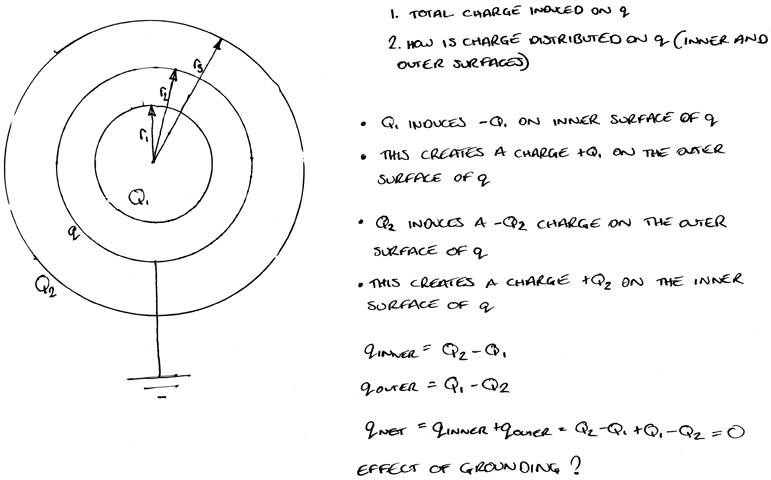
200v2vc.jpg
 
Physics news on Phys.org
What is the field inside a charged sphere?
From that, what is the contribution due to the outer sphere?

Thus, what is the electric field on the the center sphere like?
How would the charges in the middle sphere arrange themselves to that field?
 
Eliminate the outer spherical shell. Remove the ground. Place a charge Q on the inner shell's outer surface then a charge -Q will form on the inner surface of the outer shell and a charge Q will be induced on the outer surface of the outer shell? Now ground the outer shell and all that changes is the positive charge Q will be drained off the outer shell while the charge -Q remains on the inner surface of the outer shell and the charge Q remains on the outer surface of the inner shell? Now add the outer shell and nothing changes?

Hope this helps.
 
Simon Bridge said:
What is the field inside a charged sphere?
From that, what is the contribution due to the outer sphere?

Thus, what is the electric field on the the center sphere like?
How would the charges in the middle sphere arrange themselves to that field?

My understanding is this,

Inside a charged sphere the field E=Q/ε04∏r2 i.e. the net flux through any closed surface is equal to the net enclosed charge - Gauss's Law - rearranged to solve for E
The contribution due to the outer sphere is essentially the same but the outer and inner polarities are reversed (because the outer sphere is outside?)

The electric field on the centre sphere is 0 as it is assumed to be in equilibrium
The -ve charges in the middle sphere are attracted to both the positive of the inner sphere and positive of the outer sphere (see my original solution).

I'm not sure where you're going with the first three questions but essentially the last question I have attempted to answer in my original working. Essentially what I don't understand is that the ground can supply charge to balance out the effect of the two charged objects surrounding the inner sphere so the -Q's on each side are sunk to Earth while the +Q's are provided with electrons, thus the net charge distribution = 0 OR are only the +Q's provided with electrons and the -Q's remain on the surfaces leaving -Q1 on the outer sphere and -Q2 on the inner sphere.

Hope you can see where I am confused, thanks for your input

Spinnor said:
Eliminate the outer spherical shell. Remove the ground. Place a charge Q on the inner shell's outer surface then a charge -Q will form on the inner surface of the outer shell and a charge Q will be induced on the outer surface of the outer shell? Now ground the outer shell and all that changes is the positive charge Q will be drained off the outer shell while the charge -Q remains on the inner surface of the outer shell and the charge Q remains on the outer surface of the inner shell? Now add the outer shell and nothing changes?

Hope this helps.

If the outer shell is charged then the same effect will happen will it not? so this time a -Q will form on the outer surface (shown in original working) and Q will form on the inner surface i.e. it is the other way around because this time the charge is outside the sphere.

Thanks
 
Just a sec... Because the inner metal ball induces a charge +Q on the outer surface of the middle sphere and this is negated due to grounding, are you saying there is no electric field between the middle sphere and outer sphere thus no potential difference is created?

i.e. qinner = -Q1
qouter = 0

Thanks again
Dan
 
Last edited:
fonz said:
Just a sec... Because the inner metal ball induces a charge +Q on the outer surface of the middle sphere and this is negated due to grounding, are you saying there is no electric field between the middle sphere and outer sphere thus no potential difference is created?

i.e. qinner = -Q1
qouter = 0

Thanks again
Dan
I don't know if he's saying that or not, but yes, it's true that there is zero electric field between the grounded sphere and the outer sphere.
 
Inside a charged sphere the field E=Q/ε04∏r2 i.e. the net flux through any closed surface is equal to the net enclosed charge - Gauss's Law - rearranged to solve for E The contribution due to the outer sphere is essentially the same but the outer and inner polarities are reversed (because the outer sphere is outside?)
The electric field inside a spherical shell of uniform charge distribution is zero. By Gauss' Law: there is zero charge inside the shell.
Just a sec... Because the inner metal ball induces a charge +Q on the outer surface of the middle sphere and this is negated due to grounding, are you saying there is no electric field between the middle sphere and outer sphere thus no potential difference is created?
I hadn't got that far yet :)

Q1(part): what is the charge induced on q by Q2?

By the superposition principle, you can take each field (of the two charged sphere's) separately: therefore, the only field you need to account for is that of the inner sphere.

How would this affect the charges in the middle sphere, if it were not grounded?
eg. Faraday's "ice bucket" experiment.

Then consider what effect grounding has on the situation.

[edit]
re-reading your answer sheet from post #1... the effect of grounding is where you are confused.
Consider a related experiment:

Charged object A is brought close to one side of neutral conductor B, glued to an insulated surface so it cannot move.
The opposite side of B is briefly grounded, then A is removed to a far location.
The charge on B is measured - what do we find and why?
 
Last edited:
Simon Bridge said:
The electric field inside a spherical shell of uniform charge distribution is zero. By Gauss' Law: there is zero charge inside the shell.
I hadn't got that far yet :)

Q1(part): what is the charge induced on q by Q2?

By the superposition principle, you can take each field (of the two charged sphere's) separately: therefore, the only field you need to account for is that of the inner sphere.

How would this affect the charges in the middle sphere, if it were not grounded?
eg. Faraday's "ice bucket" experiment.

Then consider what effect grounding has on the situation.

[edit]
re-reading your answer sheet from post #1... the effect of grounding is where you are confused.
Consider a related experiment:

Charged object A is brought close to one side of neutral conductor B, glued to an insulated surface so it cannot move.
The opposite side of B is briefly grounded, then A is removed to a far location.
The charge on B is measured - what do we find and why?

The charge on B would be equal to the charge of A but opposite sign since the grounding will provide electrons to the excess positive charge.

I can see where I was going wrong on my original answer however I now believe this is the solution

qinner = -Q1
qouter = -Q2

qnet = qinner + qouter = -Q1 - Q2

Therefore a field will still exist between q and Q2 because Q2 is positively charged and the outer surface of q will be neutral thus inducing a -Q2 on the outer surface of q

Thanks again
 
Surely by that reasoning q(inner)=-Q1 and q(outer)=0 leaving a net charge on the middle sphere of -Q1?

How did the -Q2 get there?
The field due to the Q2 distribution anywhere inside it's radius is zero!
 
  • #10
Simon Bridge said:
Surely by that reasoning q(inner)=-Q1 and q(outer)=0 leaving a net charge on the middle sphere of -Q1?

How did the -Q2 get there?
The field due to the Q2 distribution anywhere inside it's radius is zero!

I can't see how if Q2 is charged why a field will not exist inside it's radius that will be attracted to the middle sphere.
 
  • #11
I can't see how if Q2 is charged why a field will not exist inside it's radius that will be attracted to the middle sphere.
Neither could Faraday (at first) - but he failed to detect one in experiments. It's the principle on which Faraday cages are built. Gauss' law shows you why not.
In the problem - the center sphere is inside a Faraday cage.
 
  • #12
Simon Bridge said:
Neither could Faraday (at first) - but he failed to detect one in experiments. It's the principle on which Faraday cages are built. Gauss' law shows you why not.
In the problem - the center sphere is inside a Faraday cage.

Of course! thanks for your help and patience.

Regards
Dan
 
  • #13
No worries - I'm amazed there are people still doing problems through December.
 

Similar threads

  • · Replies 3 ·
Replies
3
Views
2K
  • · Replies 1 ·
Replies
1
Views
2K
  • · Replies 3 ·
Replies
3
Views
1K
  • · Replies 3 ·
Replies
3
Views
2K
  • · Replies 1 ·
Replies
1
Views
2K
  • · Replies 5 ·
Replies
5
Views
719
  • · Replies 7 ·
Replies
7
Views
1K
  • · Replies 7 ·
Replies
7
Views
10K
  • · Replies 18 ·
Replies
18
Views
2K
Replies
5
Views
873