Confused about proof of "sin(θ + Φ) = cosθsinΦ + sinθcosΦ"

Click For Summary

Homework Help Overview

The discussion revolves around the proof of the trigonometric identity sin(θ + Φ) = cosθsinΦ + sinθcosΦ, as presented in a textbook. Participants are examining the geometric reasoning behind the proof, particularly focusing on the relationships between angles and the similarity of triangles involved in the proof.

Discussion Character

  • Exploratory, Conceptual clarification, Assumption checking

Approaches and Questions Raised

  • Participants are questioning how certain angles are determined, specifically the measure of angle TPR and the similarity between triangles TPR and ROQ. There is also a discussion about the angles in triangle ROS and their implications for the proof.

Discussion Status

Some participants are beginning to clarify their understanding of the angles involved and the relationships between the triangles. There is an acknowledgment of the geometric reasoning, but no consensus has been reached on all aspects of the proof.

Contextual Notes

Participants note assumptions about right angles and the relationships between angles in the triangles, indicating that the proof relies heavily on geometric properties and definitions that may not be explicitly stated in the textbook.

JS-Student
Messages
10
Reaction score
0
Hi,
This is also a sort of geometry question.
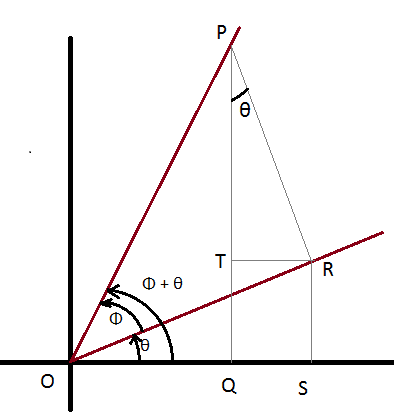
My textbook gives a proof of the relation: sin(θ + Φ) = cosθsinΦ + sinθcosΦ.
It uses a diagram to do so:
upload_2015-10-27_17-22-21.png

http://imgur.com/gLnE2Fn

sin (θ + Φ) = PQ/(OP)
= (PT + RS)/(OP)
= PT/(OP) + RS/(OP)
= PT/(PR) * PR/(OP) + RS/(OR) * OR/(OP)
= cosθsinΦ + sinθcosΦ

My confusion with this is
How do they know that angle TPR also measures θ?
How do they know that triangle TPR is similar to triangle ROQ?


Thanks

The textbook is: Calculus with Analytic Geometry, 2e by George F. Simmons
 
Physics news on Phys.org
Hey,

I think I kind of figured it out, angle ros = theta, angle ors = 90 -θ

the angle between the TR and the brown line is theta, the angle between PR and the brown line is 90degrees right so angle PRT is 90 - theta and so TPR is theta I've attached a diagram because I feel like these words aren't making sense. Is the diagram clear?

They are similar triangles because they have the same angles.
 

Attachments

  • Screen Shot 2015-10-27 at 21.50.17.png
    Screen Shot 2015-10-27 at 21.50.17.png
    5.7 KB · Views: 611
  • Like
Likes   Reactions: JS-Student
JS-Student said:
Hi,
This is also a sort of geometry question.
My textbook gives a proof of the relation: sin(θ + Φ) = cosθsinΦ + sinθcosΦ.
It uses a diagram to do so:
View attachment 90905
http://imgur.com/gLnE2Fn

sin (θ + Φ) = PQ/(OP)
= (PT + RS)/(OP)
= PT/(OP) + RS/(OP)
= PT/(PR) * PR/(OP) + RS/(OR) * OR/(OP)
= cosθsinΦ + sinθcosΦ

My confusion with this is
How do they know that angle TPR also measures θ?
How do they know that triangle TPR is similar to triangle ROQ?


Thanks

The textbook is: Calculus with Analytic Geometry, 2e by George F. Simmons
They use geometry.

I assume they intend for ∠ORP to be a right angle.

∠RTO measures θ. ∠TRP measures 90° - θ . etc.

(I assume you meant ΔROS, not ΔROQ .)
As for ΔTPR and ΔROS, they're both right triangles each having an acute angle with the same measure, namely θ.
 
  • Like
Likes   Reactions: JS-Student
thegirl said:
Hey,

I think I kind of figured it out, angle ros = theta, angle ors = 90 -θ

the angle between the TR and the brown line is theta, the angle between PR and the brown line is 90degrees right so angle PRT is 90 - theta and so TPR is theta I've attached a diagram because I feel like these words aren't making sense. Is the diagram clear?

They are similar triangles because they have the same angles.
Oh, wow thanks. It makes sense now. Thanks especially for taking the time to upload a picture.
 

Similar threads

Replies
8
Views
2K