Connection between Euler's four-square identity and Maxwell's equations

6 replies · 2K views · last reply
Edgar53
Messages
3
Reaction score
0
The 4-Squares-Identity of Leonhard Euler
(https://en.wikipedia.org/wiki/Euler%27s_four-square_identity) :


Equation: (a1^2 + a2^2 + a3^2 + a4^2)(b1^2 + b2^2 + b3^2 + b4^2) =

Partial formula beginning (a1 b1 − a2 b2 − a3 b3 − a4 b4)² + followed by a plus sign, the start of Euler's four-square identity.

Partial formula beginning (a1b2 + a2b1 + a3b4 - a4b3)^2 + followed by a plus sign, the opening of Euler's four-square identity.

Fragment of an equation showing the start of Euler's four-square identity: (a1 b3 − a2 b4 + a3 b1 + a4 b2)² +

Equation: (a1 b4 + a2 b3 - a3 b2 - a4 b1)^2, a quaternion-style bilinear combination of a1 to a4 and b1 to b4 squared.


has the numeric structure of Maxwell’s equations in 4-space:

Covariant wave equation for the four-potential A: the d'Alembert operator (1/c² ∂²/∂t² − ∂²/∂x₁² − ∂²/∂x₂² − ∂²/∂x₃²) applied to A equals μ₀J.

Four-current density vector J = (ρc, J1, J2, J3), written in italic symbols with the time component ρc first and the three spatial components J1, J2, J3 following.

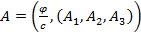
Equation A = (φ/c, (A1, A2, A3)), a four-component vector potential with scalar part φ/c and spatial part (A1, A2, A3).

Is somebody aware of litterature about this?
 
Attachments
  • Equation: (a1^2 + a2^2 + a3^2 + a4^2)(b1^2 + b2^2 + b3^2 + b4^2) =
    upload_2017-11-19_23-4-30.jpg
    2.4 KB · Views: 892
  • Partial formula beginning (a1b2 + a2b1 + a3b4 - a4b3)^2 + followed by a plus sign, the opening of Euler's four-square identity.
    upload_2017-11-19_23-4-30.jpg
    1.7 KB · Views: 915
  • Partial formula beginning (a1 b1 − a2 b2 − a3 b3 − a4 b4)² + followed by a plus sign, the start of Euler's four-square identity.
    upload_2017-11-19_23-4-30.jpg
    1.6 KB · Views: 963
  • Equation: (a1 b4 + a2 b3 - a3 b2 - a4 b1)^2, a quaternion-style bilinear combination of a1 to a4 and b1 to b4 squared.
    upload_2017-11-19_23-4-30.jpg
    1.7 KB · Views: 450
  • Fragment of an equation showing the start of Euler's four-square identity: (a1 b3 − a2 b4 + a3 b1 + a4 b2)² +
    upload_2017-11-19_23-4-30.jpg
    1.7 KB · Views: 516
  • Covariant wave equation for the four-potential A: the d'Alembert operator (1/c² ∂²/∂t² − ∂²/∂x₁² − ∂²/∂x₂² − ∂²/∂x₃²) applied to A equals μ₀J.
    upload_2017-11-19_23-5-23.png
    1,018 bytes · Views: 503
  • Equation A = (φ/c, (A1, A2, A3)), a four-component vector potential with scalar part φ/c and spatial part (A1, A2, A3).
    upload_2017-11-19_23-6-41.png
    660 bytes · Views: 487
  • Four-current density vector J = (ρc, J1, J2, J3), written in italic symbols with the time component ρc first and the three spatial components J1, J2, J3 following.
    upload_2017-11-19_23-7-31.png
    553 bytes · Views: 483
Edgar53 said:
has the numeric structure of Maxwell’s equations in 4-space:

It appears not to.
 
If you adjust the signs: Euler = (+,+,+,+) and Minkowski = (+, - , - , - ) in your notation, why should there be a difference? Not sure about the Maxwell equations, but the other one is just a formula. Both have symmetries and both are four dimensional, so similarities can be expected, which happens quite often in science without any deeper correlations.
 
Edgar53 said:
has the numeric structure of Maxwell’s equations in 4-space
I am with @Vanadium 50 on this. It doesn’t seem to have the same structure to me. One is a scalar equation and the other is a vector equation.
 
Of course, it has much to do:

Leonhard Euler's four-squares identity prefigures quaternion multiplication:
Product of two quaternions written as (a0 + i a1 + j a2 + k a3) * (b0 + i b1 + j b2 + k b3) =, with the right-hand side not shown.

Mathematical expression beginning (a0b0 - a1b1 - a2b2 - a3b3) +, the first term of Euler's four-square identity product expansion, partly cut off at the right edge.

Single line of mathematics: i(a0b1 + a1b0 + a2b3 - a3b2) +

Single line of mathematics: j(a0b2 − a1b3 + a2b0 + a3b1) +

Equation k(a0b3 + a1b2 - a2b1 + a3b0) written in plain text, a single line showing a product of coefficients a and b with indices 0 to 3.

It is the very reason why quaternions have a multiplicative norm, i.e. the length
of a product of two quaternions equals the product of the lengths of the
quaternions. Multiplication with a unit quaternion performs an isoclinic
double-rotation in 4-dimensional space; multiplication with an arbitrary
quaternion a double-rotation plus a stretching by the length of the quaternion.

Taking the quaternion differential
upload_2017-12-4_22-5-30.png
of the 4-potential A yields directly
the electromagnetic field in both components E and B:
Quaternion product expression: (∂0, i∂1, j∂2, k∂3) * (A0, iA1, jA2, kA3) =, with the terms written as a row of components.

Equation: ((δ0A0 − δ1A1 − δ2A2 − δ3A3), followed by an imaginary-unit term, shown in a quaternion-style expression.

Equation i(δ0A1 + δ1A0 + δ2A3 − δ3A2): a single line of mathematics with i times a bracketed sum of four products, each a partial derivative δ times a 4-potential component A.

j
Mathematical expression: (δ0A2 − δ1A3 + δ2A0 − δ3A1), a combination of partial derivatives of components of a 4-potential A.

k
Equation: δ0A3 + δ1A2 − δ2A1 + δ3A0 = (an expression whose right-hand side is cut off in the image)

after rearranging the terms in lines 2, 3, and 4:
Handwritten-style expression with a double bracket containing a sum of four products, each a delta-subscript-zero times A-subscript-zero term, minus terms of the form delta-one A-one, delta-two A-two, delta-three A-three.

i
Equation: (δ0A1 + δ1A0 + δ2A3 - δ3A2) with indices as shown, a quaternion-style combination of 4-potential derivatives.

j
Mathematical expression: δ0A2 + δ2A0 − δ1A3 + δ3A1 = 0, written as a quaternion-style combination of 4-potential components A0 to A3 with partial derivatives δ0 to δ3.

k
Equation: (δ0A3 + δ3A0 + δ1A2 − δ2A1) with partial derivative operators on the 4-potential components A0 to A3.

The first line identically vanishes under Lorenz gauge
Equation: ∂_α A^α = 0, the Lorenz gauge condition written with a partial derivative and the four-potential.
;
The terms:
Equation: (δ0Ai + δiA0) - (1/c)(δ/δt)Ai + (δ/δxi)(φ/c) = Ei, with the symbols as printed.

are the components of the electric field (under inversion of sign, due to
the Minkowski metric (+1,-1,-1,-1));
and the terms:
Mathematical expression: (δ2A3 − δ3A2), with the subscripts and superscripts shown as small indices on the δ and A symbols.
;
Mathematical expression: minus delta-1 A3 plus delta-3 A1, with subscripts and a minus sign at the start.
;
Handwritten-style expression: the difference of two terms, delta-1 A-2 minus delta-2 A-1, shown as a single line of mathematics.
are
Equation: B = ∇ × A, with B on the left and the curl of the vector potential A on the right.

are the components of the magnetic field.
The result is then:
Equation: dA = i(E1/c + B1) + j(E2/c + B2) + k(E3/c + B3), a quaternion expression combining electric field components divided by c with magnetic field components.

i.e. the quaternion differential of the 4-potential A yields both,
the source (E) and the curl (B) part of the electromagnetic
field.
Leonhard Euler's four-square identity offers the most direct access to,
and is probably the reason for Electrodynamics!
 
Attachments
  • Mathematical expression beginning (a0b0 - a1b1 - a2b2 - a3b3) +, the first term of Euler's four-square identity product expansion, partly cut off at the right edge.
    upload_2017-12-4_21-55-41.png
    594 bytes · Views: 425
  • Single line of mathematics: j(a0b2 − a1b3 + a2b0 + a3b1) +
    upload_2017-12-4_21-55-41.png
    684 bytes · Views: 425
  • Single line of mathematics: i(a0b1 + a1b0 + a2b3 - a3b2) +
    upload_2017-12-4_21-55-41.png
    655 bytes · Views: 397
  • Equation k(a0b3 + a1b2 - a2b1 + a3b0) written in plain text, a single line showing a product of coefficients a and b with indices 0 to 3.
    upload_2017-12-4_21-55-41.png
    689 bytes · Views: 437
  • Product of two quaternions written as (a0 + i a1 + j a2 + k a3) * (b0 + i b1 + j b2 + k b3) =, with the right-hand side not shown.
    upload_2017-12-4_22-1-12.png
    870 bytes · Views: 404
  • upload_2017-12-4_22-5-30.png
    upload_2017-12-4_22-5-30.png
    205 bytes · Views: 409
  • Equation: δ0A3 + δ1A2 − δ2A1 + δ3A0 = (an expression whose right-hand side is cut off in the image)
    upload_2017-12-4_22-12-50.png
    674 bytes · Views: 424
  • Mathematical expression: (δ0A2 − δ1A3 + δ2A0 − δ3A1), a combination of partial derivatives of components of a 4-potential A.
    upload_2017-12-4_22-12-50.png
    638 bytes · Views: 425
  • Equation i(δ0A1 + δ1A0 + δ2A3 − δ3A2): a single line of mathematics with i times a bracketed sum of four products, each a partial derivative δ times a 4-potential component A.
    upload_2017-12-4_22-12-50.png
    665 bytes · Views: 427
  • Quaternion product expression: (∂0, i∂1, j∂2, k∂3) * (A0, iA1, jA2, kA3) =, with the terms written as a row of components.
    upload_2017-12-4_22-12-50.png
    914 bytes · Views: 435
  • Equation: ((δ0A0 − δ1A1 − δ2A2 − δ3A3), followed by an imaginary-unit term, shown in a quaternion-style expression.
    upload_2017-12-4_22-12-50.png
    640 bytes · Views: 434
  • Handwritten-style expression with a double bracket containing a sum of four products, each a delta-subscript-zero times A-subscript-zero term, minus terms of the form delta-one A-one, delta-two A-two, delta-three A-three.
    upload_2017-12-4_22-14-20.png
    640 bytes · Views: 392
  • Equation: (δ0A1 + δ1A0 + δ2A3 - δ3A2) with indices as shown, a quaternion-style combination of 4-potential derivatives.
    upload_2017-12-4_22-14-20.png
    652 bytes · Views: 381
  • Mathematical expression: δ0A2 + δ2A0 − δ1A3 + δ3A1 = 0, written as a quaternion-style combination of 4-potential components A0 to A3 with partial derivatives δ0 to δ3.
    upload_2017-12-4_22-14-20.png
    635 bytes · Views: 422
  • Equation: (δ0A3 + δ3A0 + δ1A2 − δ2A1) with partial derivative operators on the 4-potential components A0 to A3.
    upload_2017-12-4_22-14-20.png
    668 bytes · Views: 395
  • Equation: ∂_α A^α = 0, the Lorenz gauge condition written with a partial derivative and the four-potential.
    upload_2017-12-4_22-15-55.png
    451 bytes · Views: 388
  • Equation: (δ0Ai + δiA0) = (1/c)(δ/δt)Ai + (δ/δxi)(φ/c), with terms for the time and spatial derivatives of the four-potential.
    upload_2017-12-4_22-17-7.png
    996 bytes · Views: 432
  • Mathematical expression: minus delta-1 A3 plus delta-3 A1, with subscripts and a minus sign at the start.
    upload_2017-12-4_22-18-37.png
    494 bytes · Views: 392
  • Mathematical expression: (δ2A3 − δ3A2), with the subscripts and superscripts shown as small indices on the δ and A symbols.
    upload_2017-12-4_22-18-37.png
    509 bytes · Views: 375
  • Handwritten-style expression: the difference of two terms, delta-1 A-2 minus delta-2 A-1, shown as a single line of mathematics.
    upload_2017-12-4_22-18-37.png
    502 bytes · Views: 407
  • Equation: B = ∇ × A, with B on the left and the curl of the vector potential A on the right.
    upload_2017-12-4_22-20-29.png
    422 bytes · Views: 383
  • Equation: (δ0Ai + δiA0) - (1/c)(δ/δt)Ai + (δ/δxi)(φ/c) = Ei, with the symbols as printed.
    upload_2017-12-4_22-22-5.png
    1 KB · Views: 437
  • Equation: dA = i(E1/c + B1) + j(E2/c + B2) + k(E3/c + B3), a quaternion expression combining electric field components divided by c with magnetic field components.
    upload_2017-12-4_22-25-5.png
    975 bytes · Views: 422
Edgar53 said:
Leonhard Euler's four-squares identity prefigures quaternion multiplication

The four squares identity has squares inside the parentheses on the LHS. The quaternion multiplication equation you wrote down does not. So I don't see how your claim here is justified.