Corollary to Correspondence Theorem for Modules

  • Context: Graduate 
  • Thread starter Thread starter Math Amateur
  • Start date Start date
  • Tags Tags
    Modules Theorem
Math Amateur
Gold Member
MHB
Messages
3,920
Reaction score
48
I am reading Joseph J. Rotman's book: Advanced Modern Algebra and I am currently focused on Section 6.1 Modules ...

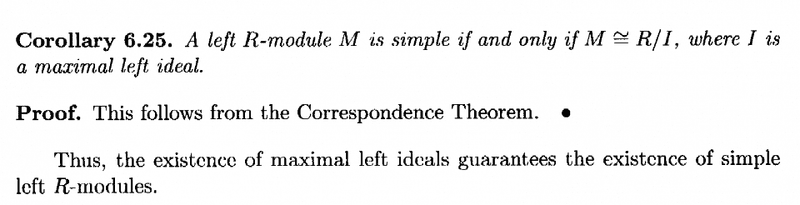
I need some help with the proof of Corollary 6.25 ... Corollary to Theorem 6.22 (Correspondence Theorem) ... ...

Corollary 6.25 and its proof read as follows:
?temp_hash=3e7e3658af5514dc0972081c2217eed4.png
Can someone explain to me exactly how Corollary 6.25 follows from the Correspondence Theorem for Modules ...?

Hope that someone can help ...

Peter=============================================

*** EDIT ***

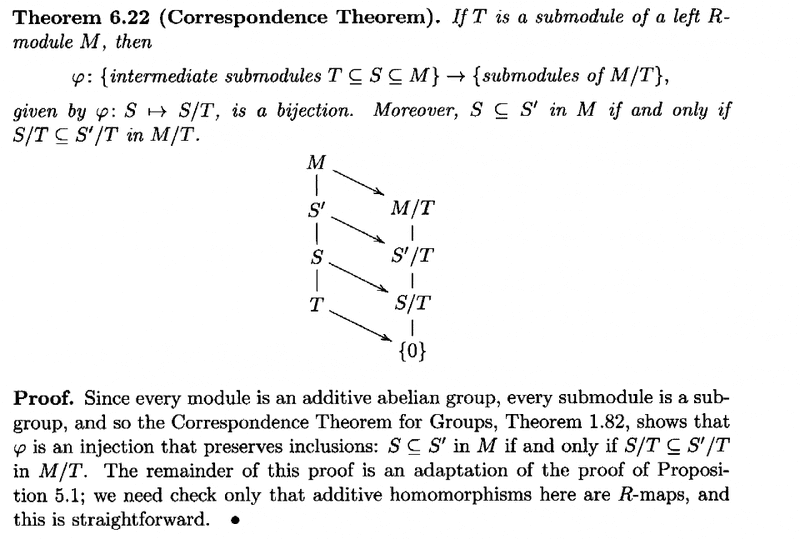
The above post refers to the Correspondence Theorem for Modules (Theorem 6.22 in Rotman's Advanced Modern Algebra) ... so I am proving the text of the Theorem from Rotman's Advanced Modern Algebra as follows:
?temp_hash=3e7e3658af5514dc0972081c2217eed4.png
 

Attachments

  • Rotman - AMA - Corollary 6.25    ....png
    Rotman - AMA - Corollary 6.25 ....png
    34.5 KB · Views: 827
  • Rotman - Theorem 6.22.png
    Rotman - Theorem 6.22.png
    40.1 KB · Views: 1,394
Physics news on Phys.org
If I is a maximal ideal of R and M := R / I then a submodule of M is of the form S / I with I ⊆ S ⊆ R (6.22). The module property makes S an ideal of R. So either S = I, i.e. S / I = 0, or S = R, i.e. S / I = M, which means M is simple. On the other hand, if M is a simple R left module then we can pick an element m ∈ M, m ≠ 0. Then φ : R → M with φ(r) := r.m defines a ring homomorphism. φ cannot be 0, because otherwise {m} would be a non-zero submodule of M. (We suppose that either R has a 1 and 1.m = m or more generally require that R doesn't operate trivially on M, i.e. R.M may not be {0}.) Since I am φ is a non-zero submodule of M and M is simple, φ has to be surjective (im φ = M) with kernel I:= ker φ.
Therefore R / I = R / ker φ ≅ I am φ = M.
According to Theorem 6.22 the absence of submodules of M ≅ R / I implies the absence of ideals in R containing I, i.e. I is a maximal left ideal.
 
Last edited:
  • Like
Likes   Reactions: Math Amateur
Thanks so much for your analysis Fresh 42 ... most helpful ...

Peter
 

Similar threads

  • · Replies 1 ·
Replies
1
Views
2K
  • · Replies 1 ·
Replies
1
Views
3K
Replies
4
Views
2K
  • · Replies 2 ·
Replies
2
Views
1K
Replies
9
Views
2K
  • · Replies 3 ·
Replies
3
Views
6K
  • · Replies 3 ·
Replies
3
Views
2K
Replies
2
Views
2K
  • · Replies 5 ·
Replies
5
Views
2K
  • · Replies 6 ·
Replies
6
Views
2K