Correspondence Theorem for Groups .... Rotman, Propn 1.82 ....

  • Context: Undergrad 
  • Thread starter Thread starter Math Amateur
  • Start date Start date
  • Tags Tags
    Groups Theorem
Click For Summary

Discussion Overview

The discussion revolves around the proof of Proposition 1.82 from Joseph J. Rotman's "Advanced Modern Algebra," specifically focusing on the Correspondence Theorem for groups. Participants seek clarification on the implications of certain steps in the proof, particularly regarding the kernel of a homomorphism and the mapping of elements in relation to cosets.

Discussion Character

  • Technical explanation
  • Conceptual clarification
  • Debate/contested

Main Points Raised

  • Peter questions how the statement ##\pi(a) = \pi(s)## leads to the conclusion that ##as^{-1} \in \text{ker } \pi = K##.
  • Some participants explain that since ##\pi## is a homomorphism, the equality ##\pi(a) = \pi(s)## implies ##\pi(as^{-1}) = e##, thus indicating that ##as^{-1}## is in the kernel of ##\pi##.
  • Peter proposes a logical sequence leading to the conclusion that ##as^{-1} \in K##, but expresses uncertainty about its legitimacy compared to Rotman's reasoning.
  • There is a discussion about which elements map to the identity coset ##e_{G/K} = e_{G} K##, with Peter suggesting that all elements of the normal subgroup ##K## map to this coset.
  • Another participant confirms Peter's assertion regarding the elements mapping to the identity coset.

Areas of Agreement / Disagreement

Participants generally agree on the implications of the homomorphism and the mapping of elements to the kernel, but there is some uncertainty regarding the specific logical steps in Rotman's proof and how they align with Peter's reasoning.

Contextual Notes

Participants express varying levels of confidence in their interpretations of the proof, indicating potential gaps in understanding the logical flow of the argument as presented by Rotman.

Math Amateur
Gold Member
MHB
Messages
3,920
Reaction score
48
I am reading the book: "Advanced Modern Algebra" (Second Edition) by Joseph J. Rotman ...

I am currently focused on Chapter 1: Groups I ...

I need help with an aspect of the proof of Proposition 1.82 (Correspondence Theorem) ...

Proposition 1.82 reads as follows:
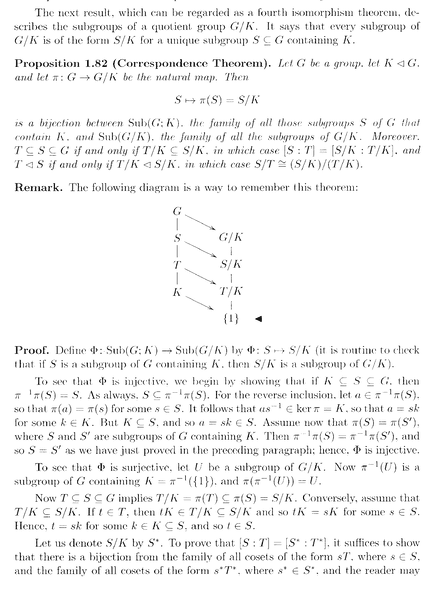
Rotman - 1 - Proposition 1.82 ... .png

Rotman - 2 - Proposition 1.82 ... .PART 2 .png

In the above proof by Rotman we read the following:

" ... ... For the reverse inclusion let ##a \in \pi^{-1} \pi (S)##, so that ##\pi (a) = \pi (s)## for some ##s \in S##. It follows that ##as^{-1} \in \text{ ker } \pi = K## ... ... "Can someone please explain exactly how/why ##\pi (a) = \pi (s)## implies that ##as^{-1} \in \text{ ker } \pi = K## ... ...?Peter

===========================================================================================***EDIT***

Just had some thoughts ... BUT ... unfortunately my logic does not seem to line up with Rotman's logic ...

My thoughts are as follows:

##\pi (a) = \pi (s)##

##\Longrightarrow aK = sK##

##\Longrightarrow a = sk## for some ##k \in K## since ##a## must belong to ##sK## ... ... (is this a legitimate step ...)

##\Longrightarrow s^{-1} a = k##

##\Longrightarrow as^{-1} = k##

##\Longrightarrow as^{-1} \in \text{ker } \pi = K##Is that correct?

BUT note ... logic is different from Rotman's set of steps ... ... what is Rotman's logic ...?Peter
 

Attachments

  • Rotman - 1 - Proposition 1.82 ... .png
    Rotman - 1 - Proposition 1.82 ... .png
    47.7 KB · Views: 500
  • Rotman - 2 - Proposition 1.82 ... .PART 2 .png
    Rotman - 2 - Proposition 1.82 ... .PART 2 .png
    13.6 KB · Views: 421
Last edited:
Physics news on Phys.org
##\operatorname{ker}\pi = \{a \in G\,\vert \,\pi(a)=[e] \in G/K\}## and ##[e] \in G/K## is the coset ##e\cdot K##. Important is that ##\pi## is a group homomorphism:
$$
\pi(a)=\pi(s) \Longrightarrow \pi(a)\cdot \pi(s)^{-1}=\pi(as^{-1})=[e] \in G/K \Longrightarrow as^{-1}\in \operatorname{ker}\pi
$$
by definition of the kernel. Now which elements of ##G## map to ##G/K \ni [e]= e\cdot K\,##?
 
  • Like
Likes   Reactions: Math Amateur
Hi fresh_42 ... thanks for the help ...

Which elements map to ##e_{G/K} = e_{G} K## ... ?

I think it is all the elements of the normal group ##K## ... Is that correct?

Peter
 
Math Amateur said:
Hi fresh_42 ... thanks for the help ...

Which elements map to ##e_{G/K} = e_{G} K## ... ?

I think it is all the elements of the normal group ##K## ... Is that correct?

Peter
Yes.
 
  • Like
Likes   Reactions: Math Amateur
The canonical map ##\pi## is a homomorphism (easy exercise). Hence, ##\pi(a) = \pi(s) \implies \pi(as^{-1}) = \pi(a)\pi(s)^{-1} = e \implies as^{-1} \in \ker \pi##
 
  • Like
Likes   Reactions: Math Amateur
Thanks Math_QED ... most helpful and clear ..

Peter
 

Similar threads

Replies
2
Views
2K
  • · Replies 5 ·
Replies
5
Views
2K
  • · Replies 2 ·
Replies
2
Views
1K
  • · Replies 8 ·
Replies
8
Views
3K
  • · Replies 1 ·
Replies
1
Views
3K
  • · Replies 3 ·
Replies
3
Views
6K
  • · Replies 3 ·
Replies
3
Views
2K
  • · Replies 2 ·
Replies
2
Views
4K
  • · Replies 1 ·
Replies
1
Views
2K
  • · Replies 7 ·
Replies
7
Views
4K
