Maximal Ideals and the Correspondence Theorem for Rings

  • Context: Undergrad 
  • Thread starter Thread starter Math Amateur
  • Start date Start date
  • Tags Tags
    Rings Theorem
Click For Summary

Discussion Overview

The discussion revolves around the Correspondence Theorem for Rings and its implications for maximal ideals, specifically in the context of Proposition 5.9 from Joseph J. Rotman's book, Advanced Modern Algebra. Participants are seeking clarity on how the theorem leads to the characterization of maximal ideals in terms of the ideals of the quotient ring.

Discussion Character

  • Technical explanation
  • Conceptual clarification
  • Debate/contested

Main Points Raised

  • Peter questions how the Correspondence Theorem implies that an ideal ##I## is maximal if and only if the quotient ring ##R/I## has no ideals other than ##(0)## and ##R/I## itself.
  • Peter reflects on the implications of maximality, suggesting that if ##I## is maximal, then the only ideals in ##R## containing ##I## are ##I## and ##R##.
  • Peter proposes that this leads to the conclusion that there are no ideals in ##R/I## except for ##R/I## itself, but expresses confusion regarding the existence of the ideal ##(0)##.
  • Another participant suggests that identifying ##I/I## with ##(0)## clarifies the situation, and discusses the implications of assuming an ideal ##\overline{J} = J + I## in ##R/I##.
  • There is an exploration of the relationship between the ideals of ##R/I## and the ideals of ##R## containing ##I##, emphasizing the bijection established by the Correspondence Theorem.

Areas of Agreement / Disagreement

Participants express uncertainty regarding the explanation of the ideal structure in ##R/I## and how it relates to the maximality of ##I##. There is no consensus reached on the clarity of these concepts, and the discussion remains unresolved.

Contextual Notes

Participants are navigating the implications of the Correspondence Theorem and the definitions of ideals, which may depend on specific interpretations and assumptions about the structure of rings and ideals.

Math Amateur
Gold Member
MHB
Messages
3,920
Reaction score
48
I am reading Joseph J. Rotman's book: Advanced Modern Algebra (AMA) and I am currently focused on Section 5.1 Prime Ideals and Maximal Ideals ...

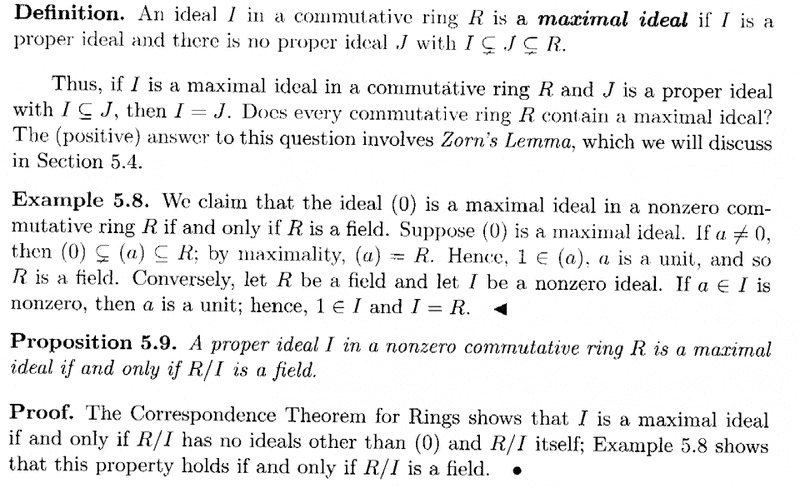
I need some help with understanding the proof of Proposition 5.9 ... ...Proposition 5.9 reads as follows:
?temp_hash=a8c6b30ae57a4ffe62159d453fb0011e.png
In the proof of Proposition 5.9, Rotman writes:

" ... ... The Correspondence Theorem for Rings shows that ##I## is a maximal ideal if and only if ##R/I## has no ideals other than ##(0)## and ##R/I## itself ... ... "

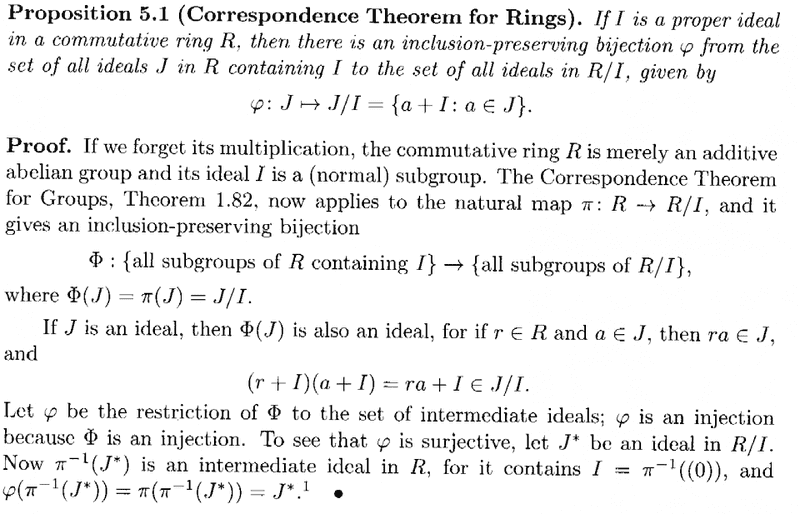
My question is: how exactly (in clear and simple terms) does Rotman's statement of the Correspondence Theorem for Rings lead to the statement that "##I## is a maximal ideal if and only if ##R/I## has no ideals other than ##(0)## and ##R/I## itself" ... ...

Hope that someone can help ...

Peter

============================================================

The above post refers to Rotman's statement of the Correspondence Theorem for Rings, so I am providing a statement of that theorem and its proof, as follows:

?temp_hash=a8c6b30ae57a4ffe62159d453fb0011e.png
 

Attachments

  • Rotman - AMA - Maximal Ideals and Proposition 5.9 ..   ....png
    Rotman - AMA - Maximal Ideals and Proposition 5.9 .. ....png
    52.2 KB · Views: 1,061
  • Rotman - AMA - Proposition 5.1    ... Correspondence Theorem for  Rings ... ... .png
    Rotman - AMA - Proposition 5.1 ... Correspondence Theorem for Rings ... ... .png
    48.4 KB · Views: 1,233
Physics news on Phys.org
Maybe I should not be responding to my own post but I have been reflecting on the question in the above post and now suspect that the answer is quite simple and goes along the lines ... ... as follows:

##I## maximal

##\Longrightarrow## there are no ideals in ##R## that contain ##I## except ##R## itself ...

##\Longrightarrow## there are no ideals in ##R/I## (except ##R/I##) since there exists a bijection between the set of ideals of ##R/I## and the ideals of ##R## containing ##I## ... ...

BUT ... it seems that the only ideal in ##R/I## is ##R/I## itself ... but how do we explain the existence of (0) ...

Seems that I still need some help ... ...

Peter
 
Math Amateur said:
I maximal

##\Longrightarrow## there are no ideals in ##R## that contain ##I## except ##R## itself ...
... and ##I##.

##\Longrightarrow## there are no ideals in ##R/I## (except ##R/I##
... and ##I/I##

) since there exists a bijection between the set of ideals of ##R/I## and the ideals of ##R## containing ##I## ... ...

BUT ... it seems that the only ideal in ##R/I## is ##R/I## itself ...
... and ##I/I##
but how do we explain the existence of (0) ...
We do by identifying ##I/I = (0)##.

You could also assume an ideal ##\overline{J}= J+I## in ##R/I##. Since ##\overline{0} = 0+I \in \overline{J}##, this means ##I \subseteq J## which means by maximality of ##I## that ##J \in \{I\,,\,R\}##.
And this holds the other way round, too.
 
Last edited:
  • Like
Likes   Reactions: Math Amateur
Thanks for the help fresh_42 ...

Just reflecting on what you have said ...

Peter
 

Similar threads

  • · Replies 3 ·
Replies
3
Views
2K
  • · Replies 3 ·
Replies
3
Views
2K
  • · Replies 31 ·
2
Replies
31
Views
3K
  • · Replies 4 ·
Replies
4
Views
2K
  • · Replies 7 ·
Replies
7
Views
4K
  • · Replies 2 ·
Replies
2
Views
2K
  • · Replies 5 ·
Replies
5
Views
2K
  • · Replies 1 ·
Replies
1
Views
3K
Replies
2
Views
1K
  • · Replies 4 ·
Replies
4
Views
2K