Correct definition of surface tension

Click For Summary
SUMMARY

Surface tension is defined as the energy required to increase the surface area of a liquid by a unit amount. This concept can be illustrated by manipulating the surface of a liquid, such as pulling a flat plane upward or downward, which effectively increases the surface area. The measurement of surface tension is expressed in terms of force per unit length (N/m), providing a clear physical perspective on the phenomenon. Understanding this definition clarifies the confusion surrounding the practical implications of surface area changes in liquids.

PREREQUISITES
  • Basic understanding of physics principles related to liquids
  • Familiarity with the concept of energy in physical systems
  • Knowledge of measurement units, specifically Newtons per meter (N/m)
  • Experience with diagrams illustrating physical concepts
NEXT STEPS
  • Research the methods for measuring surface tension in liquids
  • Explore the effects of temperature on surface tension
  • Learn about the applications of surface tension in real-world scenarios, such as in detergents
  • Investigate the relationship between surface tension and molecular interactions in liquids
USEFUL FOR

Students of physics, educators explaining fluid dynamics, and researchers studying liquid properties will benefit from this discussion on surface tension.

mcfaker
Messages
43
Reaction score
0
Hi,

I have a question, because I am confused with the definition of surface tension.
In my book it is defined as follows:
"Surface tension is the energy required to increase the surface area of a liquid
by a unit amount"


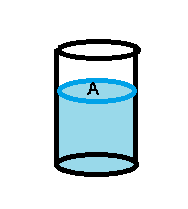
What do they mean with increasing the surface area, how do you do that? If I take a glass with water it will look like this:
4fe8941a4cfed29c937e22f848dc410f.png


I don't think there is any possible way to increase A. Can someone please help me out?

Thanks in advance!
 
Physics news on Phys.org
(A) in your diagram is a flat plane basically. Its surface area can be increased by pulling it upward or downward in the middle for example.

The definition in your book is a little confusing because it is from a physics perspective and that is how surface tension is measured; force/length (N/m)

350px-Surface_Tension_Diagram.svg.png
 

Similar threads

Replies
39
Views
2K
  • · Replies 2 ·
Replies
2
Views
1K
  • · Replies 5 ·
Replies
5
Views
2K
Replies
2
Views
2K
  • · Replies 4 ·
Replies
4
Views
2K
  • · Replies 12 ·
Replies
12
Views
2K
  • · Replies 22 ·
Replies
22
Views
1K
  • · Replies 1 ·
Replies
1
Views
2K
  • · Replies 2 ·
Replies
2
Views
2K
Replies
4
Views
1K