Correlation between a Star's Luminosity and Distance?

Click For Summary

Discussion Overview

The discussion revolves around the correlation between a star's luminosity and its distance from Earth, based on charts created from various sources. Participants explore whether a relationship exists between these two variables, considering factors such as selection bias and the visibility of stars based on their intrinsic brightness.

Discussion Character

  • Debate/contested
  • Exploratory
  • Technical explanation

Main Points Raised

  • One participant presents charts showing a correlation between luminosity and distance, with varying R-squared values suggesting a relationship.
  • Another participant argues that the observed correlation may be due to selection bias, as only visible stars (which are typically more luminous) are included in the analysis.
  • A different viewpoint emphasizes that the correlation between intrinsic brightness and distance may exist, drawing an analogy to population density in rural versus urban areas.
  • Some participants highlight that bright stars are visible from greater distances, which could skew the perceived correlation.
  • One participant insists that their analysis is based on luminosity rather than apparent brightness, asserting that a correlation exists for more distant stars.
  • Another participant suggests that the distribution of stars is not uniform, with clusters of luminous stars affecting the correlation observed.

Areas of Agreement / Disagreement

Participants express disagreement regarding the existence and nature of the correlation between luminosity and distance. Some believe that selection bias affects the results, while others maintain that a genuine correlation exists for certain star populations.

Contextual Notes

Limitations include potential selection bias in the data used, the dependence on definitions of luminosity and distance, and the unresolved nature of the correlation for different star populations.

fizixfan
Messages
105
Reaction score
35
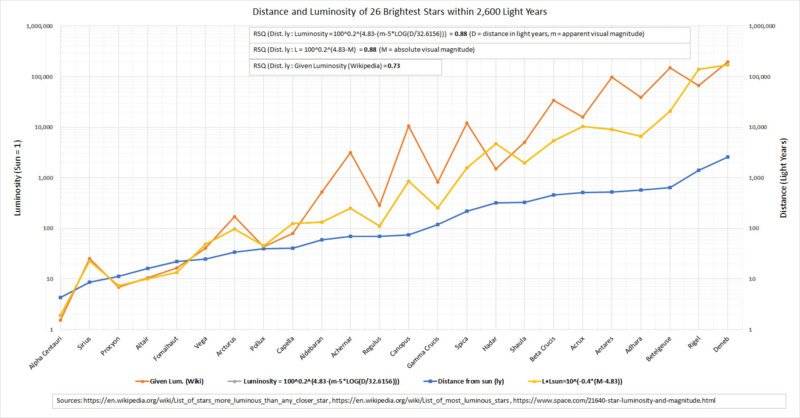
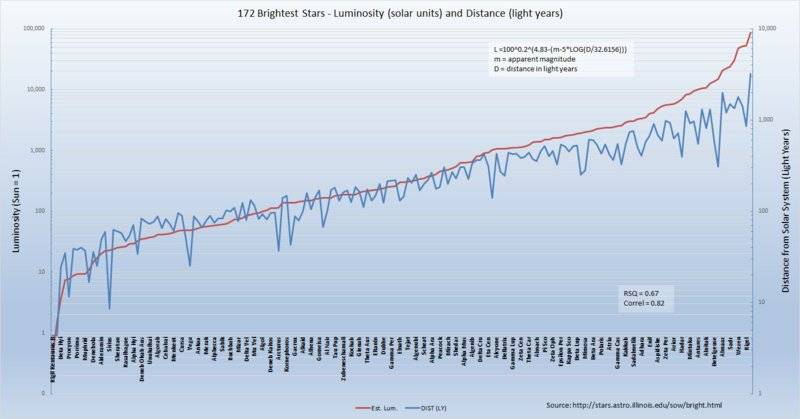
I made three charts from several different sources plotting the luminosity and distance from Earth of 26 to 300 Stars. In each chart, there appears to be a correlation between a star's luminosity (in solar units) and its distance from Earth (or solar system, whichever you prefer) in light years. I used R-squared (Coefficient of Determination) as a measurement of the relationship between luminosity and distance. I got values of 0.43, 0.67, and 0.88 depending on the source and sample size. These appear to range between moderate to very strong. I'm no expert in statistics, but if you look at the charts there is a visible relation between the two variables (in my opinion).

I don't think these correlations are artifacts, but then again I'm only an amateur astronomer. However I have read in the literature that there are clusters of OB stars in the solar neighborhood which may include Rigel and the possible birthplace of Betelgeuse (an M-class star with started out as an O star) https://www.aanda.org/articles/aa/abs/2015/12/aa27058-15/aa27058-15.html. There is an interactive diagram which shows these star clusters in 3D: http://sci.esa.int/hipparcos/ob-stars-interactive/ This research may lend support to the idea that the solar system is in a kind of "gap" between large stellar structures and areas of star formation.

Within about 300 parsecs from the sun, it appears that the more distant the star, the greater its intrinsic brightness. Is it reasonable to hypothesize that there is a correlation between the distance of stars from the solar neighborhood and their luminosity?
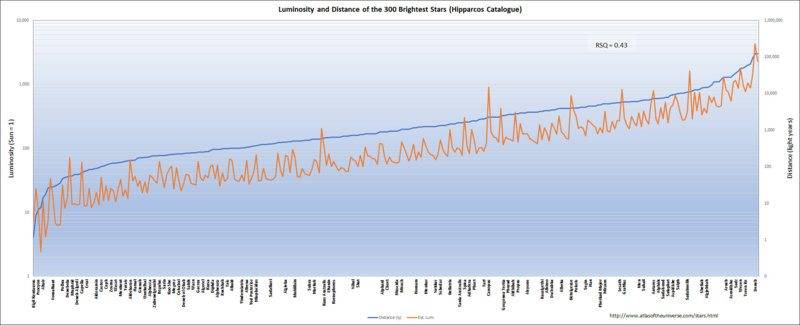
300 Brightest Stars w-in 3,000 ly Lum & D (ly).jpg
26 Brightest Stars w-in 2,600 ly Lum & D (ly).jpg
172 Brightest Stars w-in 3,200 ly - Distance vs. Luminosity (02Nov2018) rsq.jpg
 

Attachments

  • 300 Brightest Stars w-in 3,000 ly Lum & D (ly).jpg
    300 Brightest Stars w-in 3,000 ly Lum & D (ly).jpg
    28.1 KB · Views: 665
  • 26 Brightest Stars w-in 2,600 ly Lum & D (ly).jpg
    26 Brightest Stars w-in 2,600 ly Lum & D (ly).jpg
    35.5 KB · Views: 635
  • 172 Brightest Stars w-in 3,200 ly - Distance vs. Luminosity (02Nov2018) rsq.jpg
    172 Brightest Stars w-in 3,200 ly - Distance vs. Luminosity (02Nov2018) rsq.jpg
    33.5 KB · Views: 766
Astronomy news on Phys.org
If you are talking about visible stars then yes. Stars with low luminosity that are far away are not visible.

Stars with names tend to be the visible stars.
 
  • Like
Likes   Reactions: sophiecentaur
You have plotted the brightest stars, as measured by apparent brightness as seen from the Earth. So of course, as stefan r said, a more distant star must be intrinsically brighter in order to appear in the list you started with. A faint distant star would be too dim to be in your list. If you were to plot all of the stars within some distance from the sun, regardless of apparent brightness, you would see no such correlation. Try it. This is a perfect example of what is called "selection bias"
 
  • Like
Likes   Reactions: sophiecentaur and davenn
stefan r said:
If you are talking about visible stars then yes. Stars with low luminosity that are far away are not visible.

Stars with names tend to be the visible stars.

That’s not what I’m taliking about. I mean the correlation between the intrinsic brightness of a star and its distance from the solar neighbourhood. It appears that the more luminous the star (in solar units) the more distant it is from us. Here’s an analogy: if you live in a sparsely populated rural area and you’re surrounded by several large metropolitan areas, then the farther you travel from the rural area, the denser the population will be. I tried to make that clear in my OP.

I understand that apparent magnitude decreases with the square of the distance it is removed from the observer.

“”Stars with names tend to be the visible stars.” I understand that too. But a bright star like Sirius is 25 times as luminous (intrinsically bright) as the sun but only 8.6 light years away, whereas a star like Rigel, which doesn’t appear quite as bright as Sirius, is about 800 light years away and 66,000 times as bright as the sun.

Perhaps you could try going back and reading my post again. Your answer doesn’t really address my question.
 
phyzguy said:
You have plotted the brightest stars, as measured by apparent brightness as seen from the Earth. So of course, as stefan r said, a more distant star must be intrinsically brighter in order to appear in the list you started with. A faint distant star would be too dim to be in your list. If you were to plot all of the stars within some distance from the sun, regardless of apparent brightness, you would see no such correlation. Try it. This is a perfect example of what is called "selection bias"

No, I have NOT plotted the brightest stars by apparent magnitude, I have plotted them by luminosity in solar units, which is equivalent to absolute magnitude.

Here is a plot of the absolute magnitude vs. distance of the 900 closest stars. You can see that there is no correlation. But there does appear to be a correlation between M and D of the more distant stars.
900 Closest Stars - Distance & Magnitude01.jpg

Please read my post more carefully.
 

Attachments

  • 900 Closest Stars - Distance & Magnitude01.jpg
    900 Closest Stars - Distance & Magnitude01.jpg
    36.8 KB · Views: 562
Last edited:
I'm sorry, I think you have cause and effect backwards...

Bright stars are visible from a greater distance because they are bright.
Happens that such are rare, as those massive stars 'burn' through their fuel disproportionately fast ( In cosmic terms !) but, meanwhile, they are visible from afar.

Mid-range stars such as main sequence GKF will last a lot longer, but their clocks are ticking...
( Our G8 is no exception...)

Conversely, the much more common, but very dim stars such as tiny red dwarfs, brown dwarfs, old white dwarfs etc will last a long, long time, but are hard to spot even in our own neighbourhood. IIRC, several new neighbours have turned up recently, via WISE etc infrared surveys, with some more expected.

IMHO, you need to study the 'local population' listed at...
http://www.recons.org/
https://en.wikipedia.org/wiki/List_of_nearest_stars_and_brown_dwarfs
and
http://www.johnstonsarchive.net/astro/nearstar.html
 
Nik_2213 said:
I'm sorry, I think you have cause and effect backwards...

Bright stars are visible from a greater distance because they are bright.
Happens that such are rare, as those massive stars 'burn' through their fuel disproportionately fast ( In cosmic terms !) but, meanwhile, they are visible from afar.

Mid-range stars such as main sequence GKF will last a lot longer, but their clocks are ticking...
( Our G8 is no exception...)

Conversely, the much more common, but very dim stars such as tiny red dwarfs, brown dwarfs, old white dwarfs etc will last a long, long time, but are hard to spot even in our own neighbourhood. IIRC, several new neighbours have turned up recently, via WISE etc infrared surveys, with some more expected.

IMHO, you need to study the 'local population' listed at...
http://www.recons.org/
https://en.wikipedia.org/wiki/List_of_nearest_stars_and_brown_dwarfs
and
http://www.johnstonsarchive.net/astro/nearstar.html

No I do not have cause and effect backwards. You are simply not reading my post carefully enough. This looks like a case of "piling on."

Here again is a plot of the 900 closest stars (distance vs abs. mag.) within 50 light years. You can see there is no correlation. But there IS a correlation between distance and abs. mag. (luminosity in solar units) for stars within 3,000 light years, as I have noted in my OP. This is because there are large structures and clusters of very luminous stars (e.g., Betelgeuse and Rigel) within about 300 pc of the solar system (see second diagram), which makes the distribution of stellar matter discontinuous. The sun is in a gap between these structures.

900 Closest Stars - Distance & Magnitude01.jpg
.

star structures within 200 pc.png


These are my sources:
http://calgary.rasc.ca/nearbystars.htm
http://www.atlasoftheuniverse.com/stars.html
http://stars.astro.illinois.edu/sow/bright.html
https://en.wikipedia.org/wiki/List_of_stars_more_luminous_than_any_closer_star
https://en.wikipedia.org/wiki/List_of_most_luminous_stars
https://www.space.com/21640-star-luminosity-and-magnitude.html

You can look up the data at these sites and do the chars of Distance (ly) vs. Luminosity (solar units, sun = 1)
You can convert absolute magnitude or apparent magnitude to luminosity (sun = 1) using the following forumulas:
Luminosity = 100^0.2^(4.83-(m-5*LOG(D/32.6156))) where m = apparent magnitude, D = distance (ly)
or
Luminosity = 100^0.2*(4.83-M) where M = absolute magnitude.

TRY IT.
 

Attachments

  • 900 Closest Stars - Distance & Magnitude01.jpg
    900 Closest Stars - Distance & Magnitude01.jpg
    36.8 KB · Views: 600
  • star structures within 200 pc.png
    star structures within 200 pc.png
    71.3 KB · Views: 552
Last edited:
fizixfan said:
No, I have NOT plotted the brightest stars by apparent magnitude, I have plotted them by luminosity in solar units, which is equivalent to absolute magnitude.
Please read my post more carefully.

Please read my post more carefully. I am not talking about your plot axes, I am talking about how you chose which stars to plot in the first place. Your criterion for choosing the stars which you plotted was that their brightness in apparent magnitude exceeded some value. This introduces a bias where distant stars need to be intrinsically more luminous in order to be included in your list.

Note the title of your first plot, "Luminosity and Distance of the 300 Brightest Stars". Brightest in this case refers to apparent magnitude.

Do you see now, or are you still missing the point?
 
  • Like
Likes   Reactions: sophiecentaur
phyzguy said:
Please read my post more carefully. I am not talking about your plot axes, I am talking about how you chose which stars to plot in the first place. Your criterion for choosing the stars which you plotted was that their brightness in apparent magnitude exceeded some value. This introduces a bias where distant stars need to be intrinsically more luminous in order to be included in your list.

Note the title of your first plot, "Luminosity and Distance of the 300 Brightest Stars". Brightest in this case refers to apparent magnitude.

Do you see now, or are you still missing the point?

Yep, I have seen the error of my ways. So I plotted Distance and Luminosity of the most luminous stars within 38,700 light years ( https://en.wikipedia.org/wiki/List_of_most_luminous_stars ) and found that the RSQ was only 0.03 and correlation was 0.2. I didn't use the remaining 40 stars because they were either in one of the Magellanic Clouds or in another galaxy altogether. So now I understand that there is no relation between the distance of stars in the solar neighborhood and their luminosity. It was an interesting and persistent delusion while it lasted, but now I can let it go. Thank you for you patience.

80 Most Luminous Stars - Distance vs. Luminosity (03Nov2018) rsq.jpg
.
 

Attachments

  • 80 Most Luminous Stars - Distance vs. Luminosity (03Nov2018) rsq.jpg
    80 Most Luminous Stars - Distance vs. Luminosity (03Nov2018) rsq.jpg
    22.5 KB · Views: 613
  • Like
Likes   Reactions: sophiecentaur, Bandersnatch, Nik_2213 and 1 other person
  • #10
fizixfan said:
Yep, I have seen the error of my ways. So I plotted Distance and Luminosity of the most luminous stars within 38,700 light years ( https://en.wikipedia.org/wiki/List_of_most_luminous_stars ) and found that the RSQ was only 0.03 and correlation was 0.2. I didn't use the remaining 40 stars because they were either in one of the Magellanic Clouds or in another galaxy altogether. So now I understand that there is no relation between the distance of stars in the solar neighborhood and their luminosity. It was an interesting and persistent delusion while it lasted, but now I can let it go. Thank you for you patience.

I'm glad you got it, and glad I could help. Keep asking those questions!
 
  • Like
Likes   Reactions: Nik_2213 and fizixfan
  • #11
It's always a feel good moment when someone graciously accepts an error and learns from it. If only the history of Science had more examples like this and fewer 'fights to the death' between opposing ideas.
 
  • Like
Likes   Reactions: phyzguy, Nik_2213 and fizixfan

Similar threads

  • · Replies 0 ·
Replies
0
Views
902
  • · Replies 1 ·
Replies
1
Views
3K
  • · Replies 6 ·
Replies
6
Views
4K
  • · Replies 6 ·
Replies
6
Views
2K
  • · Replies 21 ·
Replies
21
Views
6K
  • · Replies 19 ·
Replies
19
Views
6K
  • · Replies 1 ·
Replies
1
Views
7K
  • · Replies 1 ·
Replies
1
Views
3K
Replies
1
Views
4K
Replies
2
Views
4K