Cost of the conversion of a string to an other string

  • Context: MHB 
  • Thread starter Thread starter evinda
  • Start date Start date
  • Tags Tags
    String
Click For Summary

Discussion Overview

The discussion revolves around the problem of converting one string into another using a set of operations (insertion, deletion, and replacement) with associated costs. Participants explore the optimal sequence of operations to achieve this conversion while discussing the costs involved and the recursive formula for calculating the minimum cost.

Discussion Character

  • Technical explanation
  • Mathematical reasoning
  • Debate/contested

Main Points Raised

  • One participant presents a recursive formula for calculating the minimum cost of converting string A to string B based on allowed operations and their costs.
  • Another participant provides an example of transforming "help" to "hello" and discusses various methods and their respective costs.
  • Several participants express confusion about the cost calculations and the implications of keeping characters unchanged during the conversion process.
  • There is a discussion about the values of T(i,j) when either string length is zero, with participants debating the costs associated with inserting characters.
  • Participants explore different paths to achieve the same result, noting that the order of operations can affect the total cost.
  • Questions arise about specific values of T(3,2) and T(3,3), with participants discussing the implications of replacing letters and the costs involved.

Areas of Agreement / Disagreement

Participants express uncertainty regarding the cost calculations and the recursive approach. While some agree on certain costs and methods, there is no consensus on the overall minimum costs or the best strategies for specific cases.

Contextual Notes

Participants highlight the complexity of the problem, including the need to consider multiple paths and operations, which may lead to different costs. There are unresolved questions about the implications of keeping characters unchanged and how that affects the overall cost.

Who May Find This Useful

This discussion may be useful for those interested in algorithm design, particularly in string manipulation and dynamic programming approaches to optimization problems.

evinda
Gold Member
MHB
Messages
3,741
Reaction score
0
Hello! (Wave)

We are given $2$ strings $A=[1 \dots m]$ and $B[1 \dots n]$ and the following $3$ operations are allowed:

  • Insert a charachter,with cost $c_i$
  • Delete a character,with cost $c_d$
  • Replace a character,with cost $c_r$


We are looking for the optimal sequence of operations(sequence of operations with the minimum cost),for the conversion of the string $A$ to the string $B$.

$$T(i,j)=\text{ the minimum cost of the conversion of the string } A[1 \dots i] \text{ to } B[1 \dots j], 1 \leq i \leq m, 1 \leq j \leq n$$

According to my notes:
$$T(i,j)=\min \left\{\begin{matrix}
T(i-1,j)+c_d & \text{ // delete the i-th charachter of A}\\
T(i,j-1)+c_i & \text{ // insert the j-th charachter of B} \\
T(i-1,j-1) & \text{if } A=B[j]\\
T(i-1,j-1)+c_r & \text{if } A \neq B[j]
\end{matrix}\right.$$

Why is the cost given by the above formula?Could you explain it to me? (Thinking)
 
Physics news on Phys.org
The $\le$ direction is pretty obvious since the right-hand side suggests recursive algorithms to do the conversion.
 
Let's pick an example.
Suppose you want to transform A="help" to B="hello".
How would you do it?
Which other alternatives do you have?
 
I like Serena said:
Let's pick an example.
Suppose you want to transform A="help" to B="hello".
How would you do it?
Which other alternatives do you have?

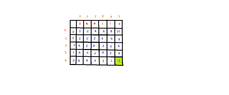
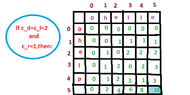
That's what I have tried:

View attachment 2993

Is it right? If so,is the cost $T[5,5]=10$?Or don't we have to take $T[n,n]$ as the minimum cost of the conversion? (Thinking)
 

Attachments

  • conversion.png
    conversion.png
    5.3 KB · Views: 122
evinda said:
That's what I have tried:

Is it right? If so,is the cost $T[5,5]=10$?Or don't we have to take $T[n,n]$ as the minimum cost of the conversion? (Thinking)

I don't quite understand your table.
Can you explain? (Wondering)Anyway, the most obvious ways I can think of are:

  1. Keep "hel".
  2. Replace 'p' by 'l'.
  3. Insert 'o' at the end.
With your costs, that gives us a cost of 1+2=3.

Alternatively, we could do:
  1. Keep "hel".
  2. Insert 'l'.
  3. Replace 'p' by 'o'.
With your costs, that gives us a cost of 2+1=3.

As another alternative, we could do:
  1. Keep "hel".
  2. Delete 'p'.
  3. Insert 'l' at the end.
  4. Insert 'o' at the end.
With your costs, that gives us a cost of 2+2+2=6.

So the first 2 methods are cheaper than the last.
And I have left out a whole bunch of alternatives that will be more expensive.

In all cases presented T(3,3)=0.
In the first method, we would get T(4,4)=1 and T(4,5)=3.
In the last method, we would get T(3,4)=2, T(4,4)=4, and T(4,5)=6.
Taking the minimum recursively from the end should lead us to the cheapest solution.
 
I like Serena said:
I don't quite understand your table.
Can you explain? (Wondering)Anyway, the most obvious ways I can think of are:

  1. Keep "hel".
  2. Replace 'p' by 'l'.
  3. Insert 'o' at the end.
With your costs, that gives us a cost of 1+2=3.

Alternatively, we could do:
  1. Keep "hel".
  2. Insert 'l'.
  3. Replace 'p' by 'o'.
With your costs, that gives us a cost of 2+1=3.

As another alternative, we could do:
  1. Keep "hel".
  2. Delete 'p'.
  3. Insert 'l' at the end.
  4. Insert 'o' at the end.
With your costs, that gives us a cost of 2+2+2=6.

So the first 2 methods are cheaper than the last.
And I have left out a whole bunch of alternatives that will be more expensive.

In all cases presented T(3,3)=0.
In the first method, we would get T(4,4)=1 and T(4,5)=3.
In the last method, we would get T(3,4)=2, T(4,4)=4, and T(4,5)=6.
Taking the minimum recursively from the end should lead us to the cheapest solution.

I understand... I tried to create a matrix for $T[i,j]$ using the formula:

$$T(i,j)=\min \left\{\begin{matrix}
T(i-1,j)+c_d & \text{ // delete the i-th charachter of A}\\
T(i,j-1)+c_i & \text{ // insert the j-th charachter of B} \\
T(i-1,j-1) & \text{if } A=B[j]\\
T(i-1,j-1)+c_r & \text{if } A \neq B[j]
\end{matrix}\right.$$

but there is no cost,if we don't make any changes at a position,right? So, the cost doesn't increase , when we keep "hel" ..Or have I understood it wrong? (Thinking)
 
evinda said:
I understand... I tried to create a matrix for $T[i,j]$ using the formula:

$$T(i,j)=\min \left\{\begin{matrix}
T(i-1,j)+c_d & \text{ // delete the i-th charachter of A}\\
T(i,j-1)+c_i & \text{ // insert the j-th charachter of B} \\
T(i-1,j-1) & \text{if } A=B[j]\\
T(i-1,j-1)+c_r & \text{if } A \neq B[j]
\end{matrix}\right.$$

but there is no cost,if we don't make any changes at a position,right? So, the cost doesn't increase , when we keep "hel" ..Or have I understood it wrong? (Thinking)


You have understood it right. Keeping "hel" does not incur any cost. (Nod)

So let's take a look at your table.
We start with T(0,0) which is indeed 0, since nothing is done.
Looking at T(0,1) means we have inserted character 1 of B into A with the cost of 2.
So I think T(0,1) should be 2... (Thinking)

I see you do have T(3,3)=0, T(4,4)=1, T(4,5)=3.
I think the total cost would be T(4,5)=3, since A has 4 characters and B has 5 characters.
 
Last edited:
I like Serena said:
So let's take a look at your table.
We start with T(0,0) which is indeed 0, since nothing is done.
Looking at T(1,0) means we have inserted character 1 of B into A with the cost of 2.
So I think T(1,0) should be 2... (Thinking)

So,isn't it $T(i,j)=0 \text{ if } i=0 \text{ or } j=0$ ? (Thinking)

At the position $0$,there is no letter , or am I wrong? (Sweating)
 
evinda said:
So,isn't it $T(i,j)=0 \text{ if } i=0 \text{ or } j=0$ ? (Thinking)

At the position $0$,there is no letter , or am I wrong? (Sweating)

Isn't T(0,1) the mimimum cost to transform the string of length 0 ("") to the string of length 1 ("h")? (Wondering)
That would mean that we need to insert 'h' for a cost of $c_i$.
 
  • #10
I like Serena said:
Isn't T(0,1) the mimimum cost to transform the string of length 0 ("") to the string of length 1 ("h")? (Wondering)
That would mean that we need to insert 'h' for a cost of $c_i$.

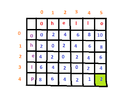
I tried it again..Tha's what I did:

View attachment 3001

Is it right now or have I done something wrong? (Thinking)
 

Attachments

  • ppp.png
    ppp.png
    4.9 KB · Views: 108
  • ppp.png
    ppp.png
    3.8 KB · Views: 108
  • #11
I think the final T(4,5) value should be 3... (Worried)
 
  • #12
I like Serena said:
I think the final T(4,5) value should be 3... (Worried)

Because of the fact that we have to insert o and replace p by l,right? (Thinking)
 
  • #13
evinda said:
Because of the fact that we have to insert o and replace p by l,right? (Thinking)

Yes. Actually we have 2 paths to the same result.
Either we replace first and insert afterwards.
Or we insert first and replace afterwards.
Both of them add up to 3. (Nerd)
 
  • #14
I like Serena said:
Yes. Actually we have 2 paths to the same result.
Either we replace first and insert afterwards.
Or we insert first and replace afterwards.
Both of them add up to 3. (Nerd)

A ok..I understand! (Nod)
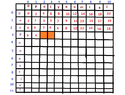
But..what do we have to do in this case:

View attachment 3002

to find,for example $T(3,2)$ and $T(3,3)$ ? For $T(3,2)$ we have to delete one letter,for $T(3,3)$ we don't have to insert a letter and also not to delete one..

For $T(3,2)$,do we have to replace two letters?Or not,since we already have a $p$ ?

Also,for $T(3,3)$ do we have to replace all the three letters,so the minimum cost is $3$ ? (Thinking)
 

Attachments

  • yy.png
    yy.png
    6.9 KB · Views: 117
  • #15
evinda said:
A ok..I understand! (Nod)
But..what do we have to do in this case:

to find,for example $T(3,2)$ and $T(3,3)$ ? For $T(3,2)$ we have to delete one letter,for $T(3,3)$ we don't have to insert a letter and also not to delete one..

True. (Nod)
For $T(3,2)$,do we have to replace two letters?Or not,since we already have a $p$ ?

To find $T(3,2)$ we need to find the cheapest way, choosing from $T(2,1)$, $T(2,2)$, and $T(3,1)$.
As it is, replace-replace-delete (4) is cheaper than delete-delete-insert (6).
So yes, we have to replace two letters, and we can't make effective use of the existing 'p' (yet). (Happy)
Also,for $T(3,3)$ do we have to replace all the three letters,so the minimum cost is $3$ ? (Thinking)

Yep!
 
  • #16
I like Serena said:
To find $T(3,2)$ we need to find the cheapest way, choosing from $T(2,1)$, $T(2,2)$, and $T(3,1)$.
As it is, replace-replace-delete (4) is cheaper than delete-delete-insert (6).
So yes, we have to replace two letters, and we can't make effective use of the existing 'p' (yet). (Happy)

I understand! (Smile)

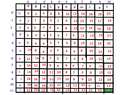
I tried to find the cost,in this case :

View attachment 3006

Could you tell me if it is right or if I have done something wrong? (Thinking)
Is the cost $T(11,10)=9$ ? (Thinking)
 

Attachments

  • yy.png
    yy.png
    12.5 KB · Views: 94
Last edited:
  • #17
I've started with the path where we simply replace all characters and finally delete the last.
In T(5,5) we have indeed 4 replacements.
How did you get T(6,6)=6?
Shouldn't it be 5? (Wondering)As for your final T(11,10)=9, shouldn't it be at least as high as the lowest of the 3 squares left and above? (Wondering)The last 3 letters "ial" are identical.
So I would expect they could remain the same without cost, but in your table the cost seems to go up as if they were replaced. (Worried)
 
  • #18
I like Serena said:
How did you get T(6,6)=6?
Shouldn't it be 5? (Wondering)

Why should it be T(6,6)=5? (Thinking)
Don't we have two replace all the 6 letters e,x,p,o,n,e by these ones: p,o,l,y,n,o ?
If we would keep "po" and "n",wouldn't it be like that:

delete e,x -> cost=4
keep po-> cost=0
insert l,y-> cost=4
keep n-> cost=0
replace e by o-> cost=1

So,wouldn't the cost be $9$ ?

Or have I done somrthing wrong?

I like Serena said:
As for your final T(11,10)=9, shouldn't it be at least as high as the lowest of the 3 squares left and above? (Wondering)The last 3 letters "ial" are identifical.
So I would expect they could remain the same without cost, but in your table the cost seems to go up as if they were replaced. (Worried)

Oh yes,you are right! (Nod)

So..to calculate T(11,10) , do we have to do the following?

replace all the letters from e till o,keep "n",replace e,n,delete t and keep "ial".

So,the cost is 4+2+2=8.

(Thinking)
 
  • #19
evinda said:
Why should it be T(6,6)=5? (Thinking)
Don't we have two replace all the 6 letters e,x,p,o,n,e by these ones: p,o,l,y,n,o ?
If we would keep "po" and "n",wouldn't it be like that:

delete e,x -> cost=4
keep po-> cost=0
insert l,y-> cost=4
keep n-> cost=0
replace e by o-> cost=1

So,wouldn't the cost be $9$ ?

Or have I done somrthing wrong?

But if we replace all 6 letters, except 'n' because it's the same, wouldn't we have a cost of 5? (Wondering)
Oh yes,you are right! (Nod)

So..to calculate T(11,10) , do we have to do the following?

replace all the letters from e till o,keep "n",replace e,n,delete t and keep "ial".

So,the cost is 4+2+2=8.

(Thinking)

I think so! (Nod)
 
  • #20
I like Serena said:
But if we replace all 6 letters, except 'n' because it's the same, wouldn't we have a cost of 5? (Wondering)

Oh yes..you are right! (Wasntme)

So,everything is wrong from T(6,6) till the end of the row,right? (Thinking)
I like Serena said:
I think so! (Nod)

Great! (Cool)
 
  • #21
evinda said:
Oh yes..you are right! (Wasntme)

So,everything is wrong from T(6,6) till the end of the row,right? (Thinking)

And also on the rows that come after I'm afraid. (Doh)
 

Similar threads

  • · Replies 27 ·
Replies
27
Views
4K
  • · Replies 2 ·
Replies
2
Views
2K
  • · Replies 2 ·
Replies
2
Views
2K
  • · Replies 4 ·
Replies
4
Views
4K
  • · Replies 15 ·
Replies
15
Views
2K
  • · Replies 3 ·
Replies
3
Views
2K
  • · Replies 19 ·
Replies
19
Views
4K
  • · Replies 0 ·
Replies
0
Views
1K
Replies
1
Views
2K
Replies
4
Views
2K