Science Advisor
Gold Member
- 2,858
- 12,753
A Science mag news article describes a possible Denisovan skull has been found and described in China.
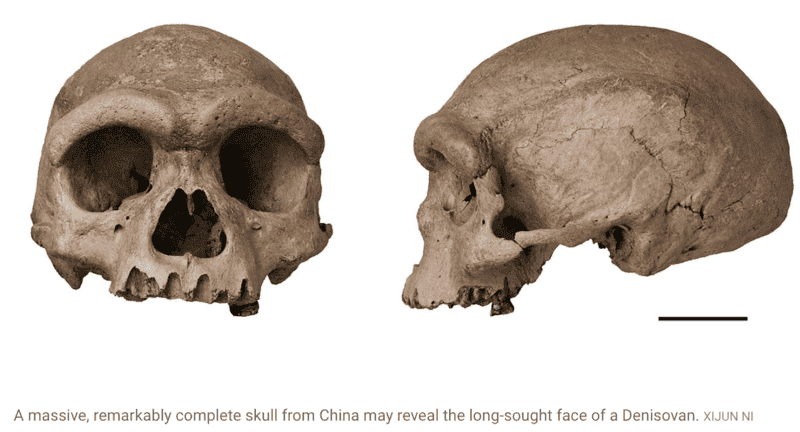
It has an interesting back story:
Although the authors are claiming it is a new species more closely related to Homo sapiens, many think it is a Denisovan.
Previously, Denisovans were only known from fossils of a tooth, a small part of a pinkie (small finger), and part of a skull from the Denisovan cave in Russia, and a part of a jaw from Tibet.
The Denisovans were determined to be a species, distinct from modern humans and Neanderthals, by sequencing their genome from the small bits of available fossils. No more was known of them other than genetic evidence that they interbred with both Neanderthals and modern humans.
The new fossil has not yet had its genome sequenced, which would provide much better evidence for it being a Denisovan.
To put the Denisovan's relationship with modern humans and their close relatives into an understandable form, here is a summary diagram from a recent Science article on Neanderthals, Denisovans, and modern humans in the mid-east.
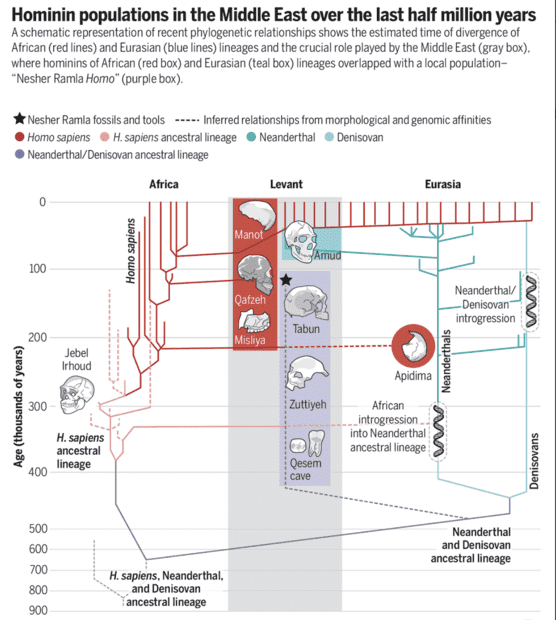
Introgression is the transfer of genes from one breeding population (like a species) to another through occasional interbreeding events, followed by breeding back to one of the original populations.
It has an interesting back story:
Almost 90 years ago, Japanese soldiers occupying northern China forced a Chinese man to help build a bridge across the Songhua River in Harbin. While his supervisors weren’t looking, he found a treasure: a remarkably complete human skull buried in the riverbank. He wrapped up the heavy cranium and hid it in a well to prevent his Japanese supervisors from finding it. Today, the skull is finally coming out of hiding, and it has a new name: Dragon Man, the newest member of the human family, who lived more than 146,000 years ago.
The stunning skull was brought to light by the bridge builder’s grandchildren, who retrieved it from the well after their grandfather told them about it on his deathbed. They donated it to the Geoscience Museum at Hebei GEO University. But before Ji could ask him precisely where he found the fossil, the man died, leaving the researchers uncertain of its geological context.
Although the authors are claiming it is a new species more closely related to Homo sapiens, many think it is a Denisovan.
Previously, Denisovans were only known from fossils of a tooth, a small part of a pinkie (small finger), and part of a skull from the Denisovan cave in Russia, and a part of a jaw from Tibet.
The Denisovans were determined to be a species, distinct from modern humans and Neanderthals, by sequencing their genome from the small bits of available fossils. No more was known of them other than genetic evidence that they interbred with both Neanderthals and modern humans.
The new fossil has not yet had its genome sequenced, which would provide much better evidence for it being a Denisovan.
To put the Denisovan's relationship with modern humans and their close relatives into an understandable form, here is a summary diagram from a recent Science article on Neanderthals, Denisovans, and modern humans in the mid-east.
Introgression is the transfer of genes from one breeding population (like a species) to another through occasional interbreeding events, followed by breeding back to one of the original populations.