Discussion Overview
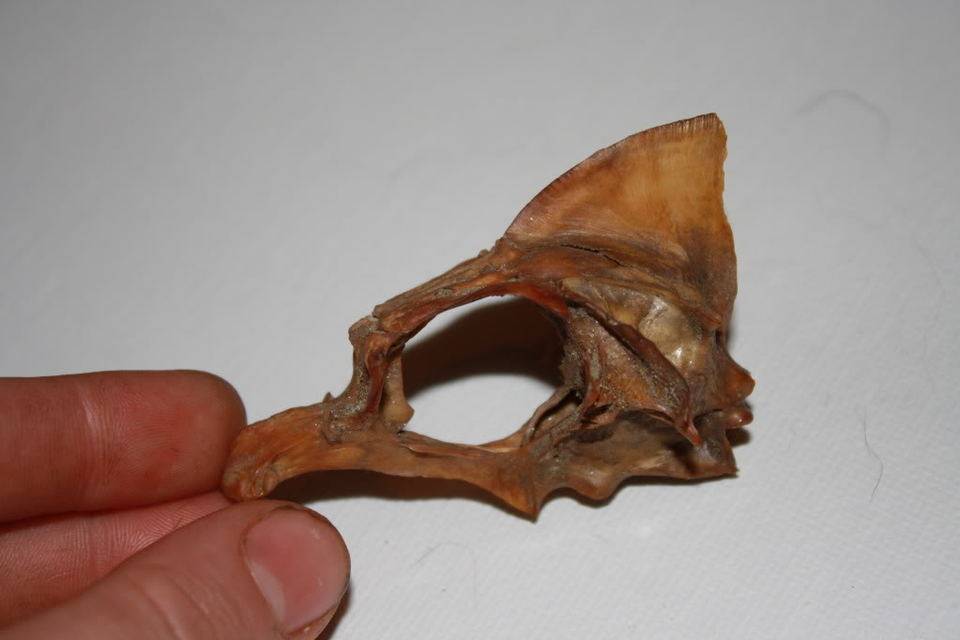
The discussion revolves around the identification of a unique skull found near the Connecticut River in western Massachusetts. Participants are exploring various hypotheses regarding the skull's origin, considering it may belong to a bird or a mammal, and are analyzing its physical characteristics based on provided images.
Discussion Character
- Exploratory
- Debate/contested
- Technical explanation
Main Points Raised
- Some participants express uncertainty about whether the object is a skull or another type of bone, noting the lack of typical openings found in skulls.
- One participant suggests that the large sagittal crest indicates a creature with strong jaws, while another counters that the upper jaw appears too small for a strong bite.
- A participant proposes that the skull resembles that of a loon, but questions the size of the sagittal crest in comparison to known loon skulls.
- Others mention that both opossum and fisher skulls have large sagittal crests, but note discrepancies in muzzle shape and other features that do not align with the found skull.
- One participant discusses the possibility of the skull belonging to a marine bird, citing features such as the narrowing above the eye socket.
- Another participant references hornbills and cassowaries as birds with crests but concludes that neither matches the skull in question.
- Several participants share links to external resources for further exploration of skull identification.
Areas of Agreement / Disagreement
Participants do not reach a consensus on the skull's identity, with multiple competing views regarding its possible origins and characteristics remaining unresolved.
Contextual Notes
Participants express limitations in their knowledge of skull anatomy and identification, indicating that further expertise may be needed to accurately classify the skull.