Countering the Movement of the Ocean & different size boats/ships

  • Context: High School 
  • Thread starter Thread starter IgnorantofPhysics
  • Start date Start date
  • Tags Tags
    Movement Ocean
Click For Summary
SUMMARY

The discussion centers on the perception of ocean movement on different sizes of boats, specifically comparing smaller recreational boats to larger vessels like cruise ships and submarines. Participants confirm that larger mass and size can mitigate the sensation of ocean tugs due to the threshold of perception of acceleration. Submarines, even at modest depths, experience significantly reduced effects from surface waves, as their inertia dampens these forces more effectively than surface boats. The conversation highlights the physics of buoyancy and wave dynamics, emphasizing the differences in experience based on vessel size and depth.

PREREQUISITES
  • Understanding of buoyancy and its effects on vessels
  • Basic knowledge of wave dynamics and surface vs. subsurface movement
  • Familiarity with the concept of inertia in physics
  • Awareness of flight simulation principles related to motion perception
NEXT STEPS
  • Research the physics of buoyancy in relation to vessel design
  • Explore the dynamics of wave propagation and its effects on different boat sizes
  • Learn about the engineering principles behind submarines and their operational depths
  • Investigate flight simulation technology and its applications in motion perception
USEFUL FOR

Marine engineers, naval architects, recreational boaters, and anyone interested in the physics of buoyancy and wave dynamics in maritime environments.

IgnorantofPhysics
Messages
6
Reaction score
0
I’ve been on cruise ships and recreational boats. But, that’s not something I do every weekend. That’s just an occasional thing. On the smaller boats, I can feel the ebb and flow of being on the ocean more noticeably. On the cruise ships, I have to be real still and off in a quiet place to notice a small tug every now and then. I don’t know the proper physics term, that’s why I’m using descriptive language. Maybe the proper physics term is “buoyancy,” or the effects of buoyancy is what I'm feeling. I don’t know. But, my physics question is “Is there a sufficient size/mass/[feel free to insert some precise term here] which would virtually eliminate the tugs you feel on a boat?”

I’ve never been in the Navy either. I wonder if those who have could testify whether passengers on an aircraft-carrier-size boat would feel the effects of the ebb and flow of the ocean? So, would that size boat take care of it? Or, would being underwater, on a submarine eliminate the movements you feel on the surface boats?

Any, insights would be helpful. Thanks.
 
Physics news on Phys.org
If I understand your question, the answer is yes. There is a threshold of perception of acceleration. Flight simulators, which have limited motions, use that effect to fool people into thinking they are on an airplane with less limited motion. Look at this video about 4 minutes in.

 
anorlunda said:
If I understand your question, the answer is yes. There is a threshold of perception of acceleration. Flight simulators, which have limited motions, use that effect to fool people into thinking they are on an airplane with less limited motion. Look at this video about 4 minutes in.


Thank you for taking the time to answer this for me. I watched the video. I think I'm going to get one of those for my garage. Since I'm not married, I shouldn't have to worry about any second-guessing nor negative feedback in trying to do so. lol I couldn't resist. I thought the rain drops were cool too.

So, I think your "Yes" is in response to my main question. Though, I created a problem by asking more than one question. That's my fault. But, it's good to know that enough mass/size/[whichever appropriate physics term(s)] would counter feeling that you're on the ocean.

If any millionaires are on the forum who have a few recreational submarines in their marina next to their yachts, I'm curious whether underwater vehicles sufficiently counter the tugs you would feel on surface boats. But, in the slim chance that there aren't any millionaires here, which I doubt since they are so common, maybe some Navy folks could inform me about submarines and this matter.
 
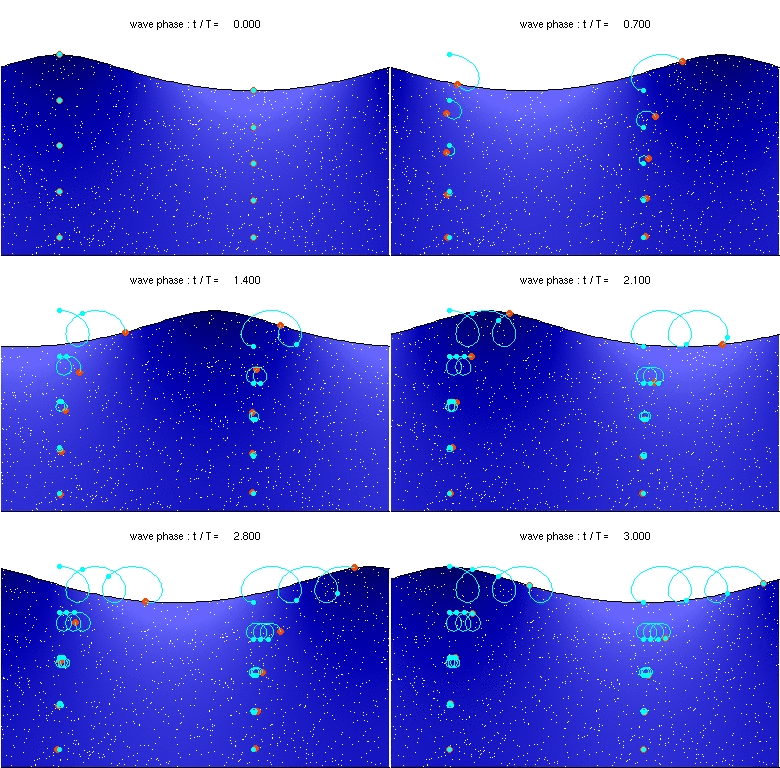
The surface waves causing displacement (movement) and rotation (rocking) of boats are wind generated. They're basically occasionally oversized ripples on water surface and not waves propagating in the medium itself. As such, the associated water displacement quickly diminishes below surface, as shown in this animation from the wiki article on wind waves:
Deep_water_wave.gif

A submarine even at a modest depth will not be affected much - its inertia will dampen these small forces much better than if the same boat were on the surface.
 
Bandersnatch said:
The surface waves causing displacement (movement) and rotation (rocking) of boats are wind generated. They're basically occasionally oversized ripples on water surface and not waves propagating in the medium itself. As such, the associated water displacement quickly diminishes below surface, as shown in this animation from the wiki article on wind waves:
Deep_water_wave.gif

A submarine even at a modest depth will not be affected much - its inertia will dampen these small forces much better than if the same boat were on the surface.
Thank you very much, sir, for this detailed reply. I'm a visual learner. And, though you didn't take a picture of the submarine you own in the marina, including the graphic was very helpful in getting me to grasp the effects below water.
 
IgnorantofPhysics said:
though you didn't take a picture of the submarine you own in the marina
I ain't got one on hand at the moment, but if you stay tuned to this thread, I should be able to afford a modestly-sized submersible and post relevant pictures in... (*checks income*) about 180 years.
 

Similar threads

  • · Replies 26 ·
Replies
26
Views
7K
  • · Replies 13 ·
Replies
13
Views
5K
  • · Replies 17 ·
Replies
17
Views
4K
  • · Replies 3 ·
Replies
3
Views
567
  • · Replies 7 ·
Replies
7
Views
3K
  • · Replies 7 ·
Replies
7
Views
3K
  • · Replies 7 ·
Replies
7
Views
3K
  • · Replies 22 ·
Replies
22
Views
9K
  • · Replies 1 ·
Replies
1
Views
4K
  • · Replies 7 ·
Replies
7
Views
3K