GodfreyHW
- 6
- 1
In chapter 1, page 10, real numbers are found by confining them to an interval that shrinks to "zero" length (we consider subintervals ##I_0,\,I_1,...,\,I_n##). Basically, if ##x## is between ##c## and ##c+1##, then we can divide that interval into ten subintervals, and we can, then, have ##c+\frac{1}{10}c_1\leq x\leq c+\frac{1}{10}c_1+\frac{1}{10}##, where ##c_1## is a digit from zero to nine.
Repeating this process, and making ##n\to\infty## subdivisions, we'll eventually get ##x=c+0.c_1c_2c_3...##
I am confused by this, though:
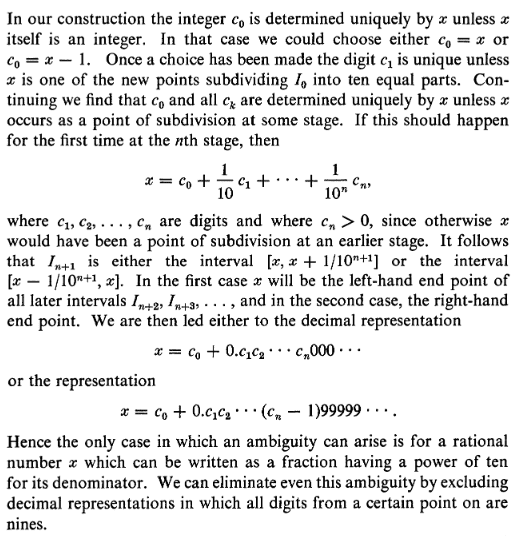
1) How is he constructing that ##I_{n+1}## interval?
If I suppose ##c_0-1\leq x##, then I can do ##c_0-1+\frac{1}{10}c_1+...+\frac{1}{10^n}c_n\leq x##, and if I say that ##n\to\infty##, then I can also write ##\underbrace{(c_0-1+\frac{1}{10}c_1+...+\frac{1}{10^n}c_n)}_x-\frac{1}{10^{n+1}}\leq x##, so that ##\frac{1}{10^{n+1}})## is like an infinitesimal.
Would this be correct for ##\left[x-\frac{1}{10^{n+1}},x\right]##? If so, then I guess that it should be the same with ##x\leq c_0+1## by subtracting ##\frac{c_i}{10^i}##s and adding ##\frac{1}{10^{n+1}}##.
2) How is he getting the second representation with ##c_n-1##? (typo?)
I see that, maybe, we'd do ##c_0\leq x##, and get it to ##c_0+\frac{1}{10}c_1+...+\frac{1}{10^n}c_n\leq x##, but we would have ##c_{i>0}=9##.
Repeating this process, and making ##n\to\infty## subdivisions, we'll eventually get ##x=c+0.c_1c_2c_3...##
I am confused by this, though:
1) How is he constructing that ##I_{n+1}## interval?
If I suppose ##c_0-1\leq x##, then I can do ##c_0-1+\frac{1}{10}c_1+...+\frac{1}{10^n}c_n\leq x##, and if I say that ##n\to\infty##, then I can also write ##\underbrace{(c_0-1+\frac{1}{10}c_1+...+\frac{1}{10^n}c_n)}_x-\frac{1}{10^{n+1}}\leq x##, so that ##\frac{1}{10^{n+1}})## is like an infinitesimal.
Would this be correct for ##\left[x-\frac{1}{10^{n+1}},x\right]##? If so, then I guess that it should be the same with ##x\leq c_0+1## by subtracting ##\frac{c_i}{10^i}##s and adding ##\frac{1}{10^{n+1}}##.
2) How is he getting the second representation with ##c_n-1##? (typo?)
I see that, maybe, we'd do ##c_0\leq x##, and get it to ##c_0+\frac{1}{10}c_1+...+\frac{1}{10^n}c_n\leq x##, but we would have ##c_{i>0}=9##.
Last edited: