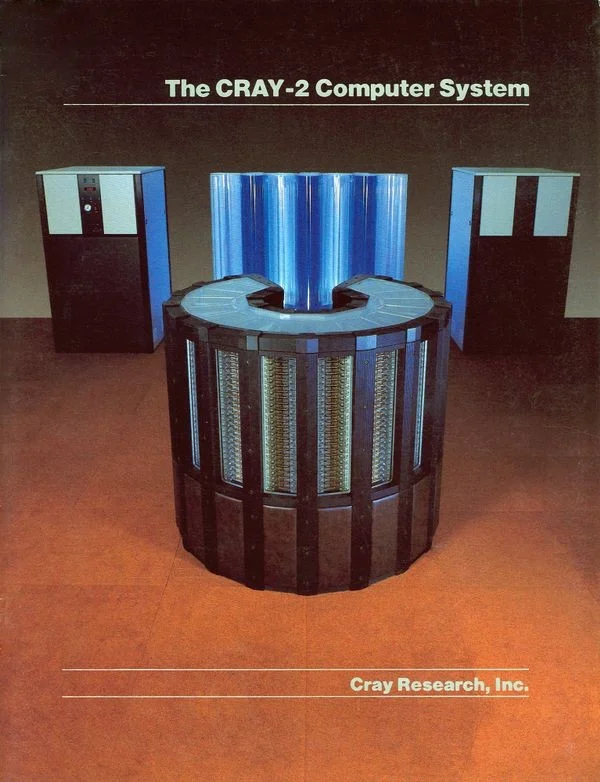
Cray-2 Supercomputer Comparisons

  • Thread starter Thread starter berkeman
  • Start date Start date
Join the discussion
Ask a follow-up here, or get your own question answered by working scientists, mathematicians and engineers — people, not an autocomplete.
Real named experts · corrections over time · the nuance an AI answer skips
1 reply · 195 views
Messages
69,682
Reaction score
25,442
I "liked" a post on Facebook earlier today that compared the computing power of a Cray-2 supercomputer from the 1980s to a current full-featured desktop graphics computer. The current computer was amazingly stronger compared to the Cray-2 computer system.

I was fortunate enough to see a Cray-2 system at the national weather lab in Boulder Colorado in the early 1980s when I was working in Denver, and it was amazing. The cooling system was very impressive, and I liked the playful additions like the seat cushions around the cylindrical main computing unit (not shown in the image below of a Cray-2 system that I found online, unfortunately).

Because of that "like", I got this follow-up post in my FB feed:

1784767743306.webp


1784767860659.webp

https://www.computerhistory.org/revolution/supercomputers/10/68
 
Reply
  • Wow
Likes   Reactions: Matterwave and FactChecker
Physics news on Phys.org
From what I've heard:
This is a major piece of computing history. The Cray-2 was an extraordinary machine for its time. When launched in 1985, it was the fastest computer in the world, capable of a peak performance of around 1.9 gigaflops. Its liquid-immersion cooling system using Fluorinert was a truly innovative engineering feat, and the cylindrical design was driven by the need to minimize wire lengths to reduce signal propagation delays—a serious bottleneck at those clock speeds.

The comparison with modern consumer hardware is striking. A high-end modern GPU, like the NVIDIA RTX 5090, delivers performance in the range of several hundred teraflops in FP16 or mixed precision; even in FP64 (double precision, which is required for scientific computing like climate modeling), it offers performance in the range of a few teraflops. This means a single modern consumer graphics card outperforms the Cray-2 by three or four orders of magnitude in raw floating-point performance, at a fraction of the power consumption and cost.

What makes this comparison even more interesting is the context in which the Cray-2 was used. The National Center for Atmospheric Research in Boulder—likely where you saw it—used theirs for climate and weather modeling. Today, those same workloads run on GPU clusters with performance measured in petaflops, enabling simulations with dramatically higher resolution and longer time horizons.

The padded seating around the base of the Cray units was actually a deliberate design choice by Seymour Cray, who wanted the machines to have an inviting presence rather than looking like cold industrial equipment. It became one of the most recognizable aesthetic details in the history of computing.