Create Concentric Circles with Equal Distances

  • Thread starter Thread starter TimeRip496
  • Start date Start date
  • Tags Tags
    Circle
Click For Summary
Creating concentric circles with objects that maintain equal distances from each other, regardless of their circle, is complex. The discussion reveals that while it's feasible to have equal spacing on a single circle, achieving uniform distances across multiple circles is problematic. Specifically, it can only be accomplished for a central point surrounded by six equidistant points, but not with additional concentric circles. The need for clarity in defining which objects are to be equidistant is emphasized, as this affects the arrangement. Ultimately, the consensus is that while some configurations are possible, a perfect solution for all conditions is unattainable.
TimeRip496
Messages
249
Reaction score
5
Is it possible to create a concentric circles whereby all the objects on it have equal distance from each other?
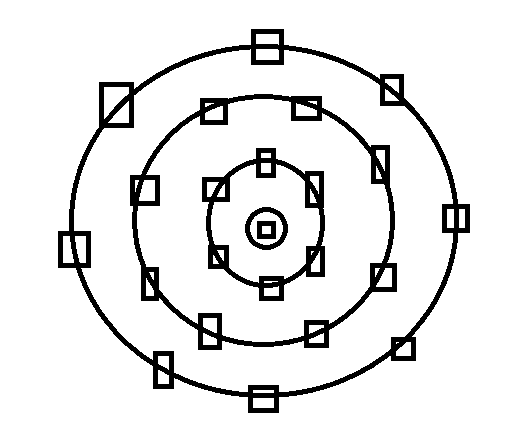
upload_2016-2-6_23-25-3.png

where the squares/rectangles are object and are equal distance from each other regardless on what circle they are on.
Thanks!
 
Mathematics news on Phys.org
TimeRip496 said:
Is it possible to create a concentric circles whereby all the objects on it have equal distance from each other?
Hi Rip:

I don't understand what you are asking. Can you specify which squares/rectangles are to have the same distance relative to other specific squares/rectangles?

Regards,
Buzz
 
Buzz Bloom said:
Hi Rip:

I don't understand what you are asking. Can you specify which squares/rectangles are to have the same distance relative to other specific squares/rectangles?

Regards,
Buzz
As in same distance from each other regardless whether they are on the same circle or not. Assume that the square/rectangle(I can't draw properly such that all of them are equal) are all the same thing.
 
TimeRip496 said:
As in same distance from each other regardless whether they are on the same circle or not. Assume that the square/rectangle(I can't draw properly such that all of them are equal) are all the same thing.
Hi Rip:

You show 1+6+8+8=23 squares/rectangles (items). For each of the 22 x 23 / 253 pairs of items, do you want the distance between the two items in the pair the have the same distance as all the other pairs?

Regards,
Buzz
 
Buzz Bloom said:
You show 1+6+8+8=23 squares/rectangles (items). For each of the 22 x 23 / 253 pairs of items, do you want the distance between the two items in the pair the have the same distance as all the other pairs?
CORRECTION
You show 1+6+8+8=23 squares/rectangles (items). For each of the 22 x 23 / 2 = 253 pairs of items, do you want the distance between the two items in the pair the have the same distance as all the other pairs?
 
No, the left-most object is further away from the right-most object than it is from the one in the centre.

If that doesn't answer the question you think you are asking, you need to give more details i.e.
Buzz Bloom said:
specify which squares/rectangles are to have the same distance relative to other specific squares/rectangles
 
Buzz Bloom said:
Hi Rip:

You show 1+6+8+8=23 squares/rectangles (items). For each of the 22 x 23 / 253 pairs of items, do you want the distance between the two items in the pair the have the same distance as all the other pairs?

Regards,
Buzz
Ignore the picture, i drew it just to show how it looks like. I just want to create a concentric circle whereby the objects on each circle are equal in distance from each other, including those that don't lie on the same circle. The distance between the each circles in the conentric circle and the radius of the center circle are the same. I am wondering whether there is such a formula for this.

Sorry for my unclear post.
 
TimeRip496 said:
the objects on each circle are equal in distance from each other
This is the crucial piece of information that was missing.

And tf the distance between the circles is the radius of the centre circle then the circumference of each circle will always be an integer multiple of the circumference of the centre circle so yes, you can fit 2 objects ## \pi r_0 ## apart on the centre circle, 4 the same distance on the next, 6 on the next and so on.
 
MrAnchovy said:
This is the crucial piece of information that was missing.

And tf the distance between the circles is the radius of the centre circle then the circumference of each circle will always be an integer multiple of the circumference of the centre circle so yes, you can fit 2 objects ## \pi r_0 ## apart on the centre circle, 4 the same distance on the next, 6 on the next and so on.
Not just that. The object on a particular is surrounded by not just objects on the same circle as it is but also other objects on other circle(outer and inner circles) and the distance away from these surrounding objects(whether they are on the same circle or not) are the same. Therefore these objects are all evenly spaced out, not just on the same circle.
 
  • #10
TimeRip496 said:
...the distance away from these surrounding objects(whether they are on the same circle or not)...
You have to define which objects are "surrounding objects" that have to keep a certain distance.
 
  • #11
If I understand the question correctly, the answer is that it can be achieved only for a circle of radius zero (a point) surrounded by six additional points. No further concentric circles are possible.
 
  • #12
I was drawing it up a bit in autocad... If you have a centerpoint and draw a unit circle with 6 points on it, each of those 6 points will be equidistant from each other and from the center point.. Then you can draw a unit circle from two adjacent points, and where they intersect will be the radius for your next 'ring' of points.. From that point you can put 6 points along that circle that will be equidistant to two points on the inner circle, but not to a neighboring point on the outer circle...

I'm having trouble uploading the screenshot of it... I'll give it a try later again
 
  • #13
Here we go.. At some point you'll have to choose which points will be equidistant from each other.. you just can't have it all

PF - equidistant points.jpg
 

Similar threads

  • · Replies 3 ·
Replies
3
Views
2K
  • · Replies 22 ·
Replies
22
Views
3K
  • · Replies 8 ·
Replies
8
Views
2K
  • · Replies 2 ·
Replies
2
Views
2K
  • · Replies 6 ·
Replies
6
Views
1K
  • · Replies 3 ·
Replies
3
Views
3K
  • · Replies 2 ·
Replies
2
Views
2K
  • · Replies 5 ·
Replies
5
Views
2K
  • · Replies 8 ·
Replies
8
Views
2K
  • · Replies 12 ·
Replies
12
Views
2K