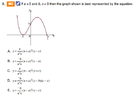
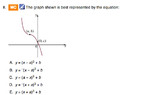
Cubic Transformations - Graph shown is best represented by the equation:

Join the discussion
Ask a follow-up here, or get your own question answered by working scientists, mathematicians and engineers — people, not an autocomplete.
Real named experts · corrections over time · the nuance an AI answer skips
5 replies · 3K views
confusedatmath
Messages
14
Reaction score
0
View attachment 1901
View attachment 1902

I am confused about using horizontal transformations such as

f(x+a) and f(x-a) to interpret these graphs.
 

Attachments
  • Screen Shot 2014-02-02 at 2.18.37 pm.png
    Screen Shot 2014-02-02 at 2.18.37 pm.png
    8.2 KB · Views: 124
  • Screen Shot 2014-02-02 at 2.18.43 pm.png
    Screen Shot 2014-02-02 at 2.18.43 pm.png
    11.3 KB · Views: 137
Mathematics news on Phys.org
confusedatmath said:
<snip>

I am confused about using horizontal transformations such as

f(x+a) and f(x-a) to interpret these graphs.

A rule of thumb I use to work out horizontal translations is that the graph moves along the x-axis in the opposite direction to the sign in the function. That is $$f(x+a)$$ moves $$a$$ units to the left (-ve) and $$f(x-a)$$ moves $$a$$ units to the right (+ve).

You can verify the direction by plugging values in and seeing what happens. Your example is a cubic so suppose we have the "base" function $$f(x) = x^3$$. It is pretty clear that $$f(x) = 0 \text{ when } x = 0$$. Now suppose we have $$f(x-4)$$ (where a=4). This translation is shifted 4 units to the right according to the previous paragraph and $$f(x-4) = 0 \text{ when } x-4 = 0 \therefore x=4$$ which is 4 units to the right of 0.

Let me know if you meant something elseedit: If I take your first example the point (a,b) is to the left of 0 on the x-axis so it'll be which sign inside the function
+. Giving us (x+a)^3
 
But the answer is f(x)=-(x-a)^3 +b ...
 
confusedatmath said:
But the answer is f(x)=-(x-a)^3 +b ...

That doesn't make sense to me. I tried it with a graph in wolfram showing the graphs of $$f(x) = -(x+5)^2 \text{ with } g(x) = -x^3$$ for comparison and the graph of f(x) is shifted 5 units left compared to g(x).
 
The first thing you should notice is that when x= a, y= b. Since all of the options have "+ b", the cubic portion must be 0 when x= a so those that have "x+ a" are impossible. That eliminates D and E.

The second thing you should notice is that the usual [tex]x^3[/tex] is reversed- this graph rises to the left, not the right. That means x is swapped for -x. Since we are using "x- a" instead of x, we must have [tex]-(x- a)^3[/tex] which is the same as (a- x)^3. That eliminates A leaving B and C which are identical.
 
Last edited by a moderator:
so we sub x=a because in the graph it says (a,b)

what if the question said (-a,b) ??