Curvilinear coordinate system: Determine the standardized base vectors

2 replies · 2K views · last reply
Karl Karlsson
Messages
104
Reaction score
12
Homework Statement
Determine the standardized base vectors in the curvilinear coordinate system $$\begin{cases} u_1 = x^2-y^2 \\ u_2 = xy \\ u_3 = z\end{cases}$$
Relevant Equations
$$\begin{cases} u_1 = x^2-y^2 \\ u_2 = xy \\ u_3 = z\end{cases}$$
How I would have guessed you were supposed to solve it:
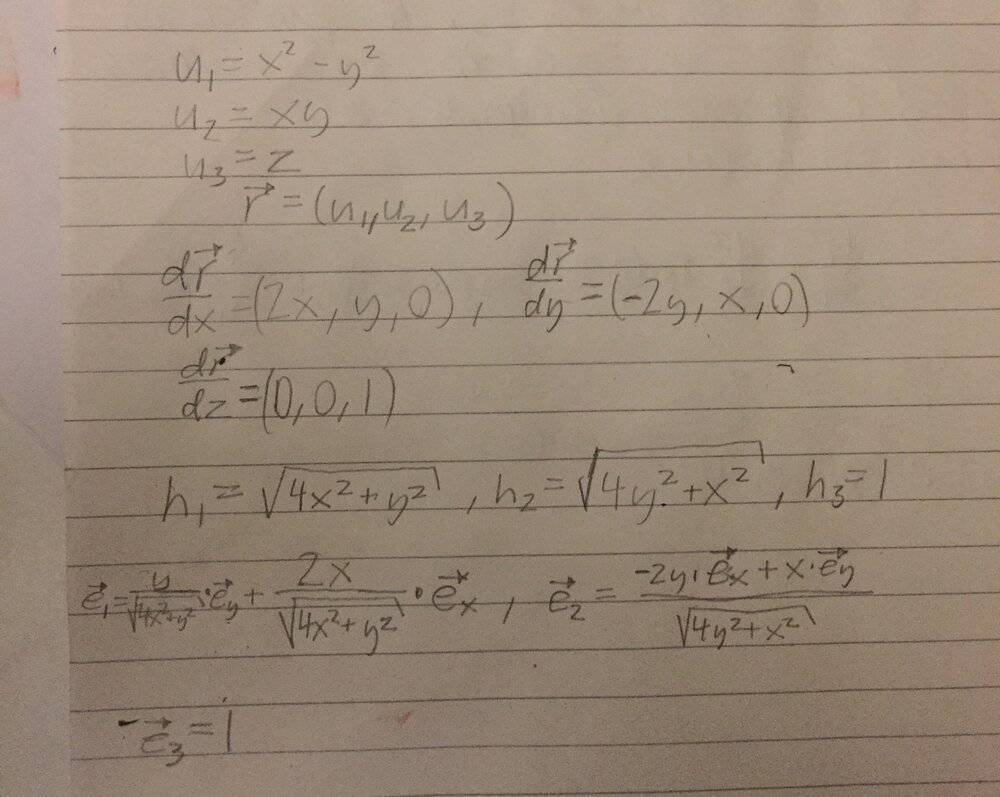
Handwritten notes on lined paper: u1 = x^2 - y^2, u2 = xy, u3 = z, r = (u1, u2, u3), dr/dx = (2x, y, 0), dr/dy = (-2y, x, 0), dr/dz = (0, 0, 1), h1 = sqrt(4x^2 + y^2), h2 = sqrt(4y^2 + x^2), h3 = 1, and attempted base vectors e1 and e2 with e3 = 1.


What you are supposed to do is just take the gradients of all the u:s and divide by the absolute value of the gradient? But what formula is that why is the way I did not the correct way to do it?

Thanks in advance!
 
The position vector is always [itex]\mathbf{r}(u,v,w) = (x(u,v,w),y(u,v,w),z(u,v,w))[/itex]. Here you are given [itex]u(x,y,z)[/itex] etc., and you would have to invert this to get [itex](x,y,z)[/itex] in terms of [itex](u,v,w)[/itex], but you don't have to.

The basis vector [itex]\mathbf{e}_{u_i}[/itex] points in the direction of increasing [itex]u_i[/itex] and is normal to surfaces of constant [itex]u_i[/itex]. The vector [itex]\nabla u_i[/itex] does exactly this.

Now it turns out that if the [itex]\nabla u_i[/itex] are orthogonal then [itex]\nabla u_i[/itex] and [itex]\frac{\partial \mathbf{r}}{\partial u_i}[/itex] are parallel.
 
pasmith said:
The position vector is always [itex]\mathbf{r}(u,v,w) = (x(u,v,w),y(u,v,w),z(u,v,w))[/itex]. Here you are given [itex]u(x,y,z)[/itex] etc., and you would have to invert this to get [itex](x,y,z)[/itex] in terms of [itex](u,v,w)[/itex], but you don't have to.

The basis vector [itex]\mathbf{e}_{u_i}[/itex] points in the direction of increasing [itex]u_i[/itex] and is normal to surfaces of constant [itex]u_i[/itex]. The vector [itex]\nabla u_i[/itex] does exactly this.

Now it turns out that if the [itex]\nabla u_i[/itex] are orthogonal then [itex]\nabla u_i[/itex] and [itex]\frac{\partial \mathbf{r}}{\partial u_i}[/itex] are parallel.
Is it because they have taken ##grad φ = \sum_{i} \frac {1} {h_i} \frac {\partial φ} {\partial u_i}## and ##φ=u_i##?