Cutting a figure into two identical parts

  • Level: High School 
  • Thread starter bob012345
  • Start date
21 replies · 4K views · last reply
bob012345
Gold Member
Messages
2,474
Reaction score
1,136
Here is a little puzzle from Pierre Berloquin’s book 100 Geometric Games. The goal is to cut the figure once to make two identical parts. Have fun!
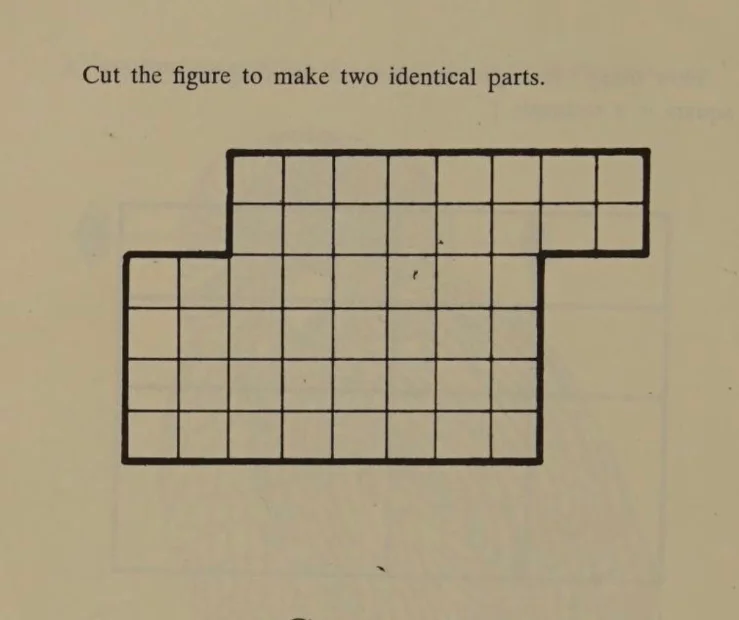

Grid-based polyomino figure of 46 unit squares, with a 2-row strip of 8 squares on top at the right, a 4-square-wide step on the left and a 6-row bottom section, drawn on a square grid under the printed instruction 'Cut the figure to make two identical parts.'
 
  • Like
Likes   Reactions: Lnewqban, Greg Bernhardt and OmCheeto
Does "identical" mean that after the object is cut into two, one can superimpose the two pieces into one with no more than a simple rotation in the plane of the screen?
 
kuruman said:
Does "identical" mean that after the object is cut into two, one can superimpose the two pieces into one with no more than a simple rotation in the plane of the screen?
Identical here means they have the same shape. Think of it like two pieces of physical paper. Only the shapes matter.
 
bob012345 said:
Identical here means they have the same shape. Think of it like two pieces of physical paper. Only the shapes matter.
Grid-squared figure made of two stacked blocks: a top strip of two rows offset to the right, and a larger lower block, with a red line marking a horizontal cut between them.
This doesn't help. A cut along the red line produces two pieces that have the same shape, namely rectangles. Is this a valid solution? If not, why not?
 
bob012345 said:
Identical here means they have the same shape. Think of it like two pieces of physical paper. Only the shapes matter.
Can you flip one, so that a clockwise outer perimeter becomes a counter-clockwise perimeter?

ADDED: Sorry. The one I thought of with a "flip" does not solve it and the real solution does not require a flip.
 
Last edited:
FactChecker said:
Can you flip one, so that a clockwise outer perimeter becomes a counter-clockwise perimeter?
Yes.
 
kuruman said:
View attachment 372339This doesn't help. A cut along the red line produces two pieces that have the same shape, namely rectangles. Is this a valid solution? If not, why not?
Same shape in this context means that they overlap, they are the same size and thus are identical so that is not a valid solution as I understand the problem.
 
Last edited:
Here is one solution. There is at least one more.
Grid-based polyomino puzzle with the caption 'Cut the figure to make two identical parts.' A red line traces a proposed cut through the grid of squares, running down from the top edge and then down to the bottom edge.


[\SPOILER]
 
Last edited:
bob012345 said:
Here is a little puzzle from Pierre Berloquin’s book 100 Geometric Games. The goal is to cut the figure once to make two identical parts. Have fun!

View attachment 372336
The original text does not say "once". You added that in your instruction. But what does cutting once mean? It suggests a single straight cut, but that appears impossible. Do you mean one continuous line, but not necessarily straight? I can do that, but it seems too easy.
 
haruspex said:
The original text does not say "once". You added that in your instruction. But what does cutting once mean? It suggests a single straight cut, but that appears impossible. Do you mean one continuous line, but not necessarily straight? I can do that, but it seems too easy.
Yes.
 
bob012345 said:
Yes.
OK, then if turns are allowed, it is easy as @haruspex noted. Referring to the figure in post #4, separate in half each of the rectangles with vertical cuts to the red line and then connect the vertical cuts with a horizontal cut.
 
kuruman said:
OK, then if turns are allowed, it is easy as @haruspex noted. Referring to the figure in post #4, separate in half each of the rectangles with vertical cuts to the red line and then connect the vertical cuts with a horizontal cut.
That gives what I showed in post #8. But there is at least one other solution. Who can find it and possibly more?
 
BTW, if we label the bottom left corner of the original figure as (0,0) and the upper right corner as (5,3), we can describe the cut above as $$(3,3)->(3,2)->(2,2)->(2,0)$$ and we can use that method to describe other cuts.
 
Well, it’s been 2 days and no one has offered up a different solution than the one above by @kuruman which I believe is the simplest solution. There exist two other solutions. Interestingly, the solution given so far is not the ‘book’ solution! I’ll give the book solution now so perhaps that will stimulate finding the third solution. Setting two small squares as one unit, the lower left corner is ##(0,0)## and the upper right corner is ##(5,3)## make the cut $$(2,3)->(2,1)->(3,1)->(3,0)$$

Grid figure of unit squares with a red cut line drawn through it, running down from the top edge, across, and down to the bottom edge.

Then flip one of the two parts.

Two L-shaped polyomino figures on a dark surface: left one is grid-marked with small squares, right one is plain pale paper, drawn as cut-out shapes for cutting into congruent parts.
 
I'm trying it mentally. Without rechecking mechanically, I 'see' to cut along vertical segment number 4. It seems to work. Certainly laziness is stopping me from trying with a physical model.
 
symbolipoint said:
I'm trying it mentally. Without rechecking mechanically, I 'see' to cut along vertical segment number 4. It seems to work. Certainly laziness is stopping me from trying with a physical model.
Can you describe the cut using the coordinate system I suggested above?
 
bob012345 said:
Can you describe the cut using the coordinate system I suggested above?
If I try, really hard, but I am not going to take the trouble.
 
I constructed a physical paper model. What I said in post #15 was wrong. I can't do this puzzle.
 
symbolipoint said:
I constructed a physical paper model. What I said in post #15 was wrong. I can't do this puzzle.
Before I just give the answer, I offer a clue in the form of a riddle. The key to unlocking this mystery is persistence.
Solid black silhouette of an old-fashioned skeleton key with an ornate oval bow, a shaft and a notched bit at the lower end, angled diagonally on a white background.
 
Is this the third solution you had in mind?
Two Intertwined letters F
Grid figure of 2x2 squares tiled in yellow and pink, arranged as a staircase-like polyomino on a tan background, with pink and yellow regions outlined in black.
To get the mass symmetry, each piece must have 24 squares which I assumed to be six 4x4 squares. Here is one way to assemble them symmetrically.
 
  • Like
  • Wow
Likes   Reactions: bob012345, Lnewqban and symbolipoint
kuruman said:
Is this the third solution you had in mind?
Two Intertwined letters F
View attachment 372437To get the mass symmetry, each piece must have 24 squares which I assumed to be six 4x4 squares. Here is one way to assemble them symmetrically.
You nailed it! Did the clue help?
 
bob012345 said:
You nailed it! Did the clue help?
I understood its importance after solving it. A key is a key is a key. :oldsmile:

I looked for other solutions, but I did not find any, at least with 4x4 squares.