Declining scientific productivity

Join the discussion
Ask a follow-up here, or get your own question answered by working scientists, mathematicians and engineers — people, not an autocomplete.
Real named experts · corrections over time · the nuance an AI answer skips
12 replies · 2K views
BWV
Messages
1,690
Reaction score
2,022
This Nature paper that attempts to quantify diminishing returns from scientific research across a wide range of fields is getting a fair amount of press.
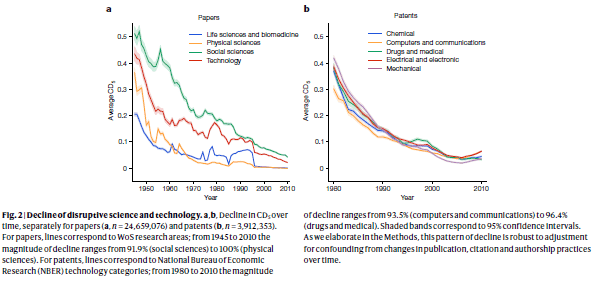
Theories of scientific and technological change view discovery and invention as endogenous processes1,2, wherein previous accumulated knowledge enables future progress by allowing researchers to, in Newton’s words, ‘stand on the shoulders of giants’3,4,5,6,7. Recent decades have witnessed exponential growth in the volume of new scientific and technological knowledge, thereby creating conditions that should be ripe for major advances8,9. Yet contrary to this view, studies suggest that progress is slowing in several major fields10,11. Here, we analyse these claims at scale across six decades, using data on 45 million papers and 3.9 million patents from six large-scale datasets, together with a new quantitative metric—the CD index12—that characterizes how papers and patents change networks of citations in science and technology. We find that papers and patents are increasingly less likely to break with the past in ways that push science and technology in new directions. This pattern holds universally across fields and is robust across multiple different citation- and text-based metrics1,13,14,15,16,17. Subsequently, we link this decline in disruptiveness to a narrowing in the use of previous knowledge, allowing us to reconcile the patterns we observe with the ‘shoulders of giants’ view. We find that the observed declines are unlikely to be driven by changes in the quality of published science, citation practices or field-specific factors. Overall, our results suggest that slowing rates of disruption may reflect a fundamental shift in the nature of science and technology.
1673301778502.png
My initial take was just a 'low hanging fruit' argument where all the 'easy' discoveries have been made. The authors argue against that, citing the uniformity of the decline as evidence against, but I don't find that argument compelling. ISTM that diminishing returns / low hanging fruit in physics can coexist with the splintering, due to complexity, of real advances in biology that nevertheless aren't considered 'revolutionary' as non specialists dont understand them.
 

Attachments

  • 1673301492323.png
    1673301492323.png
    14.2 KB · Views: 151
Reply
  • Like
Likes   Reactions: Choppy and symbolipoint
Physics news on Phys.org
I think our knowledge goes through a kind of ebb and flow where new knowledge must be consolidated, summarized and taught before the next phase of major advancements occur.
 
Reply
  • Like
  • Love
Likes   Reactions: PhDeezNutz, BillTre and Wrichik Basu
Recent decades have witnessed exponential growth in the volume of new scientific and technological knowledge, thereby creating conditions that should be ripe for major advances
I think about 2/3's of papers are redundant with the other 1/3. I understand the desire and pressure to publish, but then I sometime see the same material published in multiple journals. So we could cut the volume of redundant publications and save a lot of energy/pollution in the meantime.
 
Reply
  • Like
Likes   Reactions: dextercioby and jedishrfu
I still think this explains most of the results:

Our descendants will learn much more about nature, and they will invent gadgets even cooler than smart phones. But their scientific version of reality will resemble ours, for two reasons: First, ours… is in many respects true; most new knowledge will merely extend and fill in our current maps of reality rather than forcing radical revisions. Second, some major remaining mysteries—Where did the universe come from? How did life begin? How, exactly, does a chunk of meat make a mind?--might be unsolvable.

That's my end-of-science argument in a nutshell, and I believe it as much today as I did when I was finishing my book 20 years ago

https://blogs.scientificamerican.com/cross-check/was-i-wrong-about-8220-the-end-of-science-8221/

Chalk under the category of smart people saying dumb things:
Witten insisted (in 1995) that "the next 35 years will be one of the greatest periods of the adventure of theoretical physics."
 
Reply
  • Like
Likes   Reactions: BillTre
According to a Science Newsletter article in 2011 theorists calculated that nuclear reactors produced fewer electron neutrinos than theory predicted supporting the idea that these neutrinos might be changing into sterile neutrinos.

Recent work in France confirmed that there is no deficit.

A comment by a researcher involved in a similar experiment concluding the same thing but with a larger uncertainty commented; “As opposed to a watershed moment, I see it as a nice summation of all the things we’ve learned.”

This comment sums up the conclusion of the topic of this thread.

EDIT: For those who could not access the Science Newsletter article here is another rendition
https://science.slashdot.org/story/...mystery-solved-with-no-need-for-new-particles
 
Last edited:
Hmmmm.....
Hmmmm.....

Two papers of mine stick out.

Paper #1 gets 60-80 cites a year over the last 20-odd years. It's slowed down a little now, but that's been the pattern. This isn't a huge number, but the staying power is unusual. Over tije it's moved up through the SPIRES categoies: unknown, lesser-know all the way to very well-known and renowned. Has this paper improved over time, like a fine wine? Or is it just that it's harder to tell the impact of more recent papers until they have more, you know., time to make an impact?

The second paper killed off an entire sub-sub-sub field. It definitely settled an issue, and has relatively few cites because once it cane out, people stopped writing about it. I would argue that this is progress. We learned something: nature didn't work this way, so it was a waste of time trying to calculate it better.

I don't think the authors are measuring what they think they are measuring.
 
Reply
  • Like
Likes   Reactions: DrClaude, Astronuc, anorlunda and 2 others
Im not sure of the mechanics of citation, so take Watson & Crick's DNA Double Helix paper - what was the life cycle for citations? I am guessing in the 50s it generated a lot of follow on research and citations and no one cites it today to reference what everyone knows about the structure of DNA - but what was the decline rate? Was it still being cited in the 1970s? There may be exceptions as @Vanadium 50 lists, but these should average out in the large data set. Are there any papers in the last 20 years or so that generated a comparable level of new research as W&C's DNA paper or perhaps some of the foundational QFT / Standard Model papers of the 50s & 60s?