Degree of Unsaturation: C9H6N4 | Structural Isomerism

  • Thread starter Thread starter phoenixXL
  • Start date Start date
  • Tags Tags
    Degree
Click For Summary
SUMMARY

The degree of unsaturation for the compound with the molecular formula C9H6N4 is calculated to be 9, as confirmed by the discussion participants. The formula used for this calculation is DU = 1 + 1/2∑[n_i (v_i - 2)], which accounts for both rings and π bonds. Participants clarified that rings contribute to the degree of unsaturation, which was initially misunderstood. The discussion emphasizes the importance of understanding structural isomerism in relation to unsaturation calculations.

PREREQUISITES
  • Understanding of degree of unsaturation (DU)
  • Familiarity with molecular formulas and structural isomerism
  • Knowledge of valency and its application in chemical calculations
  • Basic concepts of π bonds and their role in unsaturation
NEXT STEPS
  • Research the derivation and applications of the degree of unsaturation formula
  • Study structural isomerism and its implications in organic chemistry
  • Learn about the significance of π bonds in molecular structures
  • Explore examples of compounds with varying degrees of unsaturation
USEFUL FOR

Chemistry students, organic chemists, and anyone interested in understanding molecular structure and unsaturation in organic compounds.

phoenixXL
Messages
49
Reaction score
4
Question
Find out the degree of unsaturation in a compound having the molecular formulae C9H6N4.

Attempt
The point lies in making the possible structure(s).
The structure that I felt possible is as follows
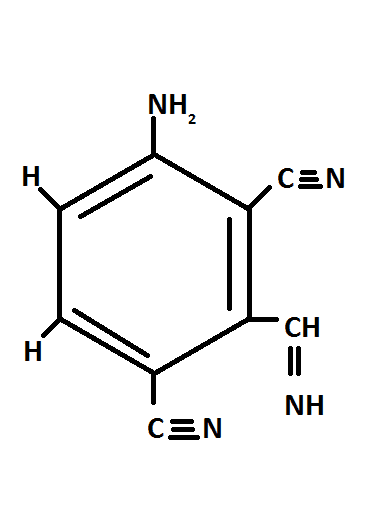
Struct.png

In the compound above there are 8-π electrons,
Hence the degree of unsaturation is 8(Ans)

Problem

The problem comes from the topic of structural isomerism and the book says the answer to be 9

Please help me out. Thanks for your time.
 
Chemistry news on Phys.org
Hint: you are aware of the fact degree of unsaturation for cyclohexane - despite the compound being saturated - is 1?

In other words, degree of unsaturation is not only about pi electrons. There are formulas to calculate degree of unsaturation based on the molecular formula alone (without any structural information).
 
Okay, I didn't knew about that.
I looked Wikipedia and found that rings are counted as a degree of unsaturation, therefore I get the missing "1" from my answer. Also I was unaware of the formula(curious to see its derivation).
Thank You.
 
phoenixXL said:
Also I was unaware of the formula(curious to see its derivation).

There is no derivation - it is more like a definition.
 
phoenixXL said:
Okay, I didn't knew about that.
I looked Wikipedia and found that rings are counted as a degree of unsaturation, therefore I get the missing "1" from my answer. Also I was unaware of the formula(curious to see its derivation).
Thank You.

##DU = 1 + \frac{1}{2}∑[n_i (v_i - 2)]## where ni is the number of atoms of an element and vi is the valency of that element. Note that this gives you the total number of rings and π bonds.
 

Similar threads

  • · Replies 4 ·
Replies
4
Views
5K
  • · Replies 1 ·
Replies
1
Views
2K
  • · Replies 4 ·
Replies
4
Views
12K
Replies
3
Views
7K
  • · Replies 2 ·
Replies
2
Views
2K
Replies
1
Views
1K
Replies
17
Views
8K
  • · Replies 9 ·
Replies
9
Views
3K
  • · Replies 13 ·
Replies
13
Views
4K
  • · Replies 20 ·
Replies
20
Views
2K