Delay in signaling between entanglement particles

Click For Summary

Discussion Overview

The discussion revolves around the concept of signaling delays between entangled particles, particularly whether there exists a delay that does not depend on the distance between them. Participants explore the implications of measuring entangled particles and the potential for observable delays in interactions as a result of such measurements.

Discussion Character

  • Debate/contested
  • Conceptual clarification
  • Exploratory

Main Points Raised

  • One participant suggests that there may be a small delay in signaling between entangled particles, potentially related to the minimum distance divided by the speed of light.
  • Another participant clarifies the terminology used, correcting "practical" to "particle" and emphasizing the distinction between the two terms.
  • A participant argues that entangled particles do not function as the original poster suggests, noting that a particle can only be part of a single entangled system at a time, and introduces the concept of "entanglement swapping" as a complex mechanism that allows for entanglement between non-adjacent particles.
  • There is a question raised about the existence of a small delay in interaction, which is met with skepticism regarding the evidence for such a delay.
  • A later response reiterates that there is no evidence for a delay in interaction and questions the existence of any reaction at all.

Areas of Agreement / Disagreement

Participants express differing views on the existence of delays in interactions between entangled particles. Some propose the possibility of delays, while others firmly reject this idea, leading to an unresolved discussion.

Contextual Notes

The discussion includes assumptions about the nature of entanglement and the mechanics of particle interactions, which remain unexamined and unresolved. The complexity of entanglement swapping and its implications for the discussion are also noted but not fully explored.

danielhaish
Messages
152
Reaction score
10
I know that there isn't any delay that depends on the distance between particles, by the time it take to signal l to arrive from point a to b , but do there is any small delay that doesn't depends on distance .
like the Minimum distance between two bodies divided by the speed of light .
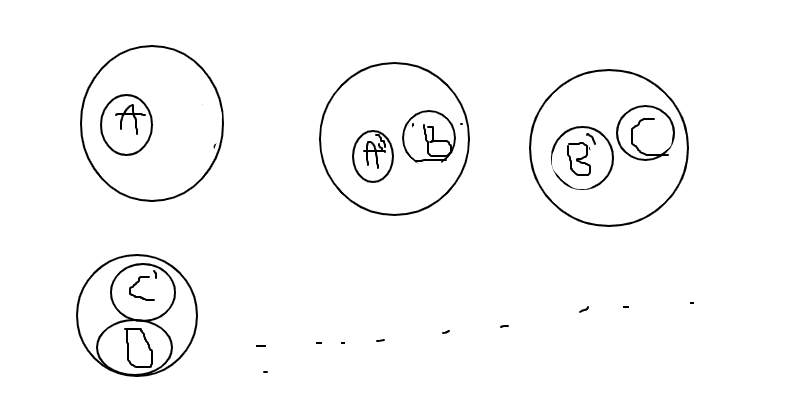
for example if we would create some kind of interaction domino with couples of entanglement practicals so when measuring one particle t will effect the practical it been entangle to which will interact with another practical and so on like the following draw
drawisland (1).png

in this draw A,A' B,B' C,C' are an couples of entanglement particles , we also know that A' is interact with B and B' with C and so on. I am wondering if would have a lot of couples of entanglement particles so we may measured a delay between the time we measure A till we can observe the result that bigger then the time it take to tell when the piratical has been measured (the time it take the electromagnetic signal to get from the first location to the last one )
 
Last edited:
Physics news on Phys.org
A “practical” is a hands-on exam or a lab exercise. A “particle” is a small object or (in QM) a quantized excitation of a corresponding particle field.
 
  • Like
Likes   Reactions: danielhaish
Dale said:
A “practical” is a hands-on exam or a lab exercise. A “particle” is a small object or (in QM) a quantized excitation of a corresponding particle field.
Ok i changed it, my mistake my browser is not recognize this word so I changed it
 
Last edited:
  • Like
Likes   Reactions: Dale
danielhaish said:
...in this draw A,A' B,B' C,C' are an couples of entanglement particles , we also know that A' is interact with B and B' with C and so on. I am wondering if would have a lot of couples of entanglement particles so we may measured a delay between the time we measure A till we can observe the result that bigger then the time it take to tell when the piratical has been measured (the time it take the electromagnetic signal to get from the first location to the last one )

Entangled particles do not operate the way you are picturing them. A particle can only be entangled as part of a single system at a time. That system can be more than 2 particles. But if it is, the statistics change.

There is a specialized mechanism which is called "entanglement swapping". It is "possible" to entangle particle A with particle D' as part of a chain of swaps. The setup is quite complex and those swaps would only occur as a very rare event.
 
  • Like
Likes   Reactions: danielhaish
DrChinese said:
Entangled particles do not operate the way you are picturing them. A particle can only be entangled as part of a single system at a time. That system can be more than 2 particles. But if it is, the statistics change.

There is a specialized mechanism which is called "entanglement swapping". It is "possible" to entangle particle A with particle D' as part of a chain of swaps. The setup is quite complex and those swaps would only occur as a very rare event.
and do you think there is small delay of interaction ?
 
Last edited:
danielhaish said:
and do you think there is small delay of reaction ?
Not only is there no evidence for a delay in the reaction, there is no reason to think that there is a reaction.
 
  • Like
Likes   Reactions: danielhaish
Nugatory said:
Not only is there no evidence for a delay in the reaction, there is no reason to think that there is a reaction.
sorry I meant interaction
 
danielhaish said:
sorry I meant interaction
I know what you meant, and my answer still stands.
 
  • Like
Likes   Reactions: PeroK

Similar threads

  • · Replies 58 ·
2
Replies
58
Views
5K
  • · Replies 23 ·
Replies
23
Views
2K
  • · Replies 2 ·
Replies
2
Views
1K
Replies
10
Views
2K
  • · Replies 3 ·
Replies
3
Views
2K
  • · Replies 4 ·
Replies
4
Views
3K
  • · Replies 7 ·
Replies
7
Views
1K
  • · Replies 10 ·
Replies
10
Views
2K
  • · Replies 10 ·
Replies
10
Views
2K
  • · Replies 1 ·
Replies
1
Views
2K