Deriving force from momentum using d(mv)/dt

Click For Summary
SUMMARY

The discussion focuses on the application of the product rule of differentiation in deriving momentum equations, particularly in the context of rocket propulsion. Participants emphasize the importance of accurately accounting for external forces, especially when dealing with systems like a leaking water tank. The correct application leads to the Rocket Equation, which describes the relationship between the mass of the rocket, the mass of the fuel, and the velocity of the ejecta. Misapplication of the formula can lead to incorrect conclusions about acceleration and forces acting on the system.

PREREQUISITES
  • Understanding of the product rule of differentiation
  • Familiarity with momentum conservation principles
  • Knowledge of the Rocket Equation and its derivation
  • Basic physics concepts related to forces and acceleration
NEXT STEPS
  • Study the derivation of the Rocket Equation in detail
  • Learn about external forces in dynamic systems
  • Explore advanced applications of the product rule in physics
  • Investigate real-world examples of momentum conservation in rocketry
USEFUL FOR

Physics students, aerospace engineers, and anyone interested in the principles of momentum and rocket propulsion will benefit from this discussion.

Mohmmad Maaitah
Messages
90
Reaction score
20
Homework Statement
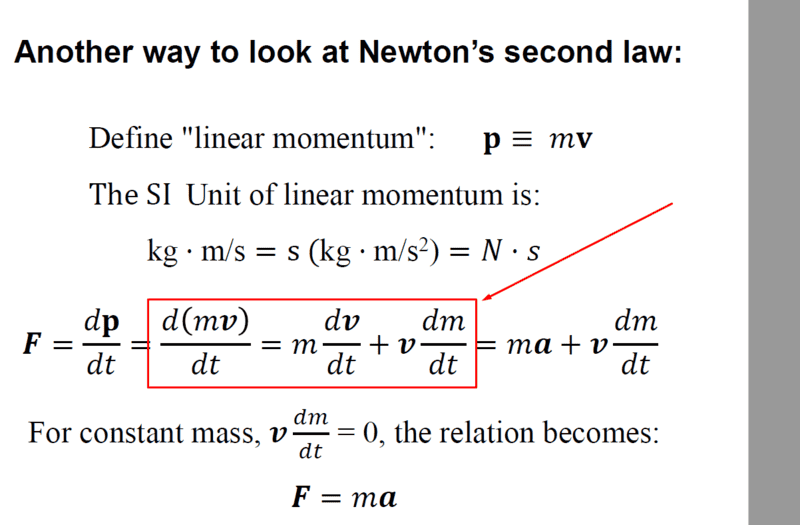
How did we Derive force from momentum
Relevant Equations
F=ma
P=mv
F=dp/dt
How did the d(mv)/dt become the other two?
Can someone explain how do we derive for new formulas in physics?
1684395405867.png
 
Physics news on Phys.org
Product rule of differentiation
 
  • Like
Likes   Reactions: MatinSAR
malawi_glenn said:
Product rule of differentiation
malawi_glenn said:
Product rule of differentiation
Thank you I just missed it.
 
You need to be very careful using this ##dp=m.dv+v.dm## form.
Consider e.g. a water tank mass m speed v leaking water at rate ##\rho##. If we blindly apply that formula we get ##\dot p= m\dot v+v\dot m=ma-v\rho##. Since there appear to be no external forces we might conclude ##ma=v\rho##, so the tank is accelerating.
The flaw is that the leaking water carries momentum away with it, which should be represented as an external force ##-v\rho##. Plugging that in gives ##a=0##.

My advice: don’t use it.
 
  • Like
Likes   Reactions: PeroK, malawi_glenn, BvU and 1 other person
haruspex said:
You need to be very careful using this ##dp=m.dv+v.dm## form.
Consider e.g. a water tank mass m speed v leaking water at rate ##\rho##. If we blindly apply that formula we get ##\dot p= m\dot v+v\dot m=ma-v\rho##. Since there appear to be no external forces we might conclude ##ma=v\rho##, so the tank is accelerating.
The flaw is that the leaking water carries momentum away with it, which should be represented as an external force ##-v\rho##. Plugging that in gives ##a=0##.

My advice: don’t use it.
So why do rockets work? I do not understand the point you are trying to make.
 
  • Skeptical
  • Like
Likes   Reactions: PeroK and MatinSAR
Frabjous said:
So why do rockets work? I do not understand the point you are trying to make.
You can solve rocketry questions using conservation of momentum quite easily without using that equation explicitly. In time ##\delta t## a mass of fuel ##\mu \delta t## is ejected at speed ##u## relative to the craft of remaining mass ##m##. ##m\delta v=u\mu\delta t##. This leads to ##v=u\ln(\frac{m_0}{m-\mu t})## as desired.

You can argue that I am effectively using the equation, but quoting the equation and then trying to apply it has pitfalls, such as the one I outlined. In the rocketry context, what exactly is the system which m represents?
 
  • Like
Likes   Reactions: PeroK and MatinSAR
@Frabjous
erobz said:
Just for clarity, correcting post #11 using the proper way to capture the accumulation of momentum in the ejecta from @anuttarasammyak:

$$\sum F_{ext} = \frac{d}{dt} \left( p_{\rm{rocket}} + p_{\rm{fuel}} + p_{\rm{ejecta}} \right)$$

Mass of the rocket is constant ##M_r##

The mass of fuel lost from the rocket is gained by the ejecta ## \frac{dM_e}{dt} = -\frac{dM_f}{dt}##

The velocity of the ejecta in the rest frame is ##v_{e/O} = v_r - v_{e/r}## and is constant after being ejected, but the momentum of the ejecta is accumulating, hence:

$$\sum F_{ext} = \frac{d}{dt} \left( M_r v_r + M_f v_r + \int \frac{dM_e}{dt}( v_r - v_{e/r}) ~dt \right)$$

Applying the derivative:

$$\sum F_{ext} = \overbrace{\left( M_r\frac{dv_r}{dt} \right)}^{\rm {rocket}} +\overbrace{\left(M_f\frac{dv_r}{dt} + \frac{dM_f}{dt}v_r\right)}^{\rm{fuel}}+ \overbrace{ \frac{dM_e}{dt}( v_r - v_{e/r})}^{\rm{ejecta}} $$

$$\sum F_{ext} = \left( M_r + M_f \right) \frac{dv_r}{dt}+ \cancel{ \left( \frac{dM_f}{dt}v_r + \frac{dM_e}{dt}v_r \right)}^0 -\frac{dM_e}{dt} v_{e/r}$$

The Rocket Equation:

$$ \sum F_{ext} = \left( M_r + M_f \right) \frac{dv_r}{dt} + \frac{dM_f}{dt} v_{e/r}$$

The issue comes up often about taking ##F = \frac{dp}{dt} = \frac{d}{dt} \big( mv \big)##.

We (several posters) took the time not too long ago to figure out how to apply it for "The Rocket Equation". I think this is what @haruspex means by "you have to be careful". It wasn't immediately obvious how to get it to work out.

The whole exchange:
https://www.physicsforums.com/threa...oblem-confused-about-newtons-2nd-law.1050482/
 
  • Like
Likes   Reactions: PeroK, Frabjous and MatinSAR

Similar threads

  • · Replies 10 ·
Replies
10
Views
2K
  • · Replies 5 ·
Replies
5
Views
750
  • · Replies 14 ·
Replies
14
Views
2K
Replies
19
Views
3K
  • · Replies 7 ·
Replies
7
Views
2K
Replies
5
Views
2K
  • · Replies 27 ·
Replies
27
Views
1K
  • · Replies 6 ·
Replies
6
Views
1K
  • · Replies 4 ·
Replies
4
Views
1K
  • · Replies 4 ·
Replies
4
Views
1K