Design an opamp circuit with this transfer function on 3 voltage inputs

3 replies · 2K views · last reply
DaniilMP3
Messages
2
Reaction score
0
TL;DR Summary: Build a circuit of given operation on voltages

I'll appreciate any help.
I need to create circuit of this operation on three voltages:

Equation: U = (4/9)·U1 − (9/11)·U2 + (2.75·10^3 rad/s) ∫ U3 dt

We'll use circuit of voltages summer:
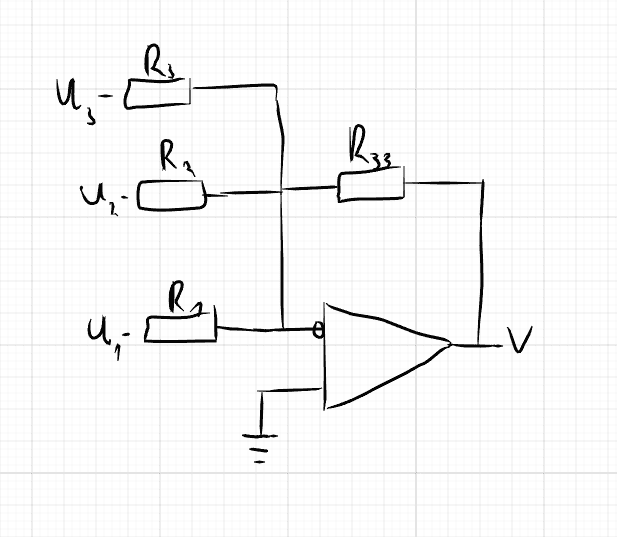
Hand-drawn op-amp summing circuit with three voltage inputs U1, U2 and U3, each through a resistor labelled R1, R2 and R3, joined at the inverting input; a feedback resistor labelled R33 connects from the output V back to that node.


The third term is the integral of U_3, so we'll use integrator:
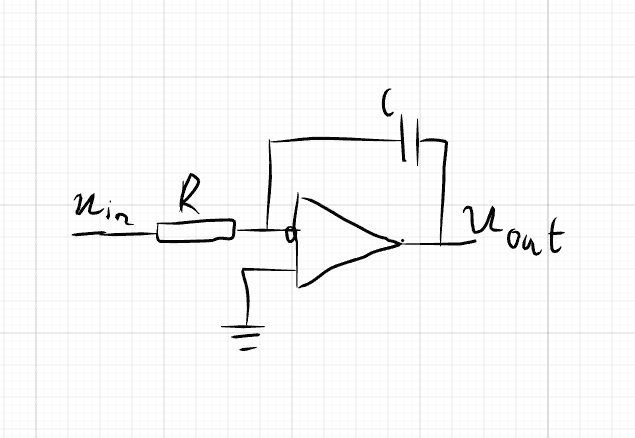
Hand-drawn op-amp inverting integrator circuit: input u_in through resistor R to the inverting input, with capacitor C in feedback from the output u_out back to the inverting input.


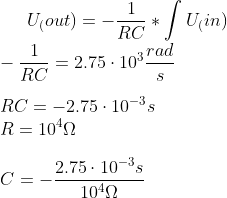
Than, calculate capacitance:
Handwritten derivation: U(out) = -(1/RC) times the integral of U(in); then -1/RC = 2.75 x 10^3 rad/s, giving RC = -2.75 x 10^-3 s, R = 10^4 Ohm, and C = -2.75 x 10^-3 s / 10^4 Ohm.

And on this step we have negative capacitance. Is it possible? Or I did something wrong?
Next, we calculate R_1, R_2.
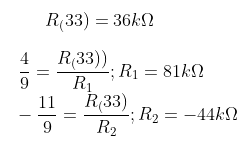
Handwritten derivation of resistor values: R_f(33) = 36 kΩ; 4/9 = R_f(33)/R_1, with R_1 = 81 kΩ; -11/9 = R_f(33)/R_2, with R_2 = -44 kΩ.

And here we have -44 kilo Ohm for R_2.
 
Welcome to PF.

Is this homework?

The negative sign comes from the simple op-amp based Miller integrator inverts the signal. If you want to cancel the negative sign, you will need to invert the signal in that branch, before or after the integration.
 
Hi, yes. This is homework. Thank you for your response.
 
Last edited: