Design Challenge: Need Help Solving Magnet Problem

Click For Summary
SUMMARY

The discussion centers on a mechanical design challenge involving a fixture that uses a magnet to detect the presence of a screw. The original design accommodates a screw location of 10mm, but a new part requires a 15mm adjustment. Proposed solutions include using reflective tape with a retro reflective sensor and inductive sensors, though concerns about false positives due to ferrous materials and operator interference were raised. Suggestions for mechanical sensing methods, such as spring-loaded pins, were also discussed as potential alternatives.

PREREQUISITES
  • Understanding of mechanical design principles
  • Familiarity with optical and inductive sensor technologies
  • Knowledge of PLC (Programmable Logic Controller) integration
  • Experience with CAD modeling for design visualization
NEXT STEPS
  • Research the implementation of retro reflective sensors in mechanical fixtures
  • Explore the use of spring-loaded pins for mechanical sensing applications
  • Investigate the limitations of inductive sensors in detecting ferrous materials
  • Learn about optical sensor configurations for detecting obstructions
USEFUL FOR

Mechanical engineers, product designers, and automation specialists seeking innovative solutions for part detection in manufacturing processes.

fitz_calc
Messages
41
Reaction score
0
A mechanical design question, just wanted to pick your brains about a project I'm working on.

I have a fixture that houses a magnet, when an operator loads a part with a screw the magnet jumps and a thru beam on the magnet detects that a screw is present. Without a screw (below) the magnet stays home and the process fails.
3MEblNp.png


I have a new part, the screw location is 15mm from the current screw location. My magnet will only accommodate 10mm range so I need to come up with something else. One idea I had was to slot my fixture, install reflective tape, and place a retro reflective sensor near the back of the fixture; if a screw is absent the sensor will detect light.

My concern with this design is an operator could potentially block the sensor and get a false pass. I'm running out of ideas, what are your thoughts?
 
Engineering news on Phys.org
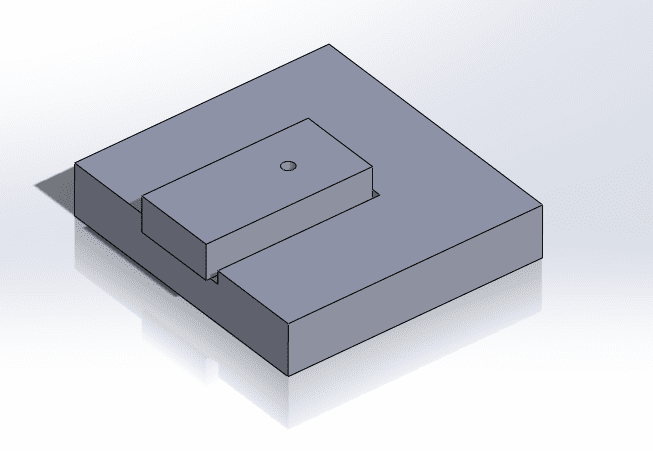
I'm not tracking your explanation very well. Do you mean that currently when the part with the screw is brought down from above the magnet, the magnet lifts up to contact the screw, and you have some optical detector that can tell when the magnet is lifted up? What is the hole-looking thing in the upper 1/3 of the magnet? Where is the current screw location on the magnet when it makes contact? Where is the new screw location?

Can you just use inductive sensors to detect the presence of the screw? You could have two inductive sensors, one for each screw position...
 
Hi berkeman,

Sorry for the poor explanation, I put together a real CAD model of my fixture:

GkTkNIY.png


You are correct, the magnet sits inside the hole, lifts with a screw present, an optic sensor detects the magnets absence and tells a PLC the part is 'good'. Without a screw the magnet is not attracted enough to lift.

I'd thought about inductive sensors but the problem is, the material the screw drives into is ferrous and will give a false pass even without a screw.

Any other ideas?
 
Can you just use mechanical sensing? When no screw is present, its hole is open, right? Can you just have spring-loaded pins that get pushed down when the screw is present?
 
0xDEADBEEF said:
I think that you need the infamous DIN 875 screw ;) http://www.luftpiraten.de/sonderschrauben.html

Curse you for making me waste yet another slot in my bookmark folder.

Fitz, why don't you just aim an optical sensor into the hole?
 
Danger said:
Fitz, why don't you just aim an optical sensor into the hole?

I had the same idea. The screw will obscure a light beam.
 

Similar threads

Replies
11
Views
2K
Replies
2
Views
715
Replies
9
Views
2K
  • · Replies 4 ·
Replies
4
Views
2K
  • · Replies 8 ·
Replies
8
Views
943
Replies
1
Views
2K
  • · Replies 2 ·
Replies
2
Views
2K
Replies
4
Views
2K
  • · Replies 1 ·
Replies
1
Views
3K
  • · Replies 4 ·
Replies
4
Views
2K